
- Synthesize all SAE J3016 levels L0 through L5 through a SINGLE crash scenario's real-world liability outcomes.
- Apply the comprehensive Comparative Matrix spanning DDT, OEDR, Fallback, and ODD responsibility boundaries.
- Analyze legal liability allocation among driver, vehicle manufacturer (OEM), software provider, and fleet operator using real vehicle examples.
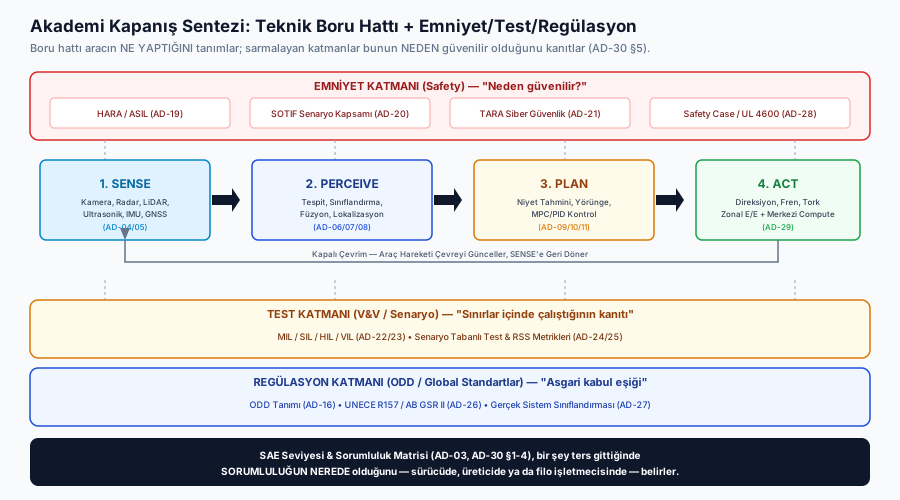
- Synthesize the Sense→Perceive→Plan→Act pipeline introduced in AD-01 end-to-end alongside the academy's full safety/testing/regulation layer.
- Evaluate the master engineering competencies gained across the Autovoltix ADAS & Automated Driving Academy and situate the transition to the academy's other tracks (Motor, EV, BMS).
AD-30 — SAE Levels in Practice: Worked Examples and Comparative Liability Analysis
FACT — This is the 30th and final lesson of the Autovoltix ADAS & Automated Driving Academy. A reader who has come this far has separately learned sensor physics (AD-04/05), perception and fusion architectures (AD-06/07/08), planning and control (AD-09/10/11), ADAS functions (AD-12/13/14/15), safety and cybersecurity frameworks (AD-16/17/19/20/21), verification methodology (AD-22/23/24/25), regulation (AD-26/27), and safety cases / future architectures (AD-28/29). This lesson’s purpose is not to leave these pieces as distributed theoretical knowledge but to bring them together by showing how the SAME crash scenario produces a fundamentally different legal outcome at four different SAE levels — and then to close the entire academy by tying it back to AD-01’s four-stage pipeline.
In this lesson, we examine:
- The Comprehensive SAE J3016 (L0–L5) Responsibility and Duty Matrix
- Worked Scenario: The Same Crash, Four Automation Levels
- Real Vehicle Comparison Table: System × Level × ODD × Liability
- Liability Law: The Shift from Tort Negligence to Product Liability
- Closing Synthesis: Back to Sense→Perceive→Plan→Act
- Frequently Asked Questions
- You Have Completed the Academy
1. The Comprehensive SAE J3016 (L0–L5) Responsibility and Duty Matrix
Let’s revisit the six levels covered in detail in AD-03 — SAE J3016 Automation Levels (L0–L5 Deconstructed), this time not merely by their technical definitions but alongside their legal consequences at the moment of a crash:
| SAE Level | Longitudinal & Lateral Control | Object & Event Detection (OEDR) | DDT Fallback (Fault Condition) | ODD Scope | Real-Time Driving Responsibility | Primary Post-Collision Legal Liability | Canonical System Example |
|---|---|---|---|---|---|---|---|
| L0 (Warning / Momentary) | Human Driver | Human Driver | Human Driver | Unrestricted | Driver | Driver | FCW, LDW, BSD, momentary AEB |
| L1 (Driver Assistance) | System OR Human (single axis) | Human Driver | Human Driver | Specific ODD | Driver (hands on wheel, eyes on road) | Driver | Classical ACC OR Lane Keep Assist (LKA) alone |
| L2 (Partial Automation) | System (both axes together) | Human Driver | Human Driver | Specific ODD | Driver (continuous supervision — even hands-free) | Driver | Tesla Autopilot/FSD (Manufacturer Claim), GM Super Cruise, Ford BlueCruise |
| L3 (Conditional Automation) | System | System | Human (within the transition-demand window) | Constrained, certified ODD (e.g., motorway, low/moderate speed) | System (driver may engage in secondary activity absent a transition demand) | Manufacturer (OEM) — while system engaged within ODD and given a genuine system fault | Mercedes-Benz Drive Pilot, Honda Legend/Sensing Elite |
| L4 (High Automation) | System | System | System (automated MRM) | Defined, geofenced ODD (urban/highway zone) | System (no “driver” in the traditional sense) | Fleet Operator / OEM | Waymo Driver, robotaxi fleets |
| L5 (Full Automation) | System | System | System (automated MRM) | Unrestricted (all roads, all weather) | System | Manufacturer / Software Provider | No commercial instance yet (theoretical target) |
CRITICAL — The most important row in this table is the transition between L2 and L3. At L2, “System” handles both longitudinal and lateral control — the driver’s hands may leave the wheel entirely — but the DEGREE OF AUTOMATION and WHERE RESPONSIBILITY SITS are INDEPENDENT axes: at L2, even though control sits with the system, legal liability remains 100% with the driver. We first covered this distinction in AD-03; §2 of this lesson shows exactly what that distinction means in a concrete crash scenario.
2. Worked Scenario: The Same Crash, Four Automation Levels
Recall the example scenario introduced in AD-01 — What Is ADAS?: a front camera and a 77 GHz radar detect a stopped vehicle ahead at 35 meters, at a relative speed of . Now we extend that scenario with a SINGLE variable: the system fails to detect the stopped vehicle, and the vehicle strikes it from behind. The same physical event — four fundamentally different legal outcomes across four automation levels.
+------------------------------------------------------------------------------------------------------+
| SCENARIO: Cruising at 110 km/h on a motorway, a vehicle stopped in-lane (disabled after a              |
| breakdown/prior crash) is struck from behind. The system's OEDR stage (see AD-01 §2, AD-06)             |
| detects the obstacle late or not at all.                                                                |
+------------------------------------------------------------------------------------------------------+

  [ L1 — Classical ACC/AEB Vehicle ]
  - ACC only regulates longitudinal speed; lane-keeping and OEDR responsibility remain FULLY
    with the driver.
  - AEB may attempt to intervene as a last-resort safety net, but is not guaranteed (see AD-12).
  - LEGAL OUTCOME: The driver was the "active driver" from start to finish (§1 table); ACC/AEB
    were mere ASSIST functions, never took over the driving task (DDT). Liability is
    100% WITH THE DRIVER.
        |
        v
  [ L2 — "Manufacturer Claim" System (e.g., Tesla Autopilot/FSD-class, GM Super Cruise) ]
  - The system handled both steering and speed; the driver's hands could have been off the wheel.
  - But AD-03's core lesson holds: at L2, OEDR responsibility STILL sits with the human — the
    system is "assistive," the driver remains defined as the "active supervisor" (§1 table).
  - LEGAL OUTCOME: No matter how the system is branded — "Autopilot," "Full Self-Driving" —
    that naming is a MANUFACTURER CLAIM, not an SAE classification. Liability at the moment of
    the crash remains 100% WITH THE DRIVER. The driver was REQUIRED to watch the road and
    intervene. This is the concrete, final legal consequence of the "Manufacturer Claim"
    warning emphasized throughout this academy.
        |
        v
  [ L3 — Operating Within Certified ODD (e.g., Mercedes-Benz Drive Pilot engaged) ]
  - The system has FULLY assumed OEDR; the driver may legitimately be engaged in a secondary
    activity at that moment (see §1).
  - ASSUMPTION: The vehicle was operating WITHIN certified ODD boundaries, the system was
    properly engaged, and the crash resulted from a GENUINE system fault (not the driver
    FAILING to respond to a valid transition demand — this distinction is critical, see the
    warning below).
  - LEGAL OUTCOME: Liability shifts substantially toward the MANUFACTURER (OEM). The driver
    was legitimately entitled to disengage attention from the road at that moment; the system
    was OBLIGATED to ensure safety while engaged within its ODD.
        |
        v
  [ L4 — Robotaxi (e.g., Waymo-class) ]
  - There is no "driver" in the traditional sense in the vehicle; the passenger may be in the
    back seat, with no access to steering controls at all.
  - The system is responsible for the FULL scope of OEDR + DDT Fallback within its defined ODD.
  - LEGAL OUTCOME: The passenger bears NO liability whatsoever. Liability rests entirely with
    the FLEET OPERATOR and/or the system's manufacturer — as if a taxi driver caused the crash,
    except that "driver" here is a software/hardware system.
+------------------------------------------------------------------------------------------------------+
WARNING — The “genuine system fault” condition in the L3 row is a vital distinction. If the crash instead resulted from the system issuing a VALID transition demand (see the handover windows covered in AD-17 — Fallback Strategies, MRM and Minimal Risk Condition) that the driver FAILED to respond to in time, the liability analysis changes entirely and driver negligence can come into play. L3’s “liability shifts to the manufacturer” principle applies to scenarios where the system SILENTLY fails within its own ODD or never ISSUES the transition demand at all — not to scenarios where the driver ignored an explicit warning.
3. Real Vehicle Comparison Table: System × Level × ODD × Liability
ASSUMPTION — The table below is based on publicly available manufacturer statements, regulatory approval documentation, and industry reporting; ODD boundaries and certification status can vary by region (country/state) and model year. Consult the manufacturer’s official documentation and the relevant jurisdiction’s regulatory approval for precise, current scope.
| System | Real SAE Level | ODD Scope | Who’s Liable If It Fails Within ODD |
|---|---|---|---|
| Tesla Autopilot / FSD | L2 (the name “Autopilot”/“Full Self-Driving” notwithstanding — this is a Manufacturer Claim, not the actual classification) | Broad, but the driver carries continuous supervisory duty; no official “driverless” ODD certification | Driver — the system is in the “assistive” class, OEDR responsibility remains human |
| GM Super Cruise / Ford BlueCruise | L2 (hands-free but eyes-on, monitored by a driver-attention camera) | Restricted to mapped, divided highways; hands-free but a driver monitoring system (DMS) is mandatory | Driver — hands-free operation does not change the SAE level, supervisory duty persists |
| Mercedes-Benz Drive Pilot | L3 (real, certified conditional automation) | NARROW and certified: specific highways, specific traffic density, specific speed range (see AD-26) | Manufacturer (OEM) — while the system is engaged within ODD and the transition demand was not violated |
| Waymo (robotaxi) | L4 (real, driverless operation) | Defined, geofenced urban/suburban zones | Fleet Operator — there is no human “driver” in the vehicle at all |
INTERPRETATION — The most important takeaway from this table is that the words “hands-free” and “autonomous” are UNRELIABLE indicators. Tesla Autopilot/FSD and GM Super Cruise/Ford BlueCruise both let the driver take their hands off the wheel — but both are classified L2 under SAE, because OEDR and fallback responsibility STILL sit with the human. Mercedes-Benz Drive Pilot, by contrast, allows the driver to disengage attention from the road (within a specific ODD) and is THEREFORE a real L3 — because what determines the SAE level is not “are the hands free” but “who holds OEDR and fallback responsibility.”
4. Liability Law: The Shift from Tort Negligence to Product Liability
As the level of automation rises, the underlying legal philosophy fundamentally changes:
- The L0–L2 World: Traditional traffic law governs. Driver negligence (inattention, distraction, reaction delay) is the central question. Mandatory motor vehicle insurance covers the driver’s own actions.
- The L3–L5 World: Product Liability and Strict Liability take over. An algorithmic classification error or a sensor-detection gap is treated as a “manufacturing/design defect.” Insurers who pay out damages can subrogate against the vehicle OEM and its suppliers.
The engineering rationale behind this shift is precisely what §2 demonstrated: from L3 onward, BOTH OEDR and fallback responsibility shift to the system (§1 table) — in an architecture where the human is no longer an “active supervisor” but at most a “standby fallback ready to take over,” tort law MUST focus on system performance rather than human negligence.
FACT — The most hazardous gap across the automation levels is not an engineering gap but a LEGAL one: the transition between SAE Level 2 and Level 3. At L2, the system can drive competently for minutes at a time, inducing dangerous driver complacency — yet at the critical moment, liability remains entirely with the driver (§2, the L2 case). At L3, liability legally transfers to the system. That two adjacent levels can feel BEHAVIORALLY similar (both can feel “hands-free”) while their LEGAL outcome (who is liable) diverges this sharply is one of the sharpest warnings emphasized throughout this academy.
5. Closing Synthesis: Back to Sense→Perceive→Plan→Act
Let’s revisit the four-stage pipeline introduced in AD-01 — What Is ADAS?, now as a reader with depth in every stage:
1. SENSE (AD-04, AD-05) ──────► Camera, radar, LiDAR, ultrasonic, IMU, GNSS — physical
                                  principles and physical limits (resolution, range, weather).
                 |
2. PERCEIVE (AD-06, AD-07, AD-08) ► Object detection, classification, tracking, early/late/deep
                                     fusion, localization via HD maps + SLAM.
                 |
3. PLAN (AD-09, AD-10, AD-11) ────► Intent prediction, behavior planning, Frenet trajectory
                                     generation, MPC/PID control loops.
                 |
4. ACT ────────────────────────────► Steering torque, brake pressure, torque command — now
                                       transported over the zonal E/E and central compute
                                       backbone covered in AD-29.
                 |
                 v
        [ VEHICLE MOTION ] ── Updates the environment (closed loop) ──► back to SENSE
This technical pipeline is not sufficient on its own — the rest of the academy is a WRAPPING layer that answers “HOW DO WE KNOW this pipeline is safe enough?”:
- Safety (AD-16, AD-19, AD-20, AD-21, AD-28): The ODD definition sets the boundaries within which the pipeline is valid; HARA/ASIL cover hardware/systematic faults, SOTIF covers functional insufficiency, TARA covers cyber threats; AD-28 — Safety Case and UL 4600 unifies ALL of these into a single logical argument.
- Testing (AD-22, AD-23, AD-24): MIL/SIL/HIL/VIL and scenario-based testing produce the evidence that every stage of the pipeline (especially Perceive and Plan) performs within expected bounds.
- Regulation (AD-26, AD-27): Frameworks such as UNECE R157 and EU GSR II define, at the jurisdictional level, what minimum standard this evidence must meet.
INTERPRETATION — The summary of this lesson, and of the academy, in one sentence: Sense→Perceive→Plan→Act defines WHAT the vehicle does; the safety/testing/regulation layer proves WHY that behavior is trustworthy; and the SAE level and responsibility matrix (§1-§4) determine WHO IS LIABLE when something goes wrong. An ADAS/AD engineer must see these three layers not as SEPARATE concerns but as parts of a single whole.
Frequently Asked Questions (FAQ)
Q: If a manufacturer markets a system as “L2+” or “advanced L2,” does that change its SAE classification?
FACT — No. SAE J3016 has no officially defined “L2+” level. Marketing terms of this kind (much like the names “Autopilot” or “Full Self-Driving”) are a Manufacturer Claim — a system’s REAL OEDR/fallback responsibility split is determined not by its name but by the technical/legal criteria defined in the §1 matrix. No matter how advanced a system appears in marketing, if OEDR and fallback responsibility still sit with the human, it is L2 by SAE definition.
Q: Why haven’t SAE Level 5 autonomous vehicles hit the road yet?
INTERPRETATION — L5 means driving in EVERY condition a human can drive in, EVERYWHERE in the world (from chaotic urban traffic to unmarked rural roads to extreme weather), with NO ODD restriction. Current sensor physics (see AD-04/05) and the generalization capability of current algorithms remain far from solving this UNRESTRICTED ODD — which is why every commercial system today is limited either to L2 (broad but driver-supervised ODD) or L3/L4 (narrow, certified ODD).
Q: What is the single most critical takeaway for an ADAS engineer from this academy?
CRITICAL — “Safety is not a feature; it is an end-to-end architectural discipline.” No AI model alone can guarantee safety; safety is only achieved when multi-sensor redundancy (AD-04/07), hardware fault tolerance (AD-17/29), rigorous V&V processes (AD-22/23), and a transparent safety case (AD-28) are applied TOGETHER — and all of these directly determine WHERE liability will fall at the moment of a crash (§1-§4).
Summary
- The difference between SAE levels is not just “how much does the system do” but “who is legally liable at the moment of a crash” — these two axes (degree of automation, and where liability sits) are INDEPENDENT, and are most often conflated at L2.
- The same “struck a stopped vehicle ahead” scenario produces a fundamentally different outcome at four levels: at L1/L2, liability stays with the driver (at L2, regardless of the system’s name — a Manufacturer Claim); at L3, within ODD and given a genuine system fault, liability shifts to the manufacturer; at L4, liability rests entirely with the fleet operator/manufacturer.
- Tesla Autopilot/FSD and GM Super Cruise/Ford BlueCruise are L2 under the real SAE classification (their names notwithstanding); Mercedes-Benz Drive Pilot is a real L3 within a narrow, certified ODD; Waymo is a real L4 robotaxi.
- The L2→L3 transition, despite appearing behaviorally similar (both can feel “hands-free”), is the sharpest threshold in terms of legal consequence — tort negligence governs L0-L2, while product liability/strict liability governs L3-L5.
- The academy’s Sense→Perceive→Plan→Act pipeline defines WHAT the vehicle does; the safety/testing/regulation layer (AD-16 through AD-28) proves WHY it is trustworthy; the SAE/responsibility matrix defines WHO is liable when something goes wrong — together these three form a complete ADAS/AD engineering framework.
Sources and Verification Note
This lesson draws on SAE J3016 (the definitive reference for automation levels and DDT/OEDR/Fallback terminology), UNECE R157, EU GSR II, UL 4600, and ISO 26262. The real vehicle comparison table in §3 is based on publicly available manufacturer statements and regulatory approval records and is marked ASSUMPTION; consult the manufacturer’s official documentation and the relevant regulator’s approval record for a given vehicle’s CURRENT ODD certification and jurisdiction-specific scope. The scenario analysis in §2 is a conceptual illustration for educational purposes, not a legal determination of any specific real crash case.
You Have Completed the Academy
Congratulations — this is the end of the 30-lesson Autovoltix ADAS & Automated Driving Academy track. Starting from ADAS’s basic definition and the Sense→Perceive→Plan→Act pipeline in AD-01, through sensor physics (AD-04/05), perception/fusion architectures (AD-06/07/08), planning and control (AD-09/10/11), production ADAS functions (AD-12/13/14/15), functional safety and cybersecurity (AD-16/17/19/20/21), verification methodology (AD-22/23/24/25), global regulation (AD-26/27), and safety cases and next-generation E/E architectures (AD-28/29) — you have completed a full path, and with this lesson, you have now seen how all these pieces determine who is liable at the moment of a crash.
The ADAS & Automated Driving Academy covered a vehicle’s autonomy layer in depth — but that layer is BUILT ON TOP of the rest of the vehicle. If you want to connect the perception, decision-making, and safety-architecture concepts you’ve learned to the vehicle’s other fundamental subsystems, this academy’s three sibling tracks are the natural next step:
- MOTOR-01, starting the Motor Academy: go deep on the electric motor itself — the thing ADAS’s ACT stage is actually commanding — covering FOC, MTPA, field weakening, and thermal/mechanical limits.
- EV-01, starting the EV Academy: learn about the electric vehicle itself that ADAS is built on top of — the powertrain, charging architecture, and vehicle-system-level engineering decisions.
- BMS-01, starting the BMS Academy: go deep on the chemistry, safety, and management system of the battery that powers the motor (and therefore ADAS’s ACT stage) — many of the functional safety concepts covered in this lesson and in AD-19 reappear, reframed, at the battery level.
Autonomous driving engineering is never an isolated discipline — it is the topmost layer of a single engineering chain running from sensor to actuator, actuator to motor, motor to battery. Congratulations on completing this academy; you are ready to explore the rest of the chain.
Technical Diagrams
Quiz
What represents the single most critical legal divergence between SAE Level 2 and SAE Level 3?
The Level 2 to Level 3 boundary represents the transfer of legal liability from human supervisor to the vehicle manufacturer.
What is the fundamental Operational Design Domain (ODD) distinction between SAE Level 4 and SAE Level 5 autonomy?
Level 4 systems are bound to defined, geofenced ODD domains, whereas Level 5 demands universal, unrestricted operational capability everywhere.
If a driver fails to resume manual control following a 10-second transition demand in an SAE Level 3 vehicle, what must the ADS execute?
Upon expiration of the transition window, the ADS must automatically execute an MRM, bringing the vehicle safely to an MRC.
As vehicular automation transitions from SAE Level 2 to Levels 3 and 4, what fundamental paradigm shift occurs within insurance and tort law?
Because the automated driving system exercises the DDT, post-crash legal liability transitions from individual driver negligence to manufacturer product liability.
Glossary
| English Term | Definition |
|---|---|
| SAE J3016 | The international taxonomy standard that categorizes driving automation levels from L0 (no automation) to L5 (full automation) based on system vs driver roles. |