
- Clearly distinguish BEV, HEV, PHEV, EREV, FCEV, and MHEV.
- Describe the basic energy flow (battery → inverter → motor → wheels) in order.
- Summarize the core EV components and the role of each.
- List the key architectural differences between an ICE vehicle and an EV.
- Explain the difference between energy (kWh) and power (kW) in an EV context.
- State, at a basic level, why and how regenerative braking works.
EV-01 — What Is an Electric Vehicle?
ASSUMPTION — This is the first lesson in the AUTOVOLTIX ELECTRIC VEHICLE ACADEMY. The concepts introduced here are the foundation every later lesson (architecture, motor, inverter, charging, thermal, controls) builds on. No model-specific hard technical data is given here; that material is covered with sources in EV-29 “Real Vehicle Examples”.
1. What Is an Electric Vehicle?
An electric vehicle (EV) is a road vehicle that provides all or part of its propulsion force through an electric machine (electric motor). In an internal combustion engine (ICE) vehicle, chemical energy is carried in the fuel tank and converted to mechanical work by combustion; in an EV, energy is stored electrochemically in a battery and converted to mechanical work by the electric machine.
FACT — “EV” covers a broad family: battery electric vehicles (BEV), hybrids (HEV, PHEV, EREV), mild hybrids (MHEV), and fuel cell vehicles (FCEV). Their common trait is having at least one electric machine that provides torque to the wheels.
FACT — Terminology note: in English, “motor” means the electric machine and “engine” means the internal combustion engine (ICE). An EV has no engine (no ICE), but it does have one or more traction motors (electric machines) that provide propulsion.
2. Levels of Electrification
Electrification is not an on/off state but a gradual spectrum. From an architecture standpoint these classes stand out:
2.1 BEV (Battery Electric Vehicle)
Fully electric. There is no internal combustion engine. Energy is stored only in the high-voltage battery, fed from the grid (AC charging) or DC fast charging. Propulsion is entirely electric.
FACT — A BEV has no exhaust, fuel tank, starter motor, alternator, or conventional multi-speed transmission. These are replaced by the HV battery, inverter, electric machine, and usually a single-speed reduction gearbox — though a few BEVs use a two-speed gearbox.
2.2 HEV (Hybrid Electric Vehicle)
Classic hybrid. Both an ICE and an electric machine are present, but the battery is small and cannot be charged from the grid. The battery recovers energy through regenerative braking and from the ICE. The electric machine provides low-speed propulsion, acceleration assist, and acts as a generator during regeneration.
2.3 PHEV (Plug-in Hybrid Electric Vehicle)
Rechargeable hybrid. It has a larger battery than an HEV and can be charged from the grid. It can run fully electric for a certain range (for example a few tens of kilometres); the ICE takes over when the range is exhausted.
FACT — A PHEV can run electric in daily use and burn fuel on long trips, which makes it a bridge technology for users with limited charging infrastructure. But carrying two drive systems adds mass and complexity.
2.4 EREV (Extended-Range Electric Vehicle)
The wheels are driven only by the electric machine; the ICE is not mechanically connected to the wheels. The engine starts when the battery drops to a certain level and acts as a generator to recharge it (extending range).
FACT — In an EREV architecture the ICE works as a range extender and is not mechanically linked to the wheels. This is a form of series-hybrid topology.
2.5 FCEV (Fuel Cell Electric Vehicle)
Energy does not come from the grid but from hydrogen on board. The fuel cell electrochemically combines hydrogen with oxygen from the air to produce electricity, which feeds the electric machine. A small battery acts as a power buffer and regeneration store.
FACT — An FCEV is an electric vehicle: its wheels are turned by an electric machine. The energy carrier is a hydrogen tank rather than a battery (apart from the buffer battery).
2.6 MHEV (Mild Hybrid Electric Vehicle)
Mild hybrid. It provides limited electrification through a low-voltage system such as 48V. A small electric machine/generator (typically a belt-integrated starter-generator) performs start-stop, acceleration assist, and light regeneration; the vehicle cannot be driven purely electrically for long.
EXAMPLE — Electrification is a spectrum: in an MHEV the electric machine assists, in an HEV it works together with the ICE, in a PHEV it charges from the grid, in an EREV propulsion is fully electric, and in a BEV the ICE is gone entirely.
3. Energy Flow
The basic energy flow in a fully electric vehicle while driving is:
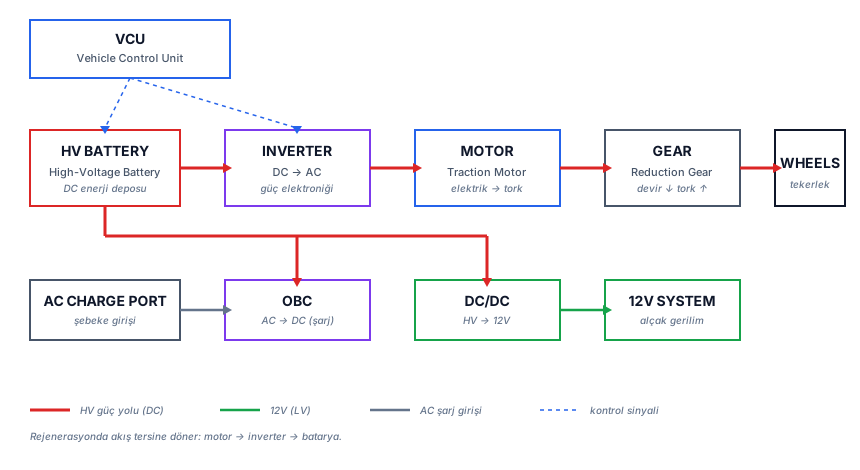
HV Battery (DC) → Inverter (DC→AC) → Electric Machine (AC) → Reduction Gear → WheelsFACT — The battery stores direct current (DC); the inverter converts this DC into the variable-frequency alternating current (AC) the electric machine needs. Motor speed and torque are continuously controlled through the inverter.
During charging the flow reverses or takes different paths:
- AC charging: grid AC → On-board Charger (AC→DC) → battery
- DC fast charging: charging station DC → battery (the OBC is bypassed; DC goes straight to the battery)
FACT — The vehicle’s 12V electrical system (lighting, controls) is fed separately from the battery. Energy drawn from the HV battery is stepped down to 12V by the DC/DC converter.
A diagram of this flow appears in the “Technical Diagrams” section below.
4. Core Components
The main EV components and their roles:
| Component | Role |
|---|---|
| HV Battery | Stores energy electrochemically (DC). |
| BMS | Monitors and protects the battery, estimates SOC/SOH, manages thermal demands. |
| Inverter | Converts battery DC to motor AC; controls motor torque/speed. |
| Electric Machine | Converts electrical energy to mechanical torque (reverse during regeneration). |
| Reduction Gear | Converts high motor speed to low wheel speed, multiplying torque. |
| OBC | Converts grid AC to battery DC during AC charging. |
| DC/DC | Feeds the 12V system from the HV bus. |
| VCU | Coordinates the vehicle’s energy/torque management. |
FACT — In-depth BMS knowledge lives separately in the AUTOVOLTIX BMS Academy; this lesson introduces the BMS only by its role in the system. For battery and BMS fundamentals see BMS Academy → BMS-01 and BMS-02.
5. Differences from an ICE Vehicle
In place of the fuel/air/ignition/exhaust chain, an EV uses an electrical power chain:
- ICE fuel tank → EV HV battery
- ICE engine + multi-speed transmission → EV electric machine + single-speed reduction (usually)
- ICE starter motor + alternator → EV distributes these jobs to the inverter/e-machine and DC/DC
- ICE exhaust/emissions system → EV has none
FACT — The electric machine delivers torque from low speed, so the gear-shifting logic of a conventional automatic transmission is largely unnecessary here. Most BEVs use a single-speed reduction gearbox.
6. Regenerative Braking
FACT — In regenerative braking the electric machine acts as a generator, converting the vehicle’s kinetic energy into electrical energy stored back in the battery. This is the opposite of mechanical brakes losing energy as heat.
The brake pedal request is turned into motor torque through the brake controller, the VCU, and the inverter. Regeneration power is limited by factors such as battery SOC, temperature, cell voltage, and the charge power limit. Full detail is in EV-08.
7. Thermal Management
An ICE engine produces waste heat the cabin can use. An EV is efficient, so waste heat is scarce: cabin heating is usually provided by a PTC heater or a heat pump, while battery/motor/inverter cooling uses a liquid cooling circuit.
FACT — The battery must operate within a certain temperature range: when too cold its performance and charge power drop, and when too hot accelerated aging becomes a risk. Thermal management is therefore a critical control layer for the battery (detail: EV-14, BMS Academy → BMS-12).
8. Control Units
In an EV, energy flow is managed by distributed control units rather than a single central unit. The VCU handles overall energy/torque coordination; the BMS manages the battery, the inverter the motor, and the DC/DC the 12V bus. These units communicate over vehicle networks such as CAN (detail: EV-15, EV-16).
9. Intermediate Technical Section: Energy and Power
The two most commonly confused quantities in EVs are energy (kWh) and power (kW):
- Energy (kWh) — answers “how far can I go”. Battery capacity is stated in kWh.
- Power (kW) — answers “how fast”. Motor power and charging power are stated in kW.
FACT —
Energy = Power × Time(E = P × t). Applying 100 kW for one hour consumes 100 kWh. Applying the same power for 6 minutes (0.1 h) consumes 10 kWh.
FACT — Basic relations:
P = V × I(power = voltage × current), and for a motorP = T × ω(power = torque × angular speed). In a battery, C-rate is current divided by capacity:C-rate = current / capacity.
ASSUMPTION — These formulas are idealized. In a real vehicle, battery internal resistance, inverter/motor losses, heating, and driving resistances (air, rolling) make behavior more complex than these simple formulas.
10. Advanced Preview
At advanced level this lesson’s topics expand into: Field Oriented Control (FOC) and Id/Iq current control (EV-07), PWM/switching and SiC semiconductors in the inverter (EV-06), torque coordination in regeneration (EV-08), the effect of 800V architecture on I²R losses (EV-12, EV-06), and zonal/central E/E architecture (EV-16, EV-23).
11. FAQ
Does an electric vehicle have engine oil?
FACT — With no internal combustion engine there is no engine oil or oil filter. However, the reduction gearbox contains oil (for lubrication) and follows a service interval.
Does an electric vehicle have a transmission?
FACT — Most BEVs have no conventional multi-speed transmission; they use a single-speed reduction gearbox. Some high-performance or commercial applications may use multi-speed solutions (EV-09).
Why does an electric vehicle lose range in winter?
FACT — In the cold, battery internal resistance rises, usable energy drops, and cabin heating consumes energy; regeneration power may also be limited. These effects are covered in EV-21 (Range) and EV-14 (Thermal).
Is 800V really better?
INTERPRETATION — At the same power, higher voltage means lower current, which can reduce conduction (I²R) losses and enable thinner cable cross-sections. But it must be weighed against insulation, safety, component cost, and EMI. Detail: EV-06, EV-12.
12. Safety Warning
FACT — High-voltage systems carry a lethal electric-shock risk. This education is for theory, engineering, design, and test methodology only; HV work on a real vehicle is performed only by qualified personnel with appropriate PPE and OEM procedures.
13. Summary
- An EV is a vehicle propelled by an electric machine; “electric” spans a spectrum from BEV to MHEV.
- BEV is fully electric, HEV/PHEV/EREV are hybrids, FCEV is fuel-cell, and MHEV is lightly electrified.
- The basic energy flow is: battery → inverter → electric machine → reduction gear → wheels.
- The difference from ICE is an electrical power chain instead of a fuel/exhaust chain.
- Energy (kWh) and power (kW) are different quantities linked by E = P × t.
- Regenerative braking returns kinetic energy to electricity; thermal management and control units keep the system safe and efficient.
14. Sources and Verification Note
No model-specific hard technical data is used in this lesson. The core concepts (energy/power relations, electrification classes, energy flow) are established textbook-level engineering knowledge.
- U.S. Department of Energy (DOE), Alternative Fuels Data Center — “How Do All-Electric Cars Work”, “How Do Hybrid Electric Cars Work”.
- SAE J1715 — Hybrid and electric vehicle terminology (classification reference).
- UNECE R100 — Electric vehicle safety regulation (general safety framework).
ASSUMPTION — Source versions/titles may change; every source must be re-verified before publication (see
data/sources/sources.jsonand the technical review checklist).
Next Lesson
- EV-02 — Electric Vehicle Architecture: the battery → HV distribution → inverter → motor → reduction → wheels chain at the architectural level.
Technical Diagrams
Quiz
Which statement about a BEV (battery electric vehicle) is correct?
A BEV is fully electric: energy is stored only in the high-voltage battery and propulsion is provided entirely by the electric machine.
Which unit stores energy in an electric vehicle?
The high-voltage (HV) battery is the main energy store; the inverter performs conversion and the DC/DC feeds the 12V system.
What is the inverter's primary job?
The battery stores DC; the inverter converts it into the variable-frequency AC the electric machine uses.
What does regenerative braking do?
During regeneration the electric machine acts as a generator and returns the vehicle's kinetic energy to the battery.
What is the key difference between a PHEV and a BEV?
A PHEV charges from the grid and offers a short all-electric range; a BEV has no internal combustion engine at all.
What is the role of the internal combustion engine in an EREV?
In an EREV the wheels are driven only by the electric machine; the ICE acts as a range-extending generator when the battery is low.
What is the relationship between energy (kWh) and power (kW)?
E = P × t: applying 100 kW for one hour consumes 100 kWh of energy.
Why do most BEVs not use a multi-speed conventional transmission?
The torque characteristic of an electric machine lets a single-speed reduction cover a wide speed range, making a multi-speed gearbox generally unnecessary.
Why can regenerative braking power be limited at high SOC and low temperature?
At high SOC the battery accepts little additional energy, and when cold its charge power limit drops; the BMS limits regeneration accordingly.
What is the energy flow in an FCEV?
In an FCEV the fuel cell generates electricity from hydrogen; the electric machine drives the wheels and a small battery acts as a power buffer and regeneration store.
Glossary
| English Term | Definition |
|---|---|
| BEV (Battery Electric Vehicle) | A vehicle with no internal combustion engine that stores energy only in a high-voltage battery and is propelled entirely by an electric machine. |
| HEV (Hybrid Electric Vehicle) | A classic hybrid combining an internal combustion engine and an electric machine, whose small battery cannot be charged from the grid. |
| PHEV (Plug-in Hybrid Electric Vehicle) | A hybrid whose larger battery charges from the grid and can cover a certain distance fully electrically. |
| EREV (Extended-Range Electric Vehicle) | A vehicle whose wheels are driven only by an electric machine, with the ICE acting as a generator to extend range when the battery is low. |
| FCEV (Fuel Cell Electric Vehicle) | An electric vehicle that generates electricity from hydrogen via a fuel cell, drives the wheels with an electric machine, and uses a small battery as a buffer. |
| MHEV (Mild Hybrid Electric Vehicle) | A vehicle with limited low-voltage electrification (e.g., 48V) providing start-stop, mild assist, and regeneration, but unable to drive on electricity alone. |
| Inverter | The power-electronics unit that converts the battery's direct current (DC) into the variable-frequency alternating current (AC) the electric machine requires. |
| Traction Motor | The electric machine that converts electrical energy into the mechanical torque that propels the vehicle; it also acts as a generator during regeneration. |
| Regenerative Braking | Braking in which the electric machine acts as a generator, converting the vehicle's kinetic energy back into electrical energy stored in the battery. |