
- Analyze SAE J3016 (Rev. April 2021) Levels 0 through 5 across the DDT execution, OEDR, DDT fallback, and ODD columns.
- Explain the critical distinction between L1 (single-axis) and L2 (dual-axis, human still the legal driver) with concrete examples.
- Evaluate the legal liability shift between Level 2 and Level 3, and the engineering/commercial consequences that explain why L3 has been slow to market.
- Justify why SAE levels are NOT a safety ranking but a responsibility-allocation scheme.
- Deconstruct the Tesla FSD/Autopilot naming case, distinguishing the manufacturer's claim from the regulatory SAE classification.
AD-03 — SAE J3016 Levels of Driving Automation (Deconstructing L0–L5)
ASSUMPTION — This is the densest reference lesson in the academy’s “Fundamentals” track. We apply the three pillars established in AD-02 (DDT execution, DDT fallback, ODD) level by level, from L0 to L5; the taxonomy built here is used as a constant reference point throughout the rest of the academy — from the sensor lessons in AD-04/05, to the ODD/fallback deep dive in AD-16/17, to functional safety in AD-19.
In this lesson, you will learn to:
- Analyze SAE J3016 (Rev. April 2021) Levels 0 through 5 across the DDT execution, OEDR, DDT fallback, and ODD columns.
- Explain the critical distinction between L1 (single-axis) and L2 (dual-axis, human still the legal driver).
- Evaluate the legal liability shift between Level 2 and Level 3 and why L3 has been slow to reach market.
- Justify why SAE levels are NOT a safety ranking but a responsibility-allocation scheme.
- Deconstruct the Tesla FSD/Autopilot naming case as manufacturer claim vs. regulatory classification.
- The SAE J3016 Level Matrix: Four Columns, Six Levels
- L0 — No Automation
- L1 — Driver Assistance: Single Axis
- L2 — Partial Automation: Dual Axis, Human Still the Driver
- L3 — Conditional Automation: The First Systematic Transfer of Responsibility
- L4 — High Automation: The System Runs Its Own Fallback
- L5 — Full Automation: Why It Doesn’t Exist Yet
- Levels Are Not a Safety Ranking
- Case Study: The Tesla Naming Controversy
1. The SAE J3016 Level Matrix: Four Columns, Six Levels
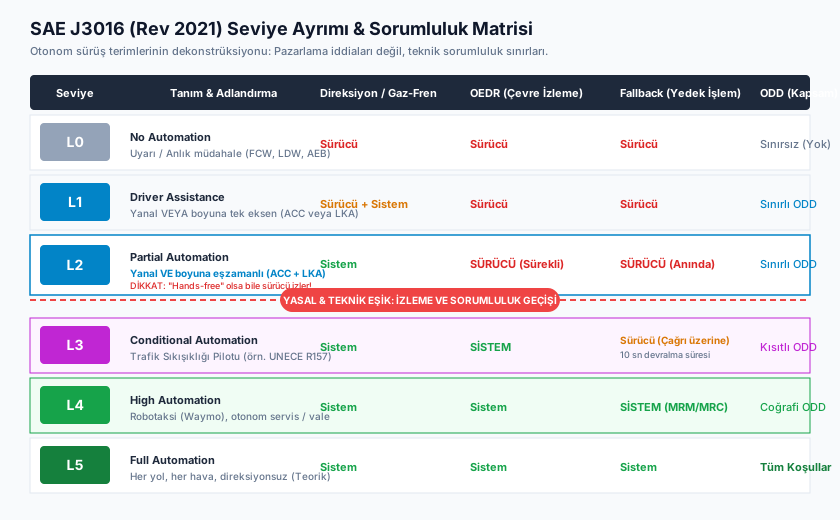
FACT — SAE International’s J3016 standard (latest revision: April 2021) divides driving automation into six levels, 0 through 5. A system’s level is determined by the pillars established in AD-02 — here we split AD-02’s “OEDR” sub-task out into its own column, because who owns OEDR is the single most critical distinction between L1/L2 and L3:
| Level | Name | DDT Execution (Lateral+Longitudinal) | OEDR Responsibility | DDT Fallback Responsibility | ODD Scope | Real-World Example |
|---|---|---|---|---|---|---|
| L0 | No Automation | Human | Human | Human | None (unrestricted) | Warning systems (FCW, BSD) — no intervention |
| L1 | Driver Assistance | Human + System (single axis: either lateral or longitudinal) | Human | Human | Limited | ACC alone, or LKA alone (never both together) |
| L2 | Partial Automation | System (both axes together) | Human | Human | Limited | Tesla Autopilot/FSD (Supervised), GM Super Cruise, Ford BlueCruise |
| L3 | Conditional Automation | System | System (within ODD) | Human (on TOR) | Narrow/restricted | Mercedes-Benz Drive Pilot |
| L4 | High Automation | System | System | System (own MRC) | Geofenced/weather-limited | Waymo robotaxi |
| L5 | Full Automation | System | System | System | Unrestricted (any road, any condition) | Not yet in commercial production |
The sections below unpack each level individually.
2. L0 — No Automation
FACT — L0 has NO sustained automation whatsoever — but that does not mean the vehicle has no electronic assistance at all. L0 includes systems that warn the driver but never physically steer or brake the vehicle: Forward Collision Warning (FCW), Blind Spot Detection (BSD), and Lane Departure Warning (LDW — an audible/haptic alert, not a steering correction). Even a momentary intervention (e.g., a single-shot emergency brake assist pulse) still falls under L0 per SAE J3016, because there is no sustained, continuous control execution.
3. L1 — Driver Assistance: Single Axis
FACT — The single criterion that defines L1: the system continuously executes only one of lateral or longitudinal control — never both simultaneously. Classic Adaptive Cruise Control (ACC, longitudinal only) or standalone Lane Keeping Assist (LKA, lateral only) are L1. OEDR and fallback remain entirely with the human, who holds manual control of the other axis at all times.
4. L2 — Partial Automation: Dual Axis, Human Still the Driver
WARNING — The most common, and most dangerous, mistake in popular media and marketing: “a Level 2 car drives itself.” The engineering reality is that in L2, both lateral and longitudinal control are simultaneously handled by the system, BUT OEDR responsibility remains entirely with the human. If the system fails to recognize a sudden obstacle, the driver is legally and technically at fault — because the system was sold on the premise “I am only an assistant; you keep watching the road.”
Three real, current L2 systems and their nuances:
- Tesla Autopilot / “Full Self-Driving (Supervised)”: Manufacturer Claim: the product name itself, “Full Self-Driving,” implies independent operation. Engineering reality: Tesla’s own US regulatory filings (including correspondence with the California DMV) classify this software as SAE Level 2 — steering-torque sensing and camera-based driver monitoring require continuous human engagement.
- GM Super Cruise: Limited to pre-mapped, LiDAR-surveyed divided highways (its ODD), hands-free but eyes-on — hands may leave the wheel, but an in-cabin eye-tracking camera must continuously confirm the driver’s gaze is on the road. If the gaze drifts, the system warns and eventually disengages.
- Ford BlueCruise: Similarly hands-free, eye-tracked, and restricted to Ford’s mapped “Blue Zone” divided highways — an L2 system.
CRITICAL — Releasing the hands from the wheel (hands-free L2) does NOT change the system’s level. “Hands-free” only concerns the physical execution mechanism of lateral control; OEDR responsibility still sits with the human, which is exactly why every one of these systems is backed by an in-cabin gaze/attention monitoring camera (DMS, AD-18) — hands may be freed, but eyes cannot.
5. L3 — Conditional Automation: The First Systematic Transfer of Responsibility
FACT — L3 is the first level where, IN ADDITION to DDT execution, OEDR is also systematically transferred to the system — but only while inside a defined, narrow ODD. While the system is engaged, the driver may legally attend to a secondary task (e.g., watching a video on the infotainment screen). When the system approaches its ODD boundary or detects a fault, it issues a defined Take-Over Request (TOR, typically at least ~10 seconds); if the driver does not take over, the vehicle executes its own Minimal Risk Condition (MRC — e.g., stopping safely in its lane or on the shoulder with hazard lights on).
EXAMPLE — Mercedes-Benz Drive Pilot, type-approved in Germany under UNECE R157 (ALKS) and subsequently approved in select US states (Nevada, California), is a genuine, narrowly-certified L3 example. Its ODD is extremely constrained: approved highway segments, traffic-congestion conditions, and below a defined speed ceiling. Outside that ODD (e.g., open highway at higher speed), the system automatically disengages and the vehicle reverts to L2 or full manual driving.
CRITICAL — The transition from L2 to L3 marks a fundamental shift in legal liability: at L3, if a crash occurs while the system is properly engaged within its ODD and the driver is occupied with a system-permitted secondary task, liability shifts from the driver toward the manufacturer. This is not just a technical distinction — it is an enormous commercial and insurance burden: the manufacturer becomes directly legally accountable for its own software’s decisions.
The concrete consequences of this liability shift explain why L3, despite being technically achievable, has been so slow to reach market:
- Mandatory fail-operational hardware: In L2, if the system fails, the driver is already present (fail-safe is sufficient, AD-01 Section 3). In L3, the driver may not be immediately ready; this mandates fail-operational hardware — redundant steering motors, redundant brake power sources, redundant processors — which significantly raises cost.
- Narrow ODD, limited commercial value: L3 certification is typically tied to a very narrow ODD (a specific highway type, a specific speed band), which limits the feature’s practical day-to-day value to the customer.
- Fragmented country-by-country regulation: While UNECE R157 covers much of Europe/Asia, the US requires separate state-by-state approval — meaning a global manufacturer faces a distinct certification process in each market.
- Insurance uncertainty: In a product where manufacturer liability is triggered, insurance premium structures and fault-determination processes are still maturing.
6. L4 — High Automation: The System Runs Its Own Fallback
FACT — L4 shares the same DDT+OEDR transfer as L3, but the critical difference is in fallback: at L4, when the system reaches its ODD boundary or detects a fault, it does not wait to hand off to a human — it executes its own Minimal Risk Condition (MRC) entirely on its own. A human may not be present at all (as in a Waymo robotaxi), or if present, is never required to take over.
EXAMPLE — Waymo operates a robotaxi service in select US cities carrying passengers with no safety driver present — a genuine commercial L4 example. Its ODD is geographically tightly bounded (specific geofenced metro areas) and typically constrained by weather/road conditions. When there is a risk of exiting the ODD, the vehicle simply doesn’t serve that area or plans its route to stay within the ODD — unlike L3, “exit the boundary and hand off to a human” is not part of the operational model at all.
INTERPRETATION — Calling L4 “high” automation rather than “full” does not mean it is less capable than L5 — it only means its ODD is bounded. Within its ODD, an L4 system assumes full responsibility with zero reliance on human intervention; this represents a qualitatively different, and in a sense higher, engineering confidence threshold than L3’s “hand back to the human” model.
7. L5 — Full Automation: Why It Doesn’t Exist Yet
FACT — L5 shares the same DDT/OEDR/fallback transfer as L4, but the ODD restriction is removed entirely: the system must be able to drive on any road, in any weather, in any geography — anywhere a human driver could go. As of 2026, no L5 system exists in commercial production.
INTERPRETATION — The core reason L5 still doesn’t exist isn’t hardware — it’s the “open world” perception and planning problem: L4 systems achieve reliability by “domesticating” their ODD in advance — high-resolution pre-built maps, statistically characterized traffic behavior, and bounded weather/lighting conditions. L5 removes that domestication entirely — the number of “long-tail” scenarios (an entirely unmapped rural road, an unexpected blizzard, an unusual object such as livestock loose on the road or debris after a natural disaster, or unpredictable human behavior such as a police officer directing traffic by hand) is practically unbounded. Providing a separately validated safety guarantee for each such scenario is not a problem current perception and planning architectures have solved.
8. Levels Are Not a Safety Ranking
CRITICAL — The most commonly misunderstood aspect of SAE J3016: the level number is NOT a safety or quality ranking. Levels only describe who does what — there is no inherent guarantee that L3 is “safer” than L2, or that L4 is “safer” than L3. A well-engineered, thoroughly validated L2 system operating within a narrow, conservative ODD can be far safer in practice than a rushed, poorly validated L3 system elsewhere.
INTERPRETATION — The practical consequence: rather than asking “which level is better,” a consumer or policymaker should ask “how rigorously has this specific system been validated within its own ODD, how often does it fail, and how gracefully does it handle failure?” The level number doesn’t answer those questions — it only defines the responsibility framework. Validation and test depth get their own dedicated track in AD-22–25.
9. Case Study: The Tesla Naming Controversy
WARNING — Tesla’s “Full Self-Driving (Supervised)” naming, and its earlier “Autopilot” branding, is the highest-profile real-world example of the exact distinction this lesson has built from the start:
- Manufacturer Claim: The product name itself (“Full Self-Driving”) literally implies a system that requires no human intervention.
- Engineering/Regulatory Reality: Tesla’s own official US regulatory correspondence (including with the California DMV) and its technical architecture (single-channel steering/braking, torque- and camera-based monitoring that mandates continuous driver supervision) classify this system as SAE Level 2 — NOT L3, L4, or L5.
This is a concrete, documented example of the mismatch between a product name and its engineering classification; the later addition of the “(Supervised)” qualifier to the product name is itself a partial acknowledgment by the manufacturer of that ambiguity.
FACT (Practical Rule) — When evaluating any ADAS/AD system, the correct question is always: “According to the manufacturer’s own official regulatory filings, what SAE level is this system?” — never the product’s marketing name, a promotional video, or casual words like “autonomous.” Every real production system encountered in this academy will be passed through this same filter (see the “Features & Architecture” track, AD-12–15).
Frequently Asked Questions (FAQ)
Q: If a car steers itself to change lanes automatically, is that Level 3?
FACT — No. Active Lane Change (ALC) is common in L2 systems; if the driver must still check mirrors and continuously supervise the maneuver, the system is still L2. It’s not the number of axes involved in a maneuver that determines the level — it’s who owns OEDR (Sections 1 and 4).
Q: Can a system go from L3 to L4 purely through a software update?
INTERPRETATION — Theoretically yes, but in practice this is never just a software change — for a system to fully assume L4’s fallback responsibility, it generally requires additional hardware redundancy (fail-operational architecture, AD-01 Section 3) that a comparable L3 system may lack. That’s why an L3-to-L4 transition typically requires a new hardware generation and re-certification, not merely an over-the-air update.
Q: Can the same system operate at different levels in different ODDs?
FACT — Yes, and this is actually common. Mercedes-Benz Drive Pilot, for example, operates as L3 within its approved traffic-congestion ODD, but automatically reverts to L2 or full manual mode outside that ODD (e.g., on an open, high-speed highway). A vehicle’s “level” is not a fixed property — it’s a state that depends on the currently active ODD.
Summary
- SAE J3016 defines levels across four columns: DDT execution, OEDR responsibility, DDT fallback responsibility, and ODD scope.
- L0 warns but never intervenes; L1 automates a single axis, L2 automates both axes together — but in both L1 and L2, OEDR and fallback remain entirely human.
- L3 is the first level where OEDR is systematically transferred to the system, bringing with it a critical legal liability shift from driver to manufacturer — which explains why L3 has been so slow to reach market.
- L4 fully executes its own fallback (MRC) with zero human reliance but is bounded by a geofenced/weather-limited ODD (Waymo); L5 has no ODD boundary and remains a theoretical endpoint, unreached because the “open world” perception problem is unsolved.
- The level number is not a safety ranking — a well-validated lower level can be safer than a poorly validated higher one.
- Tesla’s “Full Self-Driving” name is a Manufacturer Claim; the regulatory reality is SAE Level 2 — the right question is always “what SAE level, per the manufacturer’s own official filings?”
Sources and Verification Note
Sources: SAE J3016:2021 — Taxonomy and Definitions for Terms Related to Driving Automation Systems, ISO 26262:2018 Road Vehicles — Functional Safety, Winner et al. — Automotive Handbook on ADAS, UNECE Regulation No. 157 (Automated Lane Keeping Systems), NHTSA — Automated Driving Systems 2.0: A Vision for Safety. The L0–L5 definitions and the four-column framework follow SAE J3016 directly. Mercedes-Benz Drive Pilot’s ODD boundaries (approved highway/traffic-congestion/speed ceiling) and Waymo’s geofenced robotaxi operation are verified against public manufacturer/regulatory announcements; exact speed/area thresholds are given approximately since they can change over time and by market. Tesla FSD/Autopilot’s SAE Level 2 classification is based on the manufacturer’s own US regulatory correspondence.
Next Lesson
- AD-04 — ADAS Sensors: Camera, Radar, LiDAR, and Ultrasonic Physics: Which sensor hardware makes each level classified in this lesson physically possible; camera CMOS architecture, the radar Doppler effect, the LiDAR Time-of-Flight principle, and how each sensor’s physical limits govern OEDR reliability.
Technical Diagrams
Quiz
What is the defining technical boundary between SAE Level 2 and Level 3?
In Level 2, the human must monitor the environment; in Level 3, the system performs OEDR.
What is the legal requirement for a driver operating a 'Hands-Free' Level 2+ system?
Even with hands off the wheel, Level 2 requires continuous eyes-on-road human supervision.
How much transition time does a certified Level 3 system typically grant during a Take-Over Request?
Level 3 systems maintain automated trajectory control for an ~10 second grace window to allow driver orientation.
How does a Level 4 Robotaxi differ technically from theoretical Level 5 automation?
Level 4 is bounded by a strict ODD; Level 5 is completely unconstrained.
Does marketing software as 'Full Self-Driving' automatically certify a vehicle as Level 4/5?
Regulatory automation level is governed by operational liability, not commercial marketing terminology.
Glossary
| English Term | Definition |
|---|---|
| Automated Driving System (ADS) | The hardware and software collectively capable of performing the entire Dynamic Driving Task (DDT) on a sustained basis within an ODD (SAE Levels 3, 4, and 5). |
| SAE J3016 | The international taxonomy standard that categorizes driving automation levels from L0 (no automation) to L5 (full automation) based on system vs driver roles. |
| Operational Design Domain (ODD) | The specific operating conditions (roadway types, speed bounds, weather, lighting, geography) under which a driving automation system is certified and designed to function safely. |
| Dynamic Driving Task (DDT) | All the real-time operational (steering, braking, accelerating) and tactical (lane changes, gap selection, object avoidance) functions required to operate a vehicle in on-road traffic. |
| DDT Fallback | The response by the driver or the automated system to either resume manual control or achieve a minimal risk condition after a system fault or ODD boundary exit. |
| Driver Monitoring System (DMS) | An in-cabin safety system using infrared cameras and computer vision to monitor driver head pose, eye gaze, eyelid closure, and distraction to ensure readiness. |