
- Explain why EV service requires a distinct safety and qualification framework compared to ICE service.
- Summarize the role of service disconnect and isolation verification.
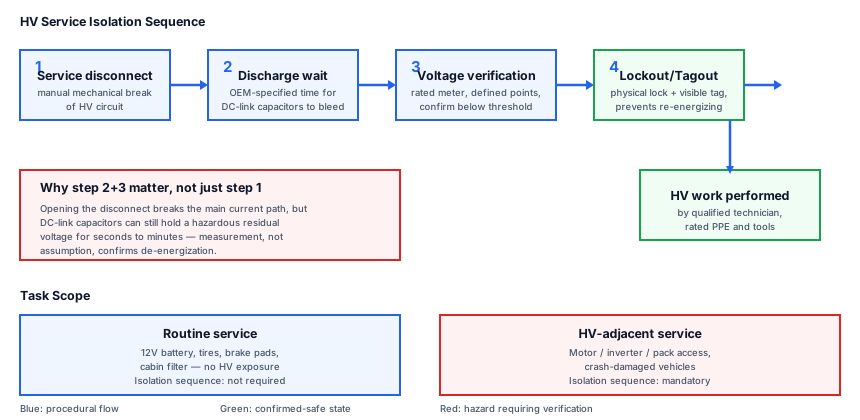
- Describe a representative HV lockout/tagout sequence and why each step exists in that order.
- Distinguish routine service work from HV-adjacent work and explain why the boundary matters.
- State the importance of OEM procedures, diagnostic tooling, and technician training.
- Explain the right-to-repair debate around EV service access and its safety trade-offs.
EV-39 — Service / Repair
ASSUMPTION — This lesson describes the architecture of EV service — why it is organized the way it is, and what qualification/procedure layers exist. It deliberately does not turn any hazardous HV intervention into step-by-step instructions a non-qualified reader could attempt on a real vehicle.
1. Why EV Service Is a Different Discipline
A technician trained only on internal-combustion vehicles cannot simply transfer that experience to an EV, because the hazard profile is fundamentally different. An ICE vehicle’s dangerous energy sources — fuel, exhaust heat, a spinning belt — are visible, familiar, and mostly self-announcing: you can see fuel, smell exhaust, hear a running engine. A high-voltage EV battery pack, by contrast, can carry several hundred volts DC while sitting completely silent, cold, and outwardly indistinguishable from a de-energized one. There is no sound, smell, or visible motion to warn an unqualified person that the orange HV cabling nearby is live. This is precisely why the EV service world layers deliberate, procedural safeguards on top of physical ones: the danger cannot be perceived directly, so the process has to compensate for what the senses cannot.
FACT — Orange cabling and connectors are a near-universal visual convention for HV circuits above roughly 60V DC / 30V AC, standardized across most OEMs precisely because the hazard itself gives no natural warning.
2. HV Technician Qualification and PPE
Working on or near an exposed HV circuit requires personnel who have completed specific EV/HV electrical-safety training, not merely general automotive experience. This training covers arc-flash awareness, insulation testing, the specific pack architecture of the vehicles being serviced, and the correct use of rated tools.
Personal protective equipment (PPE) for HV work typically includes insulated gloves rated for the voltage class present (tested and re-certified on a schedule, not used indefinitely), insulated tools, eye/face protection, and voltage-rated multimeters designed for the category of measurement being performed. None of these items are interchangeable with “regular” workshop equipment — an ordinary multimeter probe or a worn insulated glove is not a safety margin, it is a false sense of one.
FACT — Insulated gloves are rated by voltage class and require periodic dielectric re-testing; a glove that looks intact can have lost its insulating capability and still fail without visible signs.
3. Service Disconnect and Isolation Verification
Before any work that exposes HV conductors, two distinct things must happen, and they are not the same thing.
Service disconnect is a manually operated plug or switch, physically separate from the software-controlled contactors, that a technician removes or opens to mechanically break the HV circuit. Its whole purpose is to give a human being direct, physical control over disconnection that does not depend on software, a functioning BMS, or vehicle power being available.
Isolation verification is the separate step of confirming, by measurement, that the circuit is actually de-energized — not merely assuming it is because the disconnect was removed. This distinction matters because a pack’s DC-link capacitors can retain a dangerous residual voltage for some time after disconnection even though the main current path has been broken; capacitors store charge, and that charge does not disappear the instant a switch opens.
A representative isolation sequence, described conceptually rather than as a how-to, looks like this:
1. Open/remove service disconnect
2. Wait the OEM-specified discharge time (allows DC-link capacitors to bleed down)
3. Measure residual voltage with a rated meter, at points defined by the OEM procedure
4. Confirm voltage is below the safety threshold before touching any HV conductor
5. Apply lockout/tagout so no one can re-energize the circuit while work is underway
FACT — Step 3 exists because step 1 alone is insufficient: a stored capacitive charge can remain above a hazardous threshold for seconds to minutes after the disconnect is opened, depending on the discharge circuit design.
Lockout/Tagout (LOTO) is the last step and the one most often underestimated: a physical lock and a visible tag are placed on the isolation point so that no other person — not just the technician doing the work — can inadvertently re-energize the system while someone’s hands are still near exposed conductors. LOTO is a communication mechanism as much as a mechanical one; it protects against a second person’s mistake, not just the first person’s.
4. OEM Procedures, Diagnostics, and Training
Every step above is defined per-vehicle by the OEM, not improvised on the shop floor. Pack architecture, discharge time constants, connector locations, and safe-voltage thresholds all vary between manufacturers and even between model years of the same manufacturer, so a procedure valid on one vehicle is not automatically valid on another. Diagnostic scan tools read fault codes and live HV-system data (insulation resistance readings, contactor states, cell-level data from the BMS) that guide the technician toward the actual fault rather than relying on guesswork, which is both slower and riskier around HV systems.
FACT — OEM service documentation is treated as a living, versioned reference — the exact procedure, torque spec, or discharge time can change between technical service bulletins, which is one reason ad-hoc “how it worked last time” repair is discouraged in HV work specifically.
5. Routine Work vs HV-Adjacent Work
Not every EV service task requires HV isolation, and conflating the two creates unnecessary caution in some cases and unsafe shortcuts in others. The table below illustrates the general boundary; specific vehicles may differ.
| Task | Typical HV exposure | Isolation required? |
|---|---|---|
| 12V battery replacement | None (separate low-voltage circuit) | Usually no |
| Tire rotation / brake pad replacement | None (mechanical, low-voltage systems) | Usually no |
| Cabin HVAC filter / 12V accessory | None | Usually no |
| Inverter, motor, or DC/DC replacement | Direct HV conductor exposure | Yes |
| HV battery pack service, module access | Direct HV conductor exposure, stored energy | Yes |
| Crash-damaged vehicle handling | Uncertain — connectors/insulation may be compromised | Yes, treated as HV until verified otherwise |
FACT — A crash-damaged EV is treated as potentially energized and physically compromised until qualified personnel verify isolation, even if the vehicle appears powered off, because a crash can breach insulation or damage the HVIL loop in ways that are not visually obvious (see EV-45 for crash-safety design).
6. Right to Repair and Independent Shops
A live debate in the EV service world concerns how much access independent (non-dealer) repair shops get to OEM diagnostic tools, wiring diagrams, and parts. Manufacturers argue that restricting HV procedures to trained, certified technicians protects both consumer safety and brand liability; independent shops and right-to-repair advocates argue that overly restrictive access raises repair costs, limits consumer choice, and can push owners toward full-assembly replacement when a component-level repair would have sufficed.
INTERPRETATION — Both positions have a legitimate core: HV work genuinely carries lethal risk that justifies some gatekeeping, but gatekeeping can also be used, intentionally or not, to reduce competition rather than purely to protect safety. Where a given market’s regulation lands on this trade-off is jurisdiction-specific and evolving, and is not a settled engineering question.
7. FAQ
Who may work on the HV system?
FACT — Only personnel who have completed HV-specific electrical safety training, hold the qualification level the OEM procedure calls for, and use properly rated, currently certified PPE and test equipment.
Why is battery pack repair harder than replacing an ICE part?
FACT — Pack sealing, cell-to-cell electrical and thermal interconnection, and safety certification make module- or cell-level repair a specialized task; many procedures call for full-pack or full-module replacement rather than individual cell repair, partly for safety and partly for the difficulty of re-certifying a partially rebuilt pack.
Is it safe to assume a vehicle is de-energized just because it’s off?
FACT — No. “Off” describes the vehicle’s operating state, not the HV circuit’s actual voltage. Isolation verification with a rated meter is the only step that confirms de-energization; it is a distinct check, not an inference from the ignition state.
8. Safety Warning
FACT — High-voltage systems carry a lethal electric-shock and arc-flash risk. Nothing in this lesson is instructional for performing HV work; it is provided for theoretical, engineering, and test-methodology understanding only. Any real HV intervention must be performed by qualified personnel following OEM procedures with appropriate PPE.
9. Summary
- EV service safety is procedural because the hazard (live HV) gives no natural sensory warning, unlike ICE hazards.
- Service disconnect (mechanical break) and isolation verification (measured confirmation) are two distinct, sequential steps — one is not a substitute for the other.
- Stored capacitive charge means a circuit can remain hazardous for a period after the disconnect is opened; a discharge wait and a voltage measurement are both required.
- Lockout/tagout protects against a second person re-energizing the circuit, not just the original technician’s own error.
- Routine tasks (12V, tires, brakes) usually need no HV isolation; motor/inverter/pack work and crash-damaged vehicles do.
- The right-to-repair debate weighs safety gatekeeping against repair cost and consumer choice, and is regulatory territory rather than a fixed engineering answer.
10. Sources and Verification Note
No vehicle-specific procedure, discharge time, or voltage threshold is stated in this lesson; all such values are OEM- and model-specific and must be taken from current OEM service documentation, never inferred from a general lesson like this one.
- UNECE R100 — Electric vehicle safety regulation (HV isolation and safety framework).
- SAE J1715 — Hybrid and electric vehicle terminology.
- NFPA 70E — Standard for Electrical Safety in the Workplace (general electrical-safety practice referenced by HV service training programs).
ASSUMPTION — Source versions/titles may change; every source must be re-verified before publication.
Next Lesson
- EV-40 — Economics / TCO: total cost of ownership.
Technical Diagrams
Quiz
Who can work on HV?
Only trained, qualified personnel work on HV.
What does the service disconnect do?
The service disconnect manually breaks the HV circuit during service.
What does isolation verification provide?
Isolation verification measures and confirms HV is de-energized.
What is PPE in HV service?
PPE (Personal Protective Equipment) is personal protective equipment.
Does this lesson give amateur HV instructions?
The lesson does not describe hazardous HV interventions to amateurs.