
- List the main EV production stages: battery, e-drive, and vehicle assembly.
- Explain EOL (end-of-line) tests: leak, HV insulation, and functional testing.
- Summarize the role of traceability in quality control and recalls.
- Explain gigacasting as a structural manufacturing trade-off, not just a buzzword.
- State why battery manufacturing carries a distinct safety profile compared with conventional vehicle assembly.
EV-38 — EV Manufacturing
ASSUMPTION — This lesson covers the production process at the system level, describing what each stage is for and why it exists. No model-specific line layout, cycle time, or production volume figure is given.
1. Why EV Manufacturing Differs from Conventional Assembly
Building an EV shares a great deal with conventional vehicle assembly — stamping, body-in-white welding, paint, and final trim are broadly similar processes regardless of powertrain. What is genuinely new is the addition of two manufacturing domains that have no direct combustion-vehicle equivalent: battery production, which is closer in character to a chemical/electronics manufacturing process than a traditional automotive one, and e-drive assembly, which brings power electronics manufacturing (with its own cleanliness and testing requirements) into what used to be a purely mechanical drivetrain build. Because these domains carry different risks and different failure modes than stamping sheet metal, EV plants typically operate them as distinct manufacturing cells with their own specialized processes and controls, even when they ultimately feed into the same final assembly line.
2. Production Stages
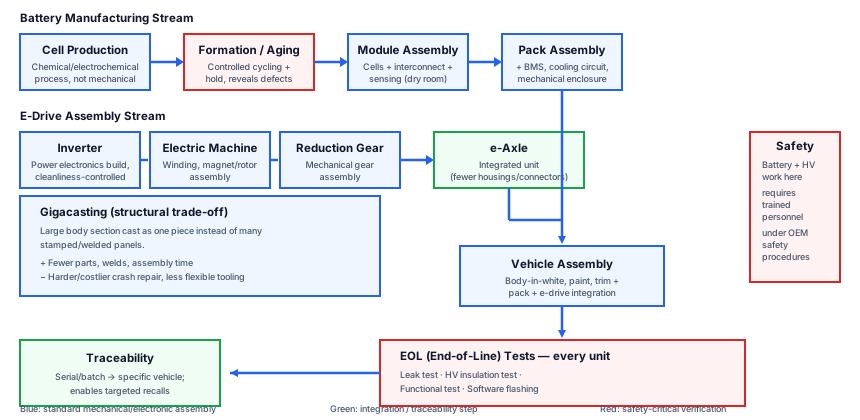
Battery manufacturing begins with individual cell production (a chemical/electrochemical process, not a mechanical one), then proceeds through module assembly — grouping cells with their interconnects, sensing, and initial structural support — and finally pack assembly, where modules are integrated with the pack-level BMS, cooling circuit, and mechanical enclosure. A step often overlooked outside battery manufacturing itself is formation and aging: newly assembled cells undergo controlled initial charge/discharge cycles and are held for a period to verify stable behavior before being accepted into a pack, because a cell that looks fine electrically on day one can still reveal a manufacturing defect through self-discharge or capacity drift over the following days.
FACT — Battery cell and module assembly is commonly performed in a dry room — an environment with tightly controlled, very low humidity — because several battery materials react readily with moisture, and even small amounts of humidity introduced during assembly can degrade cell performance or safety over the product’s life.
E-drive assembly brings together the inverter, the electric machine, and the reduction gearbox, increasingly as a single integrated e-axle unit (EV-03). Power electronics assembly for the inverter requires cleanliness and process controls closer to electronics manufacturing than to traditional engine-building, since power semiconductor modules are sensitive to contamination and mechanical stress during assembly. Vehicle assembly then integrates the completed battery pack and e-drive unit(s) into the vehicle platform alongside the body, interior, and remaining systems, following largely the same body-in-white, paint, and trim sequence used across the industry.
3. EOL (End-of-Line) Tests
Every vehicle, not just a sample, must be verified before it leaves the plant, and this final verification stage is called end-of-line (EOL) testing. A leak test checks the sealing integrity of the liquid cooling circuit that serves the battery, motor, and power electronics, since a coolant leak occurring after months of vehicle use is far more expensive and disruptive to fix than one caught before the vehicle ever ships. An HV insulation test verifies that the resistance between the high-voltage bus and the vehicle chassis meets the required minimum, confirming the electric-shock protection barrier is intact — this is one of the most safety-critical EOL checks precisely because a marginal insulation fault might not be visible at all under normal low-voltage inspection. A functional test exercises the vehicle’s major systems — propulsion, charging communication, safety systems — to confirm they behave correctly as an integrated whole, not just as individually verified components. Software flashing loads the final calibration and software version onto each controller, ensuring every vehicle leaves with the intended, verified software configuration rather than whatever development or pre-production image happened to be on a given controller during assembly.
FACT — EOL tests exist because integration failures — two individually correct components that do not work correctly together — are common in complex systems and are often impossible to detect except by testing the fully assembled vehicle.
4. Traceability
Traceability records which specific components (identified by serial or batch number) went into which specific vehicle, at what stage, and under what process conditions. This matters most when something goes wrong after vehicles are already in customers’ hands: if a defect is later traced to a specific battery cell production batch, traceability lets the manufacturer identify exactly which vehicles contain cells from that batch, rather than having to assume every vehicle of a given model year is affected. This precision is what makes a targeted recall (affecting only the vehicles that actually contain the suspect part) possible instead of a blanket one, which is both far less disruptive for customers and less costly for the manufacturer — but it depends entirely on traceability data having been captured accurately and completely during production in the first place.
5. Gigacasting as a Manufacturing Trade-off
Gigacasting refers to producing a large structural body section — sometimes most of the underbody — as a single high-pressure die casting, rather than assembling it from dozens of individually stamped and welded panels. The appeal is straightforward: fewer parts means fewer welds, fewer fixtures, and less assembly time, which can meaningfully reduce both cost and the number of process steps where defects can be introduced. But the trade-off is equally real: a single large casting is harder and more expensive to repair after a crash (a damaged section may require replacing the entire casting rather than a smaller panel), and the tooling investment for a giant casting press is far larger and less flexible than tooling for stamped panels, which makes design changes more costly to implement once committed. This is a genuine engineering and business trade-off between production efficiency and both repairability and design flexibility, not a strictly “better” technique in every dimension.
6. FAQ
Which processes stand out in EV manufacturing compared with a conventional vehicle?
FACT — Cell production and formation, module/pack assembly (including dry-room requirements), and EOL tests specific to the HV system (insulation, leak) have no direct combustion-vehicle equivalent; body-in-white, paint, and general trim assembly remain broadly similar across powertrain types.
What is gigacasting, in one sentence?
FACT — Producing a large body structure as a single die casting instead of many stamped and welded parts, trading reduced part count and assembly time for reduced crash-repairability and less flexible tooling.
Why is battery formation a separate step from module assembly?
INTERPRETATION — A freshly assembled cell has not yet demonstrated stable electrochemical behavior over time; formation cycling and an aging/observation period reveal defects (such as abnormal self-discharge) that would not be visible from a single point-in-time electrical measurement, before the cell is committed to a pack.
7. Safety Warning
FACT — Battery manufacturing and e-drive assembly involve chemical, electrical, and high-voltage hazards distinct from conventional vehicle assembly (cell material reactivity, HV energization during EOL testing, power electronics handling). This lesson describes the process conceptually only; actual production, testing, and any physical handling of battery or HV components is performed exclusively by trained personnel under the manufacturer’s safety procedures.
8. Summary
- EV manufacturing adds two domains with no direct combustion-vehicle equivalent — battery production and e-drive (power electronics) assembly — alongside broadly conventional body, paint, and trim processes.
- Battery manufacturing includes cell production, dry-room module/pack assembly, and a formation/aging step that reveals defects invisible to a single-point measurement.
- EOL tests (leak, HV insulation, functional, software flashing) verify every vehicle as an integrated whole, catching integration failures that component-level testing cannot.
- Traceability links specific components to specific vehicles, enabling targeted rather than blanket recalls.
- Gigacasting trades part count and assembly time for reduced repairability and tooling flexibility — a genuine engineering trade-off, not an unambiguous improvement.
9. Sources and Verification Note
Concepts described are established, textbook-level manufacturing engineering knowledge; no model-specific production data is used.
- SAE J1715 — hybrid and electric vehicle terminology.
- U.S. Department of Energy (DOE), AFDC — general EV technology background.
ASSUMPTION — Source versions/titles may change; every source must be re-verified before publication.
Next Lesson
- EV-39 — Service / Repair: HV technician qualification and safety.
Technical Diagrams
Quiz
What is an EOL test?
EOL (End-of-Line) is the test done at the end of production.
What does a leak test check?
A leak test checks the cooling circuit seal.
What does the HV insulation test measure?
The HV insulation test measures insulation between the HV bus and chassis.
What is software flashing?
Flashing loads calibration/software at the end of production.
Why is traceability critical?
Traceability enables recall and quality tracking via serial numbers.