
- Describe the battery-to-wheels power flow chain component by component.
- Explain the role of HV distribution, inverter, motor, and reduction in the architecture.
- Distinguish the auxiliary paths (DC/DC, OBC, DC fast charging, thermal, VCU).
- Compare front/rear/dual-motor and e-axle architecture variants.
- State the key difference between 800V and 400V class architectures.
EV-02 — Electric Vehicle Architecture
ASSUMPTION — This lesson introduces the EV powertrain architecture at the system level. No model-specific hard technical data is given; that material is covered with sources in EV-29.
1. What Is Architecture and Why It Matters
Vehicle architecture defines how energy flows from storage to the wheels and what each component does along that flow. In an ICE vehicle the chain is fuel tank → fuel pump → engine → transmission → axle → wheels; in an EV, electrical and mechanical chains combine.
FACT — In an EV, energy is converted twice: chemical → electrical in the battery, and electrical → mechanical in the electric machine. The inverter is the power-electronics layer that electrically connects these two stages.
2. The Power Flow Chain
While driving, the basic chain is:
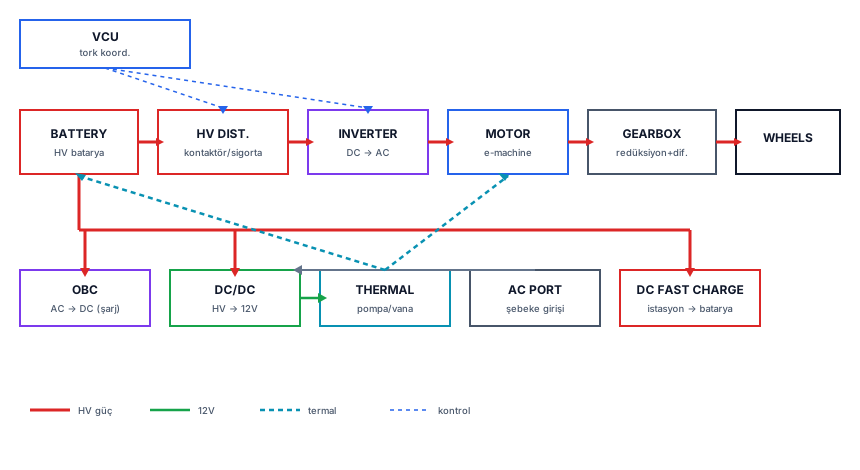
HV Battery → HV Distribution → Inverter → Electric Machine → Reduction (→ Differential) → Wheels- HV Battery — stores DC energy (chemical → electrical).
- HV Distribution (Junction Box) — safely switches the HV bus via contactors, the main fuse, pre-charge, and HVIL.
- Inverter — converts DC to variable-frequency AC and controls motor torque.
- Electric Machine — converts electrical energy to mechanical torque.
- Reduction + Differential — steps down high motor speed to wheel speed, multiplying torque.
FACT — The HV distribution box is the electrical “panel” between the battery and inverter. For deep detail on contactors and pre-charge see BMS Academy → BMS-06 and BMS-07.
3. Auxiliary Paths
Alongside the main power chain there are three important paths:
- 12V/48V path: HV bus → DC/DC → low-voltage system (lighting, ECUs, contactor coils).
- Charging paths: AC charging, grid → OBC → battery; DC fast charging, station → battery (OBC bypassed).
- Thermal path: the cooling/heating loop managing battery/motor/inverter temperature.
FACT — The VCU coordinates these paths: it turns the driver torque request into inverter commands and manages power using battery limits from the BMS. Communication is over vehicle networks such as CAN (detail: EV-15).
4. Architecture Variants
- Single motor (front or rear): simplicity and cost advantage; single-axle drive.
- Dual motor (AWD): front and rear axles driven by separate electric machines; power is distributed electrically instead of via a mechanical shaft.
- e-Axle: motor + inverter + reduction in one integrated unit; packaging and assembly advantages.
EXAMPLE — In a dual-motor vehicle there is no mechanical shaft between the axles; torque split is controlled in software. This differs from the centre differential + shaft logic of an ICE AWD.
5. Intermediate Technical Section: HV Distribution and Safety
HV distribution is not just “cable routing”; it includes safety switching:
- Contactors — relays that physically open/close the HV bus (normally open).
- Pre-charge — pre-charges DC-link capacitors through a resistor to avoid uncontrolled inrush.
- Main fuse / pyro fuse — interrupts the circuit on short-circuit or crash.
- HVIL — detects HV connector opening and moves the system to a safe state.
FACT — Each of these is one layer of battery safety; the detailed circuit and sequence are covered in the BMS Academy (BMS-06, BMS-07).
6. Advanced Preview
At advanced level the architecture expands into: 800V systems with lower current and thus lower I²R losses at the same power (EV-06, EV-12), the NVH/thermal impact of e-axle integration (EV-09, EV-42), zonal/central E/E architecture (EV-16, EV-23), and distributed control topologies (EV-15).
7. FAQ
Does an EV have a differential?
FACT — Yes, a differential is needed for wheel speed difference. In single-motor layouts it is integrated into the reduction gearbox; in dual-motor layouts torque split can also be done in software.
Why is there still a 12V battery?
FACT — The 12V system is needed to energize contactor coils and power ECUs and safety circuits while the HV contactors are open.
Is 800V really better?
INTERPRETATION — At the same power, higher voltage means lower current, reducing conduction (I²R) loss. But it must be weighed against insulation, safety, component cost, and EMI (EV-06, EV-12).
8. Safety Warning
FACT — High-voltage systems carry a lethal risk. This education is theoretical and engineering-oriented; HV work on a real vehicle is done only by qualified personnel with OEM procedures.
9. Summary
- Power chain: battery → HV distribution → inverter → motor → reduction → wheels.
- HV distribution performs safe switching via contactors, fuse, pre-charge, and HVIL.
- Auxiliary paths: DC/DC (12V), OBC (AC charging), DC fast charging, and the thermal loop.
- Architecture variants: single motor, dual motor (AWD), and e-axle.
- The VCU coordinates all paths; communication is over vehicle networks.
10. Sources and Verification Note
No model-specific hard technical data is used. The core architecture concepts are established textbook-level engineering knowledge.
- U.S. Department of Energy (DOE), AFDC — “How Do All-Electric Cars Work”.
- SAE J1715 — Hybrid and electric vehicle terminology.
ASSUMPTION — Source versions/titles may change; re-verify before publication.
Next Lesson
- EV-03 — EV Components: a component-by-component look at every major part.
Technical Diagrams
Quiz
While driving, in what order does power flow from the HV battery to the wheels?
The power path is: battery (DC) → inverter (DC→AC) → electric machine → reduction gearbox → wheels.
What is the role of the DC/DC converter?
The DC/DC converts HV bus energy to the low-voltage (12V/48V) system.
Which unit is active during AC (grid) charging?
During AC charging the OBC converts grid AC to battery DC.
During DC fast charging, what happens to the OBC?
In DC fast charging the station produces DC, so the OBC is bypassed and energy goes directly to the battery.
What does the HV distribution box (junction box) typically contain?
The HV distribution box holds switching/protection elements such as contactors, the main fuse, pre-charge, and HVIL (detail: BMS-06/07).
What is an e-axle?
An e-axle combines the electric machine, inverter, and reduction gearbox into a single compact unit.
What is the key advantage of an 800V-class architecture over 400V at the same power?
Since P = V × I, at the same power a higher voltage means lower current; conduction loss is I²R, so losses drop.
Why does an EV still carry a 12V battery?
When the HV contactors are open, the 12V system energizes contactor coils and powers ECUs and safety circuits.