
- Explain why highways are the preferred first ODD (Operational Design Domain) for raising the automation level, in terms of structural environmental features.
- Explain the hardware, monitoring, and legal-liability differences between traditional hands-on L2 and advanced hands-free L2+ systems.
- Defend, on engineering grounds, why systems marketed as 'hands-free' such as GM Super Cruise and Ford BlueCruise are still SAE Level 2.
- Analyze the technical trade-offs between steering-wheel touch sensing approaches (capacitive vs. torque sensing).
- Understand the legal requirements and take-over (TOR) dynamics of the UNECE R157 ALKS (Automated Lane Keeping System) Level 3 highway pilot.
- Distinguish the hallmark features of a mature highway pilot — automated lane-to-lane transitions, ramp entry/exit, and geofencing — from one another.
AD-13 — Highway Assist and Highway Pilot Systems
FACT — The most advanced consumer-facing automation feature a manufacturer brings to market almost always debuts on the highway first — not at an urban intersection. This is not a marketing choice; it is pure engineering. The highway is the Operational Design Domain (ODD) (see AD-16 — Operational Design Domain (ODD): Definition, Taxonomy and Boundaries) where the jump from Level 2 to Level 3 is easiest to make.
In this lesson we examine the hardware/software evolution of highway automation, the “hands-free but still Level 2” paradox, and the engineering behind the world’s only genuine consumer Level 3 certification:
- Why Is the Highway the Easiest ODD?
- The Automation Spectrum: Hands-On L2 → Hands-Free L2+ → Eyes-Off L3
- Driver Monitoring and the “Hands-Free” Paradox: Why Super Cruise/BlueCruise Are Still L2
- Steering-Wheel Sensing: Torque Sensor vs. Capacitive Matrix
- Hallmarks of a Mature Highway Pilot: Lane Changing, Ramp Transitions, Geofencing
- UNECE R157 ALKS: The World’s Only Level 3 Regulation
- Mercedes-Benz Drive Pilot: Genuine Level 3 Within a Narrow ODD
1. Why Is the Highway the Easiest ODD?
In AD-16 we defined the ODD concept along axes such as road geometry, traffic complexity, weather conditions, and speed range. The highway simplifies the algorithm designer’s job along nearly every one of these axes:
| Feature | Urban Intersection | Highway |
|---|---|---|
| Pedestrian/cyclist crossing | Present, frequent, unpredictable | Physically absent (fenced off) |
| Oncoming traffic | Same plane, crossing paths | Separated by a physical median |
| Lane-marking quality | Variable, sometimes absent | Standardized, high-contrast |
| Road geometry | Intersections, roundabouts, narrow streets | Predictable curvature radius |
| Relative speed differential | High (stationary vehicle + 50 km/h) | Low (all traffic same direction, similar speed) |
| Traffic-sign diversity | High (lights, signs, police) | Low (fixed speed limit, signage) |
INTERPRETATION — This table is not a claim that “highways are easy” — it is a relative engineering risk-budget comparison. Highways still contain long-tail scenarios: construction zones, vehicles cutting across lanes abruptly, tire blowouts. But the size of the event space is far narrower than at an urban intersection. A low-variable, structured problem reaches algorithmic saturation much sooner.
That is why, on nearly every manufacturer roadmap, “highway pilot” or “traffic jam pilot” features enter production years before urban autonomous driving does. Limited variability lowers the validation burden on both the perception and planning layers — the same engineering budget reaches a higher SAE level faster.
2. The Automation Spectrum: Hands-On L2 → Hands-Free L2+ → Eyes-Off L3
As highway automation matures, it advances through three distinct layers, and each layer adds a new engineering requirement on top of the one before it.
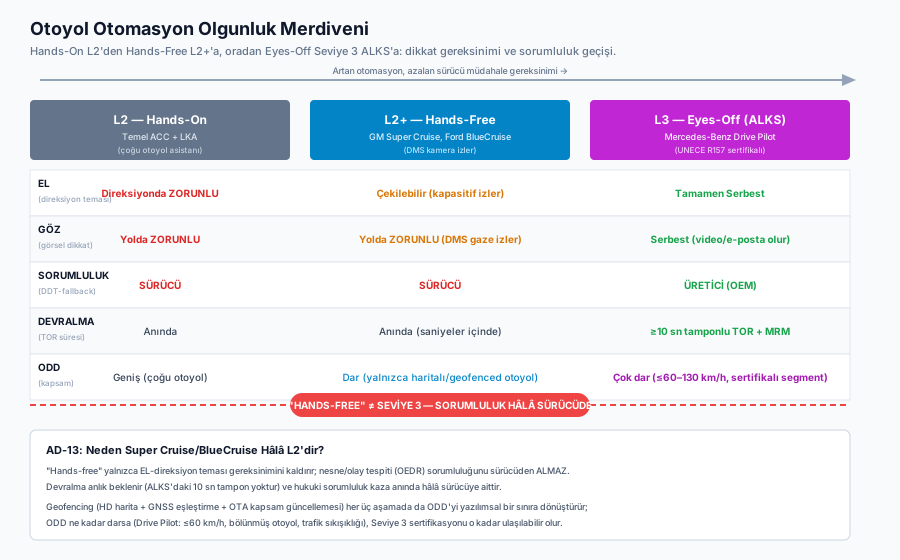
Highway Automation Maturity Ladder:

  Level 2 (Hands-On)          Level 2+ (Hands-Free)        Level 3 (Eyes-Off, ALKS)
  ──────────────────          ───────────────────          ─────────────────────────
  ACC + LKA concurrently       ACC + LKA + DMS camera        Full DDT on the system
  Hands on wheel MANDATORY     Hands MAY leave the wheel     Eyes may leave the road
  Eyes on road MANDATORY       Eyes on road MANDATORY (DMS)  (video, email permitted)
  Liability: DRIVER            Liability: DRIVER             Liability: MANUFACTURER (OEM)
  Take-over: immediate         Take-over: immediate          Take-over: TOR + ≥10 s buffer
  ODD: wide (most highways)    ODD: narrow (mapped highway)  ODD: very narrow (≤60-130 km/h,
specific highway segments)- Hands-On Level 2 (Basic Highway Assist): Adaptive Cruise Control (ACC) and Lane Keeping Assist (LKA/LCA) run concurrently. The driver’s hands must remain on the wheel; the system only assists, and full liability rests with the driver.
- Hands-Free Level 2+ (Advanced Highway Assist): The driver may take their hands off the wheel, but an in-cabin camera-based Driver Monitoring System (DMS, see AD-18) continuously verifies that the driver’s eyes remain on the road. Legal liability still rests with the human.
- Level 3 Highway Pilot (ALKS): The system takes over the entire Dynamic Driving Task (DDT); under defined conditions the driver may fully divert their visual attention from the road (watching video on the screen, for instance). Legal liability shifts to the manufacturer (OEM) while the system is engaged.
3. Driver Monitoring and the “Hands-Free” Paradox: Why Super Cruise/BlueCruise Are Still L2
Manufacturer Claim — GM’s Super Cruise and Ford’s BlueCruise marketing materials describe the system as “hands-free driving,” language that often leaves consumers with the impression that “the car drives itself.”
CRITICAL — Engineering Reality — Both Super Cruise and BlueCruise are Level 2 under the SAE J3016 taxonomy, NOT Level 3. “Hands-free” only removes the hand-on-wheel contact requirement; it does NOT transfer the Dynamic Driving Task’s object-and-event detection responsibility (OEDR) away from the driver. The distinction:
- Hands: NOT required to stay on the wheel.
- Eyes: MUST stay on the road — an in-cabin infrared camera (DMS) continuously tracks gaze direction and eyelid state.
- Mind: The driver must be ready to take over instantly, at any moment — the system hands control back to the driver within seconds of an uncertain situation; there is no 10-second buffered TOR as in ALKS.
- Legal liability: Still belongs to the driver in the event of a crash; the manufacturer does not assume it.
This distinction sits at the exact heart of SAE J3016’s “Level 2 vs. Level 3” boundary: at Level 2 the system assists the driver, but object/event detection and the decision to intervene ultimately remain under human supervision (the driver is always the source of DDT fallback). At Level 3, the system also takes on DDT fallback within the defined ODD; the driver only re-engages when the system issues a TOR.
This is why DMS integration is the safety backbone of hands-free L2+ systems: the physical feedback signal lost when the hands are freed (steering torque) is compensated for by the camera’s gaze-tracking data. If the driver looks away from the road for a few seconds, the system issues an audible/visual warning; if the driver persists, the vehicle slows and initiates an emergency call. In other words, going hands-free does NOT mean being inattentive — it requires that attention remain verifiable without mechanical hand contact.
ASSUMPTION — Because the exact current extent of the highway network supported by Super Cruise and BlueCruise (mapped kilometers) is continually expanding and depends on manufacturer release notes, this lesson does not cite a precise figure; readers should verify current coverage via the manufacturer’s official documentation/map tool.
4. Steering-Wheel Sensing: Torque Sensor vs. Capacitive Matrix
In hands-on L2 systems, the question “is the driver holding the wheel?” is answered by two different hardware approaches:
- Torque-Sensor Steering (Traditional): A torque sensor on the steering column measures the light resistive moment the driver applies to the wheel. The problem: on a straight, smooth highway, since LKA already centers the lane, the driver may be holding the wheel yet apply no corrective torque at all — the sensor mistakes this for “no hands” and produces a nuisance nag. This is a classic false-negative source that degrades the user experience.
- Capacitive Steering Wheel (Modern Standard): A capacitive sensor matrix embedded just beneath the wheel’s leather surface detects the tiny capacitance shift produced when human skin/fingers make contact — it can confirm even a light fingertip touch, with no torque applied at all. This detects human contact directly through physical touch, independent of electrical feedback.
| Criterion | Torque Sensor | Capacitive Matrix |
|---|---|---|
| False negative (“no hands” warning on a straight road) | Frequent | Rare |
| Detecting a light touch | Weak | Strong |
| Glove/wet-hand tolerance | Unaffected | Reduced on some types |
| Added cost | Low | Moderate |
| Role in hands-free systems | Backup/supplementary | Usually primary verification |
FACT — In hands-free L2+ systems, hand detection isn’t disabled entirely; when the driver places a hand on the wheel, the system still detects it and can cross-verify against the DMS. However, the primary attention signal is now the DMS camera, not wheel contact.
5. Hallmarks of a Mature Highway Pilot
Three engineering features distinguish a “mature” highway pilot system from a basic ACC+LKA combination:
A. Automated Lane Change
This splits into two subcategories:
- Driver-Confirmed Lane Change: The driver taps the turn-signal stalk; the system confirms the adjacent/rear lane is clear via side/rear radar and camera, then executes the maneuver automatically.
- Fully Automatic Tactical Lane Change (for route-following): To follow the navigation route (e.g., to exit at an upcoming interchange), the system changes lanes on its own without driver confirmation. This requires a higher level of autonomy, because the system decides “whether it’s needed,” not just “when.”
B. Ramp Entry/Exit Management
Accelerating to merge from an on-ramp and decelerating when leaving via an off-ramp are two critical transition scenarios that extend the scope of the main-highway pilot. This is a signal that the system has moved beyond “stay in the lane” to “manage the overall arc of the journey.”
C. Geofencing: The Hardware/Software Enforcement of the ODD
FACT — Hands-free L2+ and L3 systems do not operate on “any highway” — only on pre-mapped, qualified highway segments. This is called geofencing, and it is the concrete example of how an ODD gets enforced in practice.
Geofencing rests on three components:
- High-Definition Map (HD Map): The road segments where the system may operate have been pre-driven and mapped; the presence of a median/barrier, lane count, and ramp geometry have all been verified.
- GNSS + Map Matching: The vehicle continuously compares its location against qualified segments on the HD map; if the vehicle exits a qualified segment (e.g., onto an undivided road without a barrier), the system automatically disengages or requests a take-over.
- Dynamic Coverage Updates: As the manufacturer validates new road segments, coverage expands via over-the-air (OTA) updates — so the same vehicle may work on a highway today that it couldn’t a year ago.
Without geofencing, a system would effectively be claiming to be a general-purpose driving system rather than a “highway pilot” — a claim that carries a far heavier burden for both safety validation and regulation. Geofencing turns the ODD into a software wall, narrowing and making verifiable the manufacturer’s commitment.
6. UNECE R157 ALKS: The World’s Only Level 3 Regulation
FACT — For a vehicle to earn a Level 3 ALKS (Automated Lane Keeping System) certification, it must satisfy the strict requirements of UNECE Regulation No. 157:
- Operation restricted to highways divided by a physical median, free of pedestrians and cyclists (roads reserved for motor-vehicle traffic).
- Speed limit: 60 km/h in the initial certification revision (traffic-jam pilot scenario); expanded to up to 130 km/h in subsequent revisions.
- A mandatory active in-cabin DMS camera that monitors whether the driver is asleep or out of the seat.
- When the system reaches its own limit (exiting the ODD, sensor failure, map/GNSS loss, etc.), the driver must be given a minimum 10-second take-over window (Take-Over Request, TOR).
- If the take-over does not occur, the system must autonomously execute a Minimal Risk Maneuver (MRM), guiding the vehicle to a safe lane/shoulder and bringing it to a stop (for the full treatment of this concept, see AD-17 — Fallback Strategies, MRM and Minimal Risk Conditions (MRC)).
R157 is nearly the only international regulation in the world defining Level 3 for a consumer automobile (Japan and Germany were early adopters, followed by broader adoption across UNECE member states). In the US, differences in state-by-state regulation mean global Level 3 rollout remains fragmented.
7. Mercedes-Benz Drive Pilot: Genuine Level 3 Within a Narrow ODD
Mercedes-Benz Drive Pilot is the reference consumer Level 3 system carrying R157 ALKS certification. The critical point is that this system does not operate “autonomously everywhere” — it operates within an extremely narrow ODD:
- Only on mapped, divided highways.
- In the initial certification, only under heavy traffic/traffic-jam conditions, at speeds ≤60 km/h.
- In daylight or adequate visibility conditions (weather/light constraints are part of the ODD).
- The driver must be in the seat and ready to take over (must not be asleep) — the system monitors the cabin.
This narrow ODD is an even further-narrowed subset of the “the highway is the easiest ODD” principle discussed in Section 1: the low-speed traffic-jam scenario drives the relative speed differential to nearly zero and shrinks the event space even further. This is concrete proof that Level 3 does not mean “eyes-off on the highway at all times, at any speed” — certification comes easier the narrower the ODD.
EXAMPLE — With Drive Pilot engaged in a traffic jam, a driver can text on their phone (the system supports this). But when the same vehicle is cruising in free-flowing traffic at 100 km/h, this feature cannot be used — the system automatically reverts to Level 2 hands-free mode and once again requires the driver’s eyes on the road.
Frequently Asked Questions
Q1: Why aren’t Super Cruise/BlueCruise marketed as Level 3, calling them “hands-free L2” instead? Because under SAE J3016, DDT-fallback responsibility (intervening at a moment of uncertainty/failure) still rests with the driver, and take-over is expected instantaneously — none of the elements that define L3 (a TOR buffer, a wide ODD, legal liability shifting to the OEM) are present. “Hands-free” only removes hand contact, not liability.
Q2: Can a single vehicle operate in both hands-free L2+ and L3 mode? Yes — for example, a Drive-Pilot-equipped Mercedes shifts to L3 once ODD conditions (speed, traffic density, map coverage) are met, and automatically drops back to L2 hands-free mode when conditions deteriorate. The mode transition is clearly communicated to the driver.
Q3: What would happen if geofencing were removed (i.e., the system claimed to “work anywhere”)? As the ODD approaches infinity, the validation burden grows combinatorially; the manufacturer would in theory have to prove out every road geometry, marking quality, and traffic pattern it could conceivably encounter. That’s why geofencing is a practical engineering constraint that keeps safety validation manageable.
Summary
- Because the highway is structurally the lowest-variability ODD, it is the environment where manufacturers first roll out their most advanced consumer automation feature.
- Automation matures across three layers: Hands-on L2 → Hands-free L2+ (eyes-on) → Eyes-off L3 (ALKS).
- GM Super Cruise and Ford BlueCruise are marketed as “hands-free” but are SAE Level 2; a DMS camera continuously tracks the eyes, and liability stays with the driver.
- Capacitive steering-wheel matrices provide far more reliable hand detection than traditional torque sensors and serve as a complementary signal in hands-free systems.
- A mature highway pilot includes automated lane changing, ramp entry/exit management, and geofencing — geofencing turns the ODD into a software-enforced boundary.
- UNECE R157 ALKS is the principal regulation defining consumer Level 3 worldwide; it includes a 10-second TOR buffer and mandates an MRM.
- Mercedes-Benz Drive Pilot is the real-world R157-certified Level 3 example — but it operates within a narrow ODD (low speed, traffic-jam conditions, divided highway).
Sources and Verification Note
- ISO 26262 (Functional Safety — Road Vehicles)
- ISO 21448 (SOTIF — Safety of the Intended Functionality)
- SAE J3016:2021 (Taxonomy and Definitions for Terms Related to Driving Automation Systems)
- UNECE Regulation No. 157 (ALKS)
- UNECE Regulation No. 79 (Steering Equipment)
- Mercedes-Benz Drive Pilot Technical Documentation
ASSUMPTION — Because the mapped-highway coverage supported by GM Super Cruise and Ford BlueCruise, and the country/state-level certification scope of Mercedes Drive Pilot, are both updated frequently, this lesson relies on architectural/regulatory principles rather than exact figures; readers should consult official manufacturer sources for current coverage.
Next Lesson
- AD-14 — Automated Parking Systems: From APA to Autonomous Valet Parking (AVP): The automation ladder from ultrasonic-sensor-based park assist to infrastructure-assisted, fully autonomous valet parking (AVP).
Technical Diagrams
Quiz
Where must a driver look while operating a Hands-Free Level 2+ highway assist system?
Hands-free L2+ requires continuous visual supervision of the roadway.
What is the primary technical advantage of capacitive steering wheels over torque sensors?
Capacitive touch sensing eliminates the need to jiggle the steering wheel on straight roads.
Who retains legal liability during an incident when a certified UNECE R157 Level 3 system is active in its ODD?
Under certified Level 3 operation, operational driving liability transfers to the OEM.
What is the minimum transition buffer granted to the driver during an ALKS Take-Over Request?
Regulations mandate an ~10 second transition window before automated fail-safe stops.
What action does an ALKS Level 3 vehicle execute if the driver fails to respond to a 10-second TOR?
The system autonomously executes an MRM to achieve a Minimal Risk Condition (MRC).
Glossary
| English Term | Definition |
|---|---|
| SAE J3016 | The international taxonomy standard that categorizes driving automation levels from L0 (no automation) to L5 (full automation) based on system vs driver roles. |
| Driver Monitoring System (DMS) | An in-cabin safety system using infrared cameras and computer vision to monitor driver head pose, eye gaze, eyelid closure, and distraction to ensure readiness. |