
- Position Automated Parking Assist (APA), Remote Parking Assist (RPA), Summon, and Autonomous Valet Parking (AVP) within the SAE automation spectrum.
- Explain how parking-slot geometry detection works using 12 ultrasonic sensors and 360° Surround View Cameras (AVM).
- Analyze tight-space trajectory generation using Reeds-Shepp and Dubins curves.
- Compare Type 1 (vehicle-centric) and Type 2 (infrastructure-assisted) Autonomous Valet Parking (AVP) architectures under the ISO 23374 standard.
- Understand why enclosed parking structures are GPS-denied environments, and how that drives the preference for infrastructure-assisted automation.
- Explain, on engineering grounds, why parking is favored as a low-risk 'automation sandbox' by manufacturers.
AD-14 — Automated Parking Systems: From APA to Autonomous Valet Parking (AVP)
FACT — Parking is one of the lowest-speed (typically < 10 km/h) yet highest-precision driving tasks a vehicle faces — centimeter-level tolerances, tight spaces, forward-and-reverse maneuvering. That’s exactly why parking automation is one of the earliest and most widely deployed commercial applications of autonomous driving technology: low speed means a small risk budget, but the demand for geometric precision is high — this combination lets manufacturers test higher automation levels at low risk.
In this lesson we examine the maturity ladder of parking automation from APA all the way to fully autonomous valet parking (AVP), the hardware/algorithmic requirements at each rung of that ladder, and why infrastructure-assisted automation is a purpose-built engineering answer for enclosed parking structures:
- The Parking Automation Maturity Ladder: APA → RPA → Summon → AVP
- APA (Automated Parking Assist): Ultrasonic-Based Slot Detection and Automated Steering
- RPA (Remote Parking Assist): Control From Outside the Vehicle
- Summon / Smart Summon: L4-Like Autonomy Within a Constrained ODD
- Sensor Suite: 12x Ultrasonic Sensors + 360° Surround View (AVM)
- Tight-Space Trajectory Planning: Reeds-Shepp and Dubins Curves
- AVP (Autonomous Valet Parking): Infrastructure-Assisted Automation and ISO 23374
- Why Is Parking a Good “Automation Sandbox”?
1. The Parking Automation Maturity Ladder: APA → RPA → Summon → AVP
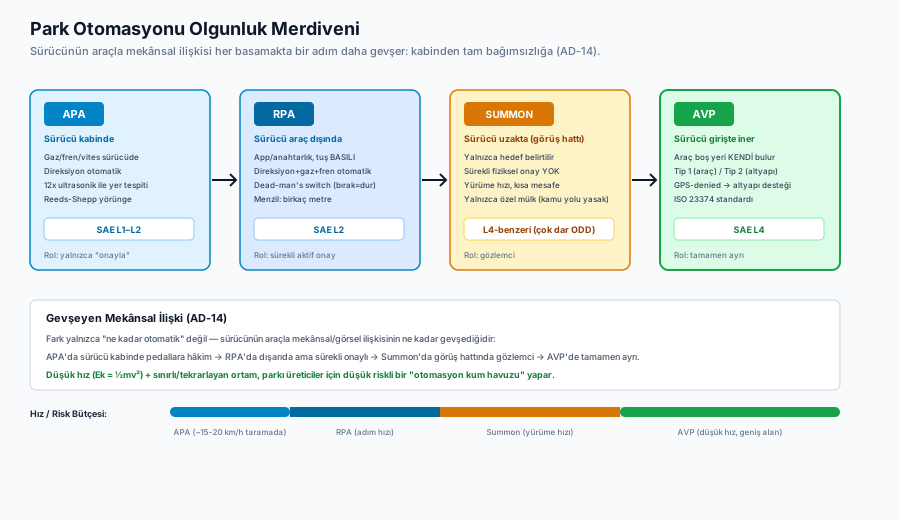
Just as with highway automation (AD-13), parking automation matures through a stepped ladder — each rung layers a new capability on top of the one before it, progressively loosening the driver’s physical/spatial relationship with the vehicle.
Parking Automation Maturity Ladder:

  APA                     RPA                     Summon                   AVP
  ───                     ───                     ───────                  ───
  Driver in cabin          Driver outside           Driver away from         Driver exits
  Throttle/brake/gear      vehicle                  vehicle (line-of-        at the drop-off
  under driver control     Holds a key/app          sight/nearby)            point
  Steering automated       button continuously       Vehicle covers a         Vehicle parks
  SAE: L1-L2               Steering+throttle+        short distance on        FULLY on its own
                            brake automated          its own                  and is recalled
                            SAE: L2                  SAE: L4-like             SAE: L4
(very narrow ODD) (ISO 23374)- APA (Automated Parking Assist): The driver remains in the vehicle and controls the throttle/brake/gear; the system manages only steering (some advanced implementations also handle throttle/brake). Depending on the implementation, this can be SAE Level 1 (steering alone is automated) or Level 2 (steering + speed control are automated concurrently).
- RPA (Remote Parking Assist): The driver stands outside the vehicle and, by holding down a button on a smartphone app or key fob, has the vehicle enter/exit a tight garage or cramped space. Steering, throttle, and braking are fully automated; the driver’s role is limited to continuously confirming “proceed” — releasing the button stops the vehicle instantly (a form of dead-man’s switch).
- Summon / Smart Summon: The vehicle covers a short distance on its own to reach the driver (e.g., meeting them at the door in the rain). This is an L4-like capability within a very narrow ODD (private property, low speed, limited distance, generally within line-of-sight) — the driver is not inside the vehicle and the entire DDT rests with the system, but the ODD is so narrow and the speed so low (walking pace) that the risk budget stays minimal.
- AVP (Automated Valet Parking): The driver exits at the parking structure’s drop-off point. The vehicle finds any available space within a multi-story parking structure entirely on its own, parks itself, and returns when summoned — genuinely Level 4, as defined under the ISO 23374 standard.
INTERPRETATION — The distinction across these four rungs isn’t just “how automated,” but “how much does the driver’s spatial/visual relationship to the vehicle loosen.” In APA the driver is still in the cabin and controls the pedals; in RPA the driver is outside but within line of sight and continuously confirming; in Summon line-of-sight relaxes but distance/speed stay tightly constrained; in AVP the driver separates entirely, and the responsibility of finding “any” available space shifts fully to the system.
2. APA (Automated Parking Assist): Ultrasonic-Based Slot Detection and Automated Steering
APA’s perception backbone is the ultrasonic sensor covered in AD-04. Because ultrasonic sensors provide high-precision short-range distance measurement (~0.1–5 m), they are more cost-effective and reliable than camera or radar for low-speed, close-proximity tasks like parking-slot geometry.
The slot-detection algorithm works as follows:
- As the vehicle slowly (~15-20 km/h) passes parked cars, the side ultrasonic sensors continuously scan distance.
- The width and depth of the gap between two adjacent vehicles is extracted from a series of distance readings as a “gap profile.”
- If the gap exceeds the geometric threshold the vehicle needs to park (typically the vehicle’s own length plus a ~0.7-1 m safety margin), the system notifies the driver that a suitable slot has been found.
- Once the driver confirms (or, for RPA, holds down the button), the system automatically manages steering along a precomputed trajectory (see Section 6); the driver only controls throttle/brake/gear (in APA’s base form).
FACT — APA’s SAE level depends on the implementation: classic APA, which automates steering alone and leaves throttle/brake to the driver, is Level 1 (a single automated function — steering). Advanced APA implementations that also automate throttle/brake are Level 2 (multiple concurrent automated functions). This is a concrete example of the principle from AD-02: “the SAE level isn’t about how many functions are automated, but which functions are.”
3. RPA (Remote Parking Assist): Control From Outside the Vehicle
RPA adds one more layer on top of APA: the driver can step outside the vehicle. The typical use case is entering a very tight garage or a space where two vehicles are parked so close together that there’s no room to open the doors, so the driver can’t stay inside.
- The driver must continuously hold down a button on a smartphone app or key fob — this acts as a dead-man’s switch. If the finger is released, or if the wireless connection (Bluetooth/Wi-Fi) drops, the vehicle stops instantly.
- The system continuously scans for obstacles using the vehicle’s surrounding ultrasonic/camera data (especially at angles the driver can’t see, such as pedestrians or pets), and automatically stops if anything unexpected is detected.
- Range is typically limited to a few meters (varies by manufacturer/model) — this is the core distinction from Summon: RPA is a short, direct maneuver (into/out of a garage), whereas Summon can cover a longer walking distance toward the driver.
CRITICAL — RPA is still SAE Level 2, not Level 4: even though the driver is outside the vehicle, they must provide “active supervision” by continuously holding the button, and DDT-fallback responsibility still rests with the human (releasing the button = an instant stop command). The driver NOT being inside the vehicle does not automatically raise the automation level — what determines the level is the structure of supervision and intervention.
4. Summon / Smart Summon: L4-Like Autonomy Within a Constrained ODD
Summon (called “Smart Summon” by some manufacturers) is the vehicle covering a short distance on its own to reach the driver — the driver no longer holds down a button continuously; they simply specify a destination (their own location, or a parking slot) and observe the vehicle.
This is qualitatively different from the previous two rungs: the entire DDT (perception, planning, control) rests with the system, and the human does not provide a continuous active-supervision signal. By definition this approaches L4 — but the ODD is kept so narrow that the risk budget stays low:
- Space: Private property only (parking lot, area around a personal garage) — public roads are off-limits.
- Speed: Limited to walking pace (typically a few km/h).
- Distance: Short (typically a few dozen meters).
- Supervision: The driver is generally required to keep the vehicle within line of sight and maintain a continuous “live” connection via a mobile app; the vehicle stops if the connection drops.
EXAMPLE — A driver exits a supermarket in the rain with a shopping cart and taps “summon my car” on the app. The vehicle leaves its parking slot, stops at crosswalks within the lot, detects and reacts to obstacles (pedestrians walking by, other shopping carts) by stopping or proceeding, and comes to a stop in front of the driver. Throughout this process, the driver monitors the vehicle on the app screen and can remotely stop it if needed.
ASSUMPTION — Because the exact countries/states where Summon/Smart Summon is active, and its legal boundaries in scenarios outside private property (e.g., a private road adjoining a parking lot exit), vary by manufacturer and region, this lesson relies on general architectural principles rather than an exact coverage list.
5. Sensor Suite: 12x Ultrasonic Sensors + 360° Surround View (AVM)
The hardware backbone of parking automation is the fusion of the two sensor types introduced in AD-04:
- 12 Ultrasonic Sensors (USS): 6 in the front bumper, 6 in the rear. Corner sensors (short-range, ~0.1-2.5 m) precisely measure very close obstacles (curbs, poles, other vehicles); mid sensors (~0.3-5 m) scan farther objects and the general geometry of parking bays.
- Around View Monitoring (AVM — 4 Fisheye Cameras): Fisheye cameras mounted under the front grille, rear bumper/tailgate, and both side mirrors, each with a field of view of roughly ~190°. The four camera feeds are combined via a homography transform (an image-processing technique that projects each camera’s optical axis onto the ground plane and stitches the results together) to produce a single “bird’s-eye” top-down view simulating a view from directly above the vehicle.
| Sensor | Range | Primary Role |
|---|---|---|
| Corner USS (4x) | ~0.1-2.5 m | Very close obstacle detection (curbs, poles) |
| Mid USS (8x) | ~0.3-5 m | Parking-bay width/depth profile |
| AVM Camera (4x) | Visual, ~190° FOV | Ground markings, pedestrian, barrier recognition |
FACT — Ultrasonic sensors excel at distance measurement but cannot distinguish what an object is (a curb vs. a child — they only report “something is there”). AVM cameras, on the other hand, can visually recognize painted parking lines, wheel stops, and marked accessible/EV parking spaces on the ground. This fusion simultaneously provides geometric precision (ultrasonic) and semantic meaning (camera).
6. Tight-Space Trajectory Planning: Reeds-Shepp and Dubins Curves
On the highway a vehicle almost never operates in reverse; parallel or perpendicular parking, however, requires sequences of forward-and-reverse maneuvers. That’s why the trajectory-planning layer uses a different mathematical toolset than the classic curves that assume unidirectional motion.
- Dubins Curves: Compute the shortest path between two configurations (position + heading) for a vehicle that moves only forward and has a fixed minimum turning radius (), as a combination of straight-line segments and constant-radius arcs.
- Reeds-Shepp Curves: A generalization of Dubins that assumes the vehicle can move both forward and backward. Since nearly all parking maneuvers (parallel parking in particular) require switching between forward and reverse gear, real-world parking planners use the Reeds-Shepp family.
The planning process can be summarized in three steps:
- The geometry of the empty parking bay and the location of neighboring obstacles are extracted from sensor data (Section 5).
- From the vehicle’s current configuration (x, y, heading angle) to the target parking configuration, the shortest Reeds-Shepp path — made up of forward/reverse segments that respect the minimum-turning-radius constraint — is computed.
- This path is converted into steering-angle and gear commands (including forward/reverse transition points) and sent to the low-level controller (actuators); if sensors detect an obstacle along the way, the trajectory is replanned instantly.
INTERPRETATION — Reeds-Shepp trajectories don’t compute the “shortest path” in the abstract — they compute the shortest path that respects the vehicle’s kinematic constraints (minimum turning radius, the cost of switching between forward and reverse). This distinction matters: the mathematically shortest path would usually be a curve the vehicle physically cannot follow; Reeds-Shepp embeds this constraint directly into the optimization problem.
7. AVP (Autonomous Valet Parking): Infrastructure-Assisted Automation and ISO 23374
AVP is the summit of parking automation: the driver exits at the parking structure’s drop-off point, and the vehicle finds any available space anywhere within an enclosed multi-story parking structure entirely on its own, parks itself, and returns when summoned via a mobile app. The ISO 23374 standard defines the safety and functional requirements for this scenario.
AVP can be implemented under two different architectural philosophies:
Type 1 — Vehicle-Centric
The vehicle maps the parking structure in real time using its own LiDAR/camera/ultrasonic sensors (SLAM-like techniques), detects available spaces with its own perception stack, and moves independently. This is consistent with the “vehicle-autonomy” philosophy we’ve seen throughout the rest of the AD stack (since AD-02) — it doesn’t depend on the parking structure’s infrastructure.
Type 2 — Infrastructure-Centric
Fixed cameras/beacons mounted on the parking structure’s ceiling, along with a central server, continuously monitor the entire facility; they detect empty spaces and send route commands to vehicles wirelessly (5G/V2X). In this mode the vehicle largely operates as an actuation slave — its own perception stack stays engaged only for last-instant safety functions like emergency braking/collision avoidance.
CRITICAL — Why Is Infrastructure Support Needed? — Enclosed multi-story parking structures systematically deviate from the operating conditions the rest of the AD stack assumes:
- GPS-Denied Environment: GNSS signal is almost entirely blocked between concrete floors; the vehicle cannot determine its own location via GPS.
- Low-Visibility Conditions: There is no natural light at night or on basement levels; camera-based perception reliability drops.
- Repetitive/Ambiguous Geometry: Nearly every floor looks the same (identical columns, identical lines), creating an aliasing risk for SLAM that relies on vehicle sensors alone.
These three factors make the parking structure an environment where the vehicle-autonomy philosophy weakens — which is why ISO 23374’s Type 2 architecture allows smart parking-lot infrastructure (fixed cameras, positioning beacons) to share responsibility with the vehicle. This is a deliberate departure from the “the vehicle carries all sensing on board” philosophy seen elsewhere in the AD stack (highway, urban driving).
FACT — In practice, most manufacturers adopt a hybrid of Type 1 and Type 2: the vehicle always independently provides core safety (emergency braking, obstacle detection) via its own sensors, but leverages infrastructure data where available for tasks like localization and slot allocation — and if infrastructure is unavailable, the vehicle can keep operating on its own (falling back to Type 1 mode).
8. Why Is Parking a Good “Automation Sandbox”?
FACT — Parking automation can be deployed early even by manufacturers not yet ready for Level 4 on public roads — because parking offers an engineering “sandbox”:
- Low Kinetic Energy = Low Risk: By the relation , kinetic energy falls with the square of speed. A collision at 5 km/h is incomparably milder than one at 100 km/h — which keeps the validation burden for the same level of autonomy far lower than on the highway.
- Bounded Environment: A parking structure is even more structured and enclosed than a highway — fixed entry/exit points, predictable traffic flow (mostly pedestrians and low-speed vehicles), and largely isolated from external weather conditions (rain, snow, direct sun glare).
- Repetitive Scenario Space: Once mapped, a parking structure stays nearly the same day after day (the only dynamic elements are vehicles/pedestrians) — much like the geofencing logic on the highway (see AD-13, Section 5.C), this makes it easier to reach algorithmic saturation within a narrow ODD.
That’s why AVP is positioned by many manufacturers and technology companies as the first real-world domain where they’ll commercially prove out L4 — before moving to L4 on public roads, it lets them validate end-to-end fully autonomous operation (perception, planning, control, fleet management) in a controlled, low-risk environment. Many of the redundancy principles in the robotaxi architecture we’ll cover in AD-15 are also conceptually exercised during AVP development — though a robotaxi operates on public roads, so its risk budget is far wider.
Frequently Asked Questions
Q1: Is Summon the same thing as a full Level 4 robotaxi? No. Both execute the entire DDT without human supervision, but Summon’s ODD (private property, walking speed, a few dozen meters) is incomparably narrower than a robotaxi’s (public roads, traffic speed, routes spanning kilometers). Summon is an “L4-like” capability; formal L4 certification is typically sought for broader-scope systems like AVP and robotaxis.
Q2: In AVP, can the vehicle rely solely on infrastructure without its own sensors? Generally no — even in ISO 23374-compliant systems, the vehicle must independently provide last-instant safety functions like emergency braking and collision avoidance using its own sensors. Infrastructure eases localization and slot allocation, but it does not fully take over final safety responsibility.
Q3: What’s the core difference between RPA and Summon? In RPA the driver provides continuous active confirmation by holding down a button (releasing it stops the vehicle); in Summon the driver only specifies a destination and observes the vehicle, with no continuous physical confirmation signal required. This means Summon shifts more DDT responsibility to the system than RPA does.
Summary
- Parking automation matures through a stepped ladder: APA → RPA → Summon → AVP; each rung further loosens the driver’s spatial/visual relationship with the vehicle.
- APA uses ultrasonic sensors to detect parking-slot geometry and is SAE Level 1 or 2 depending on implementation; RPA moves the driver outside the vehicle but requires continuous confirmation (a dead-man’s switch).
- Summon provides L4-like autonomy within a very narrow ODD (private property, walking speed, short distance).
- 12 ultrasonic sensors and 4 fisheye AVM cameras form the core sensor suite, jointly providing geometric precision (ultrasonic) and semantic meaning (camera).
- Reeds-Shepp curves compute the shortest trajectory that respects kinematic constraints in tight-space maneuvers where the vehicle switches between forward and reverse.
- AVP (ISO 23374) can be implemented as Type 1 (vehicle-centric) or Type 2 (infrastructure-assisted); the GPS-denied, low-visibility nature of enclosed parking structures makes infrastructure support a practical necessity.
- Parking offers manufacturers a low-risk “automation sandbox” thanks to low kinetic energy and a bounded, repetitive environment — serving as a proving ground before moving to L4 on public roads.
Sources and Verification Note
- ISO 26262 (Functional Safety — Road Vehicles)
- ISO 21448 (SOTIF — Safety of the Intended Functionality)
- SAE J3016:2021 (Taxonomy and Definitions for Terms Related to Driving Automation Systems)
- ISO 23374 (Intelligent Transport Systems — Automated Valet Parking Systems)
- Bosch Automated Valet Parking Technical Overview Documentation
ASSUMPTION — Because the country/region-level legal scope of Summon/Smart Summon and AVP features, and which parking structures are equipped with Type 2 infrastructure, change frequently, this lesson relies on architectural principles rather than exact deployment figures; readers should consult official manufacturer and parking-operator sources for current coverage.
Next Lesson
- AD-15 — Robotaxi Architecture: Hardware Redundancy and Fleet Operations: Why every safety-critical subsystem (sensing, compute, actuation, power) must be architected with redundancy in Level 4 robotaxis that have no human fallback, and the real-world engineering of fleet operations (teleoperation, dispatch, maintenance).
Technical Diagrams
Quiz
What is the term for Level 4 driverless valet parking where passengers alight at garage entry?
AVP designates driverless low-speed automated maneuvering within dedicated parking facilities.
Which optical camera setup synthesizes the top-down 360-degree orthographic parking view?
Four wide-angle fisheye cameras generate a stitched 360-degree top-down view around the perimeter.
Which mathematical curve family optimizes bidirectional (forward/reverse) tight-space parking trajectories?
Reeds-Shepp curves solve shortest paths with forward and reverse motion under minimum turning radius bounds.
How do lateral side ultrasonic sensors detect available parking bays while driving past?
Side ultrasonics profile the opening length and curb depth acoustically as the vehicle cruises past.
In an ISO 23374 Type 2 Infrastructure-Centric AVP architecture, where does trajectory planning compute reside?
Type 2 AVP centralizes planning in facility infrastructure servers, streaming trajectory commands to the vehicle.