
- Explain why DMS turned from an optional feature into a mandatory safety layer specifically as L2 systems grew more capable (hands-free highway pilots), tying this to the automation-complacency concept.
- Compare camera-based (infrared) and capacitive steering-wheel-torque-based DMS approaches in terms of physical principle and defeatability.
- Understand how a modern camera-based DMS measures gaze direction, eye-closure duration/frequency (PERCLOS), and head pose.
- Analyze how DMS output drives the real-time timing of the escalating alert sequence introduced in AD-17.
- Evaluate real production approaches such as GM Super Cruise, Ford BlueCruise, and Tesla's cabin camera, and Euro NCAP's growing emphasis on driver monitoring.
AD-18 — Driver Monitoring Systems (DMS) and Driver Attention Tracking
FACT — In AD-17 we established that correctly timing a takeover request (TOR) requires the system to know whether the driver is genuinely responding. The layer that produces that knowledge is the Driver Monitoring System (DMS) — an in-cabin camera/sensor system that tracks the driver’s gaze, eye-closure state, and head position in real time, and forms the perceptual foundation on which AD-17’s escalation logic is built.
In this lesson, you will learn:
- Why DMS Became Essential: the Growing Complacency Risk as L2 Grows More Capable
- Two Sensing Approaches: Camera-Based (IR) vs. Capacitive Steering-Wheel Torque
- What a Modern Camera-Based DMS Measures: Gaze, Eye Closure, Head Pose
- Hardware Architecture: 940 nm NIR Illumination and Why It Must Be Invisible
- The PERCLOS Metric: the Mathematics of Microsleep Detection
- The Link to Escalation Logic: How DMS Output Drives AD-17’s Timer
- Case Study: GM Super Cruise, Ford BlueCruise, Tesla’s Cabin Camera
- Euro NCAP and Regulatory Pressure
1. Why DMS Became Essential
CRITICAL — This lesson’s central paradox is this: the more capable an L2 system becomes, the greater the risk of driver complacency — not because the system works poorly, but precisely the opposite: because it works well enough to make the driver feel it is autonomous, while legal/functional responsibility remains 100% with the driver.
In AD-02 we introduced automation complacency and mode confusion: when a driver begins trusting a system more than its actual capability warrants, their attention drifts away from driving — but this risk is larger precisely when the system is good, not when it is bad. A simple Level 1 lane-keep assist (applying only a light steering torque) does not deceive the driver; but a hands-free highway pilot (Level 2, capable of managing steering, throttle, and braking on its own for hours) subjectively feels to the driver like “the car is driving itself” — yet under the SAE taxonomy (AD-02) it remains exactly Level 2, and continuous DDT monitoring (OEDR) is legally 100% the driver’s responsibility.
This contradiction — the better the system, the more relaxed the driver; the more relaxed the driver, the greater the attention-loss risk; yet responsibility never changes — is precisely why DMS exists. The moment hands can leave the wheel entirely (hands-free L2), the system loses any indirect evidence it previously had (steering torque, small corrective inputs); the only remaining direct evidence that the driver is still visually/cognitively monitoring the road is to observe the driver themselves.
2. Two Sensing Approaches: Camera-Based vs. Capacitive Steering Torque
The historical development of DMS spans two fundamentally different physical approaches:
2.1 Capacitive/Torque-Based “Hands-on-Wheel” Detection (Earlier Generation)
Early, non-hands-free L2 systems indirectly measure whether the driver is physically gripping the wheel:
- Torque sensing: A torque sensor on the steering column detects the small torque fluctuations caused by the driver’s natural micro-corrections (a human hand never holds perfectly still).
- Capacitive sensing: Capacitive electrodes embedded in the steering wheel rim directly detect the proximity/contact of a hand (conductive tissue).
WARNING — This approach’s fundamental weakness is that it says nothing about the driver’s cognitive state — it measures only the hands’ physical presence/motion. This is a crudely defeatable proxy signal: a weight hung on the wheel (a cup holder, an orange, purpose-made “autonomous-driving-defeat” accessories) can make the torque/capacitive sensor read “hands on wheel” while the driver is actually asleep or looking at a phone. This is a well-documented real-world driver behavior and is one of the primary reasons regulators have moved to mandate Direct DMS (direct camera-based monitoring).
2.2 Camera-Based (IR) DMS: Why It Is Superior
Camera-based DMS does not measure whether a hand is on the wheel; it measures directly where the driver’s eyes are and how long they’ve been open (see §3) — that is, it produces not a proxy signal but direct cognitive-attention evidence. This is a qualitatively different level of assurance than torque/capacitive sensing’s easily-defeated “hand presence” proxy — which is exactly why nearly every modern hands-free L2 system mandates camera-based DMS (§7).
| Property | Capacitive/Torque (Older) | Camera-Based IR (Modern) |
|---|---|---|
| Directly measures | Hand-wheel contact/torque | Gaze direction, eye closure, head pose |
| Proximity to cognitive state | Indirect, weak proxy | Direct, strong evidence |
| Defeatability | Easy (weight/accessory) | Difficult (requires physical face/eye presence) |
| Works with sunglasses/darkness | Unaffected (mechanical) | Requires extra engineering (see §4) |
| Cost | Low | Moderate-high (camera + IR illumination + compute) |
3. What a Modern Camera-Based DMS Measures
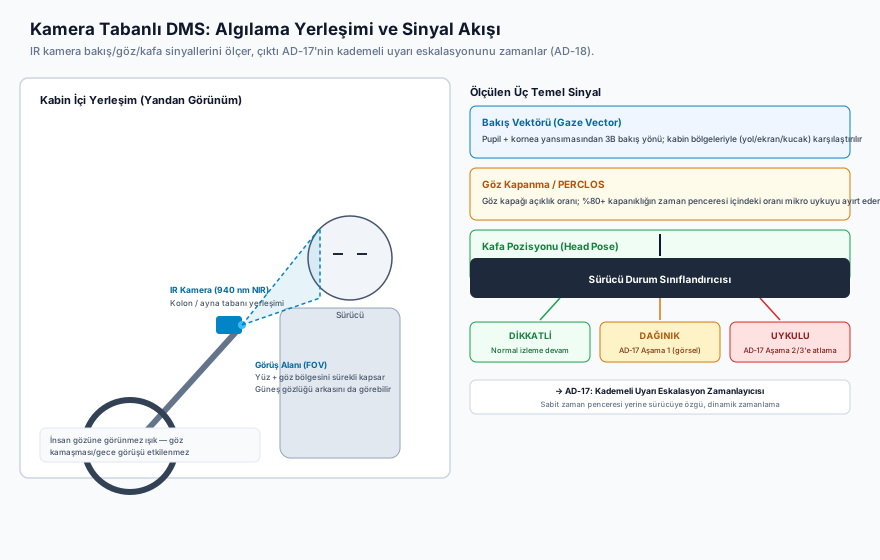
An in-cabin IR camera tracks dozens of facial landmarks in real time to derive three core signals:
- Gaze Vector: From the relative position of the pupil and the corneal reflection, the driver’s three-dimensional line of sight is computed. This vector is compared against pre-defined cabin zones (windshield, center display, rearview mirror, lap/phone area).
- Eye-Closure Duration/Frequency: Eyelid aperture (the degree of eye openness) is continuously measured; this distinguishes both brief, normal blinks and prolonged closures (microsleep) (the mathematics is covered in §5, PERCLOS).
- Head Pose: The head’s angle along three axes (yaw, pitch, roll) is computed — even if the eyes cannot be detected (e.g., the head is turned fully sideways), head pose alone is a strong indicator that attention has left the road.
EXAMPLE — When the gaze vector locks onto the center display/lap area for longer than 3 seconds, the system classifies this as “Distraction” and triggers AD-17’s escalation chain (visual alert). The threshold value (such as 3 seconds) is not arbitrary — it is grounded in driver-behavior research examining the relationship between eyes-off-road duration and reaction-time degradation.
4. Hardware Architecture: 940 nm NIR Illumination
For camera-based DMS to function, it must solve two difficult conditions simultaneously: operating in complete darkness (night) and seeing eyes behind tinted sunglasses. Both are addressed by the same physical solution:
- 940 nm Near-Infrared (NIR) LED/illumination: Entirely outside the spectrum the human eye can perceive (roughly 400–700 nm) — the driver cannot see the light illuminating them, so there is no glare or night-vision disruption risk. (This belongs to the same spectral-engineering family as the 905/1550 nm eye-safety physics we covered for LiDAR in AD-04 §4.2, though here the goal is invisibility, not eye safety.)
- IR-sensitive CMOS sensor: A standard camera sensor, once its IR-cut filter is removed, has sufficient sensitivity at 940 nm.
- Sunglasses penetration: Most commercial sunglasses lenses (especially non-polarized ones) block most visible light while transmitting a significant fraction of near-infrared — so an IR camera can resolve a pupil behind dark sunglasses with a clarity a visible-light camera cannot match.
- Placement: Steering column shroud or rearview mirror base — a position offering an unobstructed, direct sightline to the driver’s face that tolerates a wide range of head movement (fore-aft, lateral).
5. The PERCLOS Metric: the Mathematics of Microsleep Detection
PERCLOS (PERcentage of eyelid CLOSure) has become the industry-standard metric in drowsiness/microsleep research. By definition, it is the proportion of a given time window during which the eyelids remain closed above a given threshold (typically 80%):
In practice, this is computed by measuring eyelid aperture percentage (0 = fully closed, 1 = fully open) frame by frame, and dividing the total time aperture falls below 20% by the window duration. A typical production threshold band:
- PERCLOS < ~15%: Normal wakefulness.
- PERCLOS ~15–20%: Rising fatigue, early-warning band.
- PERCLOS > ~20%: High probability of microsleep onset — audible/haptic alarm triggered.
INTERPRETATION — PERCLOS’s strength lies not in a single binary “eyes open or closed” decision, but in a ratio computed over a time window — this makes it possible to statistically distinguish brief, entirely normal blinks (a few hundred milliseconds) from genuine microsleep (repeated, seconds-long closures). A single frame/instantaneous measurement (“the eye is closed right now”) cannot make this distinction; PERCLOS’s windowed/integral structure exists precisely for this reason.
6. The Link to Escalation Logic: How DMS Drives AD-17’s Timer
In AD-17 §6, we emphasized that correctly timing the escalation requires knowing the driver’s actual state. DMS output is precisely the real-time signal that fulfills this need:
DMS Output Feeding the AD-17 Escalation State Machine:

  [IR Camera] → [Gaze Vector]      ─┐
               [PERCLOS]  ──────────┼──▶ Driver State Classifier
               [Head Pose] ─────────┘         │
                                                ▼
                          ┌──────────────────────────────────┐
                          │  ATTENTIVE  │ DISTRACTED │ DROWSY │
                          └──────────────────────────────────┘
                                │             │            │
                                ▼             ▼            ▼
                          Normal          AD-17         AD-17
                          Monitoring      Stage 1       Stage 2/3
                          Continues       (visual)      (audible/haptic,
                                                          faster
                                                          escalation)
The practical consequence of this integration: if the driver is already visibly asleep (high PERCLOS), the system can skip directly to a later stage (e.g., audible+haptic combined) rather than restarting AD-17’s four-stage escalation from the top and losing precious seconds — because DMS already knows the visual stage is unlikely to be noticed (eyes closed). Conversely, if the driver is actively looking at the road (low PERCLOS, gaze vector on the road axis), the system can avoid unnecessary early escalation and reduce alarm fatigue. DMS is therefore the layer that converts AD-17’s fixed time windows into driver-specific, dynamic timing.
7. Case Study: GM Super Cruise, Ford BlueCruise, Tesla’s Cabin Camera
ASSUMPTION — The comparison below is based on publicly available manufacturer disclosures; hardware revisions, exact algorithmic details, and coverage differences by model year may vary — current technical specifications should be verified against manufacturer documentation.
GM Super Cruise: At launch (around 2017), it positioned itself as one of the early production examples securing a hands-free highway driving system with an infrared driver-facing camera — that is, the IR-camera-based DMS was designed as an inseparable part of the architecture that made hands-free operation possible, not a safety patch bolted on afterward. The camera, mounted on the steering column, continuously verifies that the driver’s head/eyes remain sufficiently close to the road axis; if that verification fails, a staged escalation of alerts (a logic similar to what we covered in AD-17) is triggered.
Ford BlueCruise: Similarly supports hands-free highway driving with a camera-based eye/gaze tracking system; the system continuously assesses whether the driver’s eyes remain sufficiently close to the road axis, and initiates a staged alert chain upon deviation.
Tesla (Cabin Camera): In addition to steering-torque-based “hands on wheel” detection, it has the capacity to visually monitor driver attention via a cabin camera mounted near the rearview mirror — an example of the two approaches compared in §2 (torque + camera) being used together.
INTERPRETATION — All three examples confirm the same engineering truth: the more a system claims to be “hands-free,” the stronger and more direct a DMS it needs to safely carry that claim — capacitive/torque-based proxy signals alone cannot satisfy the safety requirements of a hands-free architecture (§2.1).
8. Euro NCAP and Regulatory Pressure
ASSUMPTION — The regulatory framework below reflects the general direction; Euro NCAP’s exact scoring criteria and the EU GSR II’s precise technical thresholds are updated year to year — exact current requirements should be verified against the relevant official document version.
Euro NCAP has, over time, made Direct DMS (direct, camera-based systems that track eyes/gaze) an increasingly weighted criterion in vehicle safety ratings; indirect (torque/capacitive-based) systems alone are increasingly considered insufficient to achieve top-tier safety scores. This is the regulatory-language reflection of exactly the engineering rationale covered in §2 — “a proxy signal is insufficient, direct cognitive evidence is required.” The EU’s General Safety Regulation II (GSR II) similarly contains provisions mandating driver distraction and drowsiness warning systems for vehicles receiving new type approval.
Frequently Asked Questions (FAQ)
Q: Can DMS also verify the driver’s identity (biometric authentication)?
ASSUMPTION — In some production systems, the cabin camera may additionally be used for driver profile recognition/personalization, but this is a complementary use case separate from DMS’s primary safety function (attention/wakefulness monitoring) — it is outside this lesson’s scope.
Q: Is camera-based DMS also easily defeated, like capacitive/torque sensing?
WARNING — It is not fully immune (e.g., physically obstructing the camera is theoretically possible), but the defeat method it requires (physically concealing the face/eyes) is far harder to do and far more conspicuous than hanging a weight on the wheel — so the assurance-level comparison in §2 still holds. Modern systems also separately detect when the camera’s view is physically obstructed (e.g., a fully dark/blocked image) and treat that itself as a fault/warning condition.
Q: Is the PERCLOS threshold (e.g., 20%) the same for every driver?
INTERPRETATION — Most production systems start from a baseline fixed threshold, but some systems may adapt over time to an individual’s baseline blink pattern using personalized thresholds — this is an engineering choice that varies by manufacturer and system generation.
Summary
- DMS became critical because as L2 systems grew more capable (hands-free highway pilots), driver automation complacency increased: the more “autonomous” a system feels, the greater the attention-loss risk, even as responsibility remains 100% with the driver (AD-02).
- There are two fundamental sensing approaches: the earlier-generation capacitive/steering-torque “hands on wheel” detection (an easily defeated, indirect proxy signal) and modern camera-based IR monitoring (direct measurement of gaze/eye/head pose, a far stronger form of evidence).
- Modern camera-based DMS produces three core signals: gaze vector, eye-closure duration/frequency (PERCLOS), and head pose; 940 nm NIR illumination makes this possible both in darkness and behind sunglasses.
- PERCLOS is defined as the proportion of a time window during which the eyelids remain closed above a given threshold, and it statistically distinguishes brief blinks from genuine microsleep.
- DMS output converts AD-17’s fixed escalation time windows into driver-specific, dynamic timing — early stages can be skipped if the driver is already asleep, and unnecessary escalation can be avoided if the driver is actively attentive.
- GM Super Cruise, Ford BlueCruise, and Tesla’s cabin camera are real examples of camera-based DMS positioned as an inseparable part of hands-free architectures; Euro NCAP and the EU’s GSR II are making direct (camera-based) DMS an increasingly weighted safety criterion.
Sources and Verification Note
The DMS architecture and PERCLOS metric presented in this lesson are grounded in SAE J3016 terminology, Euro NCAP’s Driver Monitoring/Driver Engagement Assessment Protocol, the EU General Safety Regulation II (GSR II) provisions, and NHTSA driver drowsiness/distraction research (the origin of the PERCLOS metric). Specific architectural details attributed to GM Super Cruise, Ford BlueCruise, and Tesla are based on publicly available manufacturer disclosures and are marked as ASSUMPTION; exact current specifications should be verified against manufacturer documentation.
Next Lesson
- AD-19 — Functional Safety (ISO 26262): HARA, ASIL and Safety Goals: We examine the formal engineering discipline underlying every concept covered through this point — ODD (AD-16), Fallback/MRM (AD-17), and DMS (AD-18) — namely Hazard Analysis and Risk Assessment (HARA), ASIL classification, and how Safety Goals are formally derived.
Technical Diagrams
Quiz
Why is 940 nm Near-Infrared (NIR) illumination employed in cabin DMS cameras?
940 nm NIR illumination is invisible to occupants and penetrates polarized sunglasses.
What is the global automotive standard metric for quantifying driver eyelid closure and microsleep?
PERCLOS measures the percentage of eyelid closure over time to assess acute drowsiness.
Under Euro NCAP distraction protocols, what off-road gaze duration typically triggers an alert cascade?
Sustained visual distraction away from the forward roadway beyond ~3s mandates active driver warnings.
What automated response must follow if DMS detects complete driver incapacitation during L2+ operation?
Prolonged driver unresponsiveness escalates into an automated safe stop (MRM).
What is the complementary safety synergy between capacitive steering touch and optical DMS?
Coupling hands-on touch with gaze tracking defeats defeat devices (e.g. steering wheel weights).
Glossary
| English Term | Definition |
|---|---|
| Driver Monitoring System (DMS) | An in-cabin safety system using infrared cameras and computer vision to monitor driver head pose, eye gaze, eyelid closure, and distraction to ensure readiness. |