
Tesla Unveils Second-Gen Roadster With SpaceX Thrusters, Claims It Can Briefly Fly
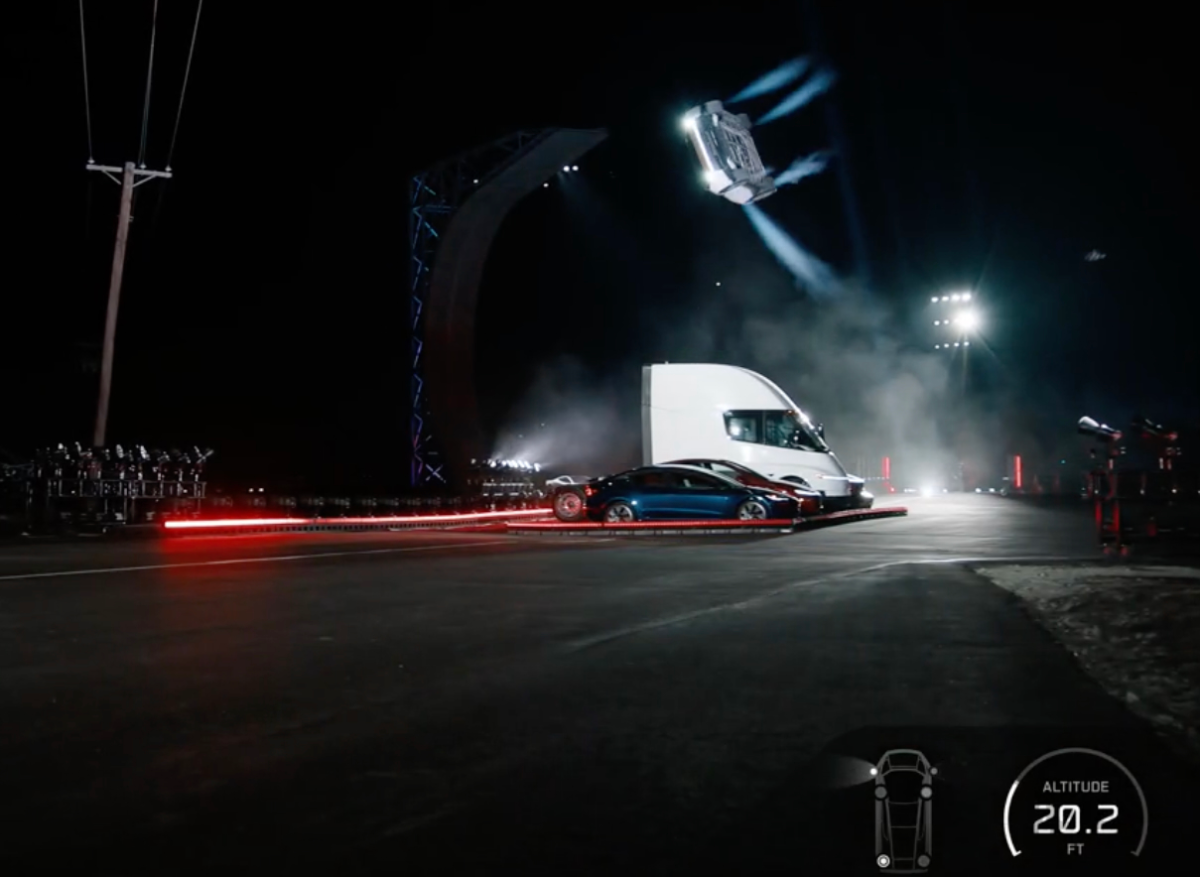
Tesla has finally pulled the wraps off its long-promised second-generation Roadster, a machine Elon Musk describes as the ultimate celebration of human-driven performance — and one that can briefly lift itself off the ground. The reveal took place at an outdoor event near Waco, Texas, where the car demonstrated a choreographed stunt: using a combination of high-output fans and cold-gas thrusters, it climbed an inverted ramp, rotated mid-air and settled back onto the pavement. In a second demonstration, it hovered over a Cybertruck, Cybercab, Model Y, Model 3 and Tesla Semi while moving.
Musk told the crowd the machine is not a concept. “This will be the actual car that’s on the roads,” he said, adding that Tesla published a 0–60 mph time of one second. Production is now targeted for 2028, though no price was announced. Buyers will choose from three trims. Performance, the entry point, is described as road-ready with two seats, active aerodynamics and a multi-mode suction system. Thrust adds rear-mounted cold-gas thrusters for sub-one-second acceleration and seats two. The top-tier Rocket trim is a single-seat, invite-only variant with ten cold-gas thrusters arranged around the body. All three carry a claimed 300-mile range and top speeds beyond 230 mph.
Reservations are already open on Tesla’s site, with the Performance requiring a $50,000 deposit and the Thrust demanding $250,000. According to engineering VP Lars Moravy, the car relies on ten thrusters fed by roughly 600 liters of compressed air to lift and spin in mid-air, and the tank can be refilled. Tesla said on X that “every usable void” in the vehicle is packed with Carbon Fiber Overwrapped Pressure Vessels — the same class of component linked to past SpaceX rocket failures. Musk also floated the idea of attempting a jump over the Snake River Canyon, the site of Evel Knievel’s famous 1974 rocket-powered attempt.
Musk has framed the Roadster as a halo product rather than a revenue driver, and he has been candid about its priorities. “If safety is your number one goal, do not buy the Roadster,” he said on a podcast earlier this year, comparing the ethos to buying a Ferrari. He added that Tesla would still “aspire not to kill anyone” in the car. At the event, he called the project the culmination of joint work by Tesla and SpaceX engineers, claiming it surpasses anything seen on screen or in a James Bond film.
The design has shifted noticeably from the version shown in 2017, when the car appeared as a surprise finale to the Tesla Semi reveal. Now finished in stark white, the body is more angular, drawing comparisons to a Lamborghini or the Lotus Esprit that appeared in The Spy Who Loved Me — a car Musk personally owns and had on display. Tesla said the shape was informed by the SR-71 reconnaissance aircraft and the F-35 fighter jet, and described an evolving design language that has moved from the S3XY lineup through the Cybertruck, Cybercab and Optimus. The reveal arrived almost nine years after the original announcement, following delays in 2020, 2021, 2023 and 2024, and reservations already placed by early depositors — including $250,000 Founders Series holders — remain part of the story. Reaction was immediate: YouTuber Marques Brownlee questioned whether the event was a prank, while other longtime observers noted the gap between the promised delivery timeline and Tesla’s track record.
What do you think?