
Tesla's Flying Roadster Won't Be Street Legal, And Musk Knows It
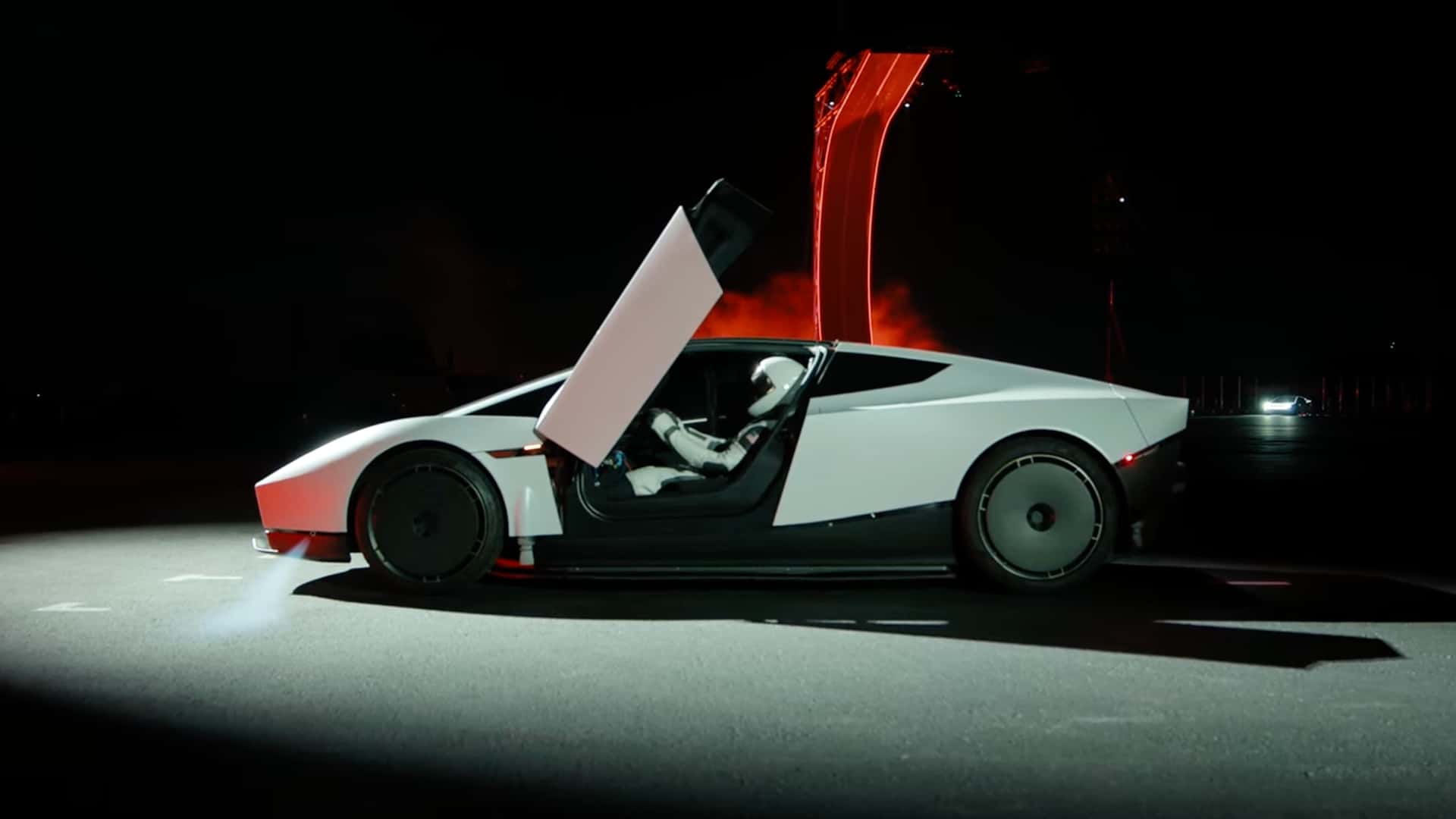
Tesla finally answered the question that has hovered over its second-generation Roadster for years: yes, the car will pack SpaceX thrusters and, to some extent, fly. What the company did not answer cleanly during its Thursday night showcase was whether any of that hardware belongs on a public road — and the way Elon Musk handled the topic said plenty.
Standing before a crowd at a SpaceX site in Waco, Texas, Musk called the Roadster “an actual car that’s on the roads,” shortly after the machine’s compressed-air thrusters launched it over a row of Teslas. He then softened the claim, conceding he wasn’t sure it would be legal in every jurisdiction, while insisting a car like it would be available to buy. Pressed later by an audience member shouting about street legality, Musk deflected with a joke about which street you happen to be on, then called it a viable car. The distinction matters: a vehicle that can only be exercised on private property is a very different product from one that can be registered and driven to work.
Tesla’s own website clears up the confusion the presentation left behind. The top-tier Rocket variant — the one that appears to have performed at the event — is invite-only, described as “air ready” with seating for one, and carries a footnote stating it is not approved for road use. Below it sits the Performance model, billed as “road ready” with two seats and equipped with the suction fan plus active aero, which suggests this is the version that could actually be plated. A middle tier called Thrust is positioned as “race ready” and adds acceleration thrusters.
The engineering claims are as extreme as the theatrics. A fan pins the car to the ground with 2Gs of force, enough that it can drive upside down, while a retractable spoiler and that downforce are meant to make cornering extraordinary. Four rear thrusters from SpaceX are credited with a claimed 0-60 mph sprint of 0.81 seconds — a figure with no precedent among production cars. Musk framed it as a machine that will “crush every track record that has ever existed.” Tesla has pitched the Roadster as the farewell to its human-driven lineup before autonomy takes over.
What the evening skipped was almost as notable as what it showed. Musk said production would begin in 2028 but gave no price, and there was no discussion of battery size, range or charging speed — including whether the 620-mile target touted back in 2017 still stands. The performance itself was heavy on acrobatics and light on concrete specifications. And if the flying variant is confined to circuits and private land, the range question becomes somewhat academic anyway.
Given that pre-orders have been open for years without a delivered car, the Roadster remains a promise wrapped in spectacle. The thrusters may be real, but for now the most road-legal thing about the program is the paperwork Tesla hasn’t finished.
What do you think?