
Honda Jumps Into Wireless EV Charging Race With Magnetic Road System
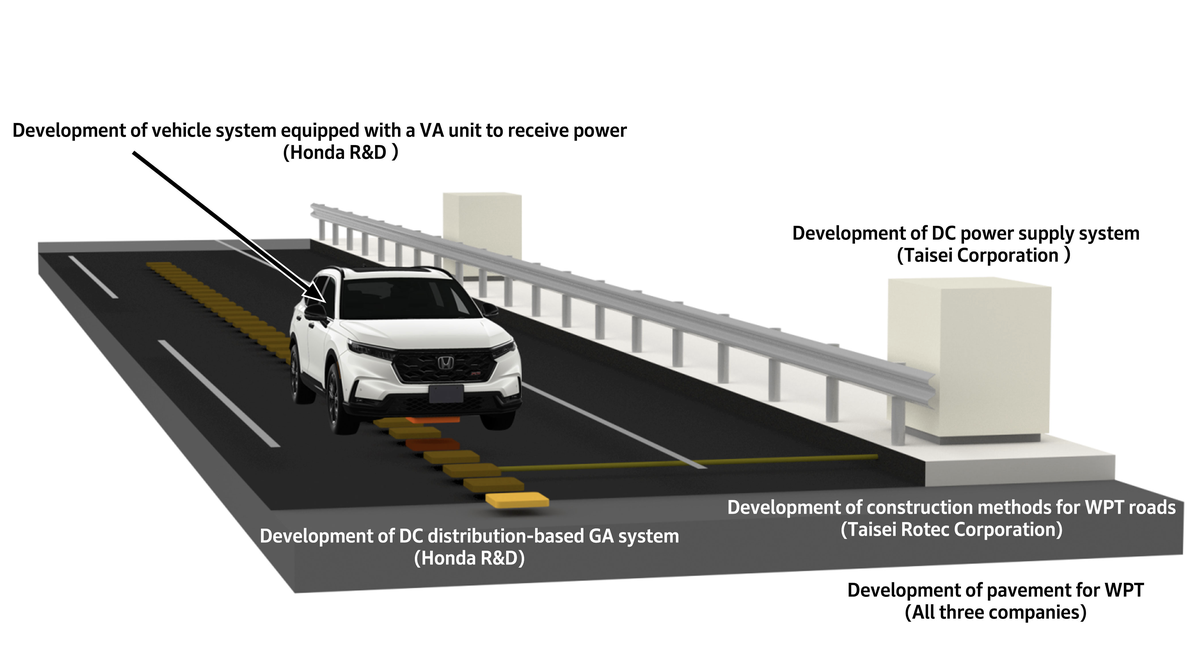
Honda has stepped into the emerging field of wireless EV charging, backing a technology that could one day let electric vehicles top up their batteries while rolling down the highway. The automaker outlined its progress on October 5, describing a “magnetic coupling wireless power transfer road system” developed through its Honda R&D subsidiary alongside Taisei Corporation and Taisei Rotec Corporation.
The system knits together three distinct pieces of hardware: Honda’s high-power-density receiver and transmitter units, which are designed to work with DC power distribution; Taisei’s fast-responding DC supply system; and Taisei Rotec’s method for embedding the equipment directly into road pavement. According to Honda, this combination delivers high-power wireless power transfer while remaining practical to install in ordinary road surfaces.
Ambitions stretch well beyond passenger cars. Honda says the setup is envisioned for everything from everyday EVs to large commercial vehicles, and the first public-road demonstration is scheduled to begin April 1, 2027. That initial rollout will lean toward trucks and other heavy commercial vehicles, where the engineering demands for durability under heavy loads are greatest. Honda frames logistics and transportation as the segment offering the highest returns, which means a wirelessly charging sedan or SUV at a dealership is not on the near horizon.
Static wireless charging first appeared in the early 2000s, and dynamic in-road versions have since moved from concept to demonstration. Germany, Sweden, and the US state of Indiana have hosted trials, while Florida announced plans in 2024 to bake wireless charging into the construction of a new highway linking Lake and Orange counties. That 125-mile route, SR 516, will include just over four miles of operational in-road charging. The US Department of Energy has noted that high-power dynamic charging could stretch EV range while allowing smaller, cheaper batteries and easing demand on fleet depot charging infrastructure.
The news lands at a complicated moment for Honda’s electrification story. The company’s only full battery EV in North America, the Prologue, is set to be discontinued once inventories run out in 2027. Honda has also reaffirmed long-term EV commitments elsewhere, including an investment through its Xcelerator Ventures arm in UK battery startup Nexeon, a strategic partner of Korea’s SKC. Closer to home, Honda recently announced plans to bring 15 hybrid models to North America within three years. Wireless charging, in other words, sits alongside hybrids and hydrogen fuel cells in a technology portfolio Honda is keeping deliberately broad.
What do you think?