
Holden Monaro GTS: The Australian Muscle Car That Took On the Mustang
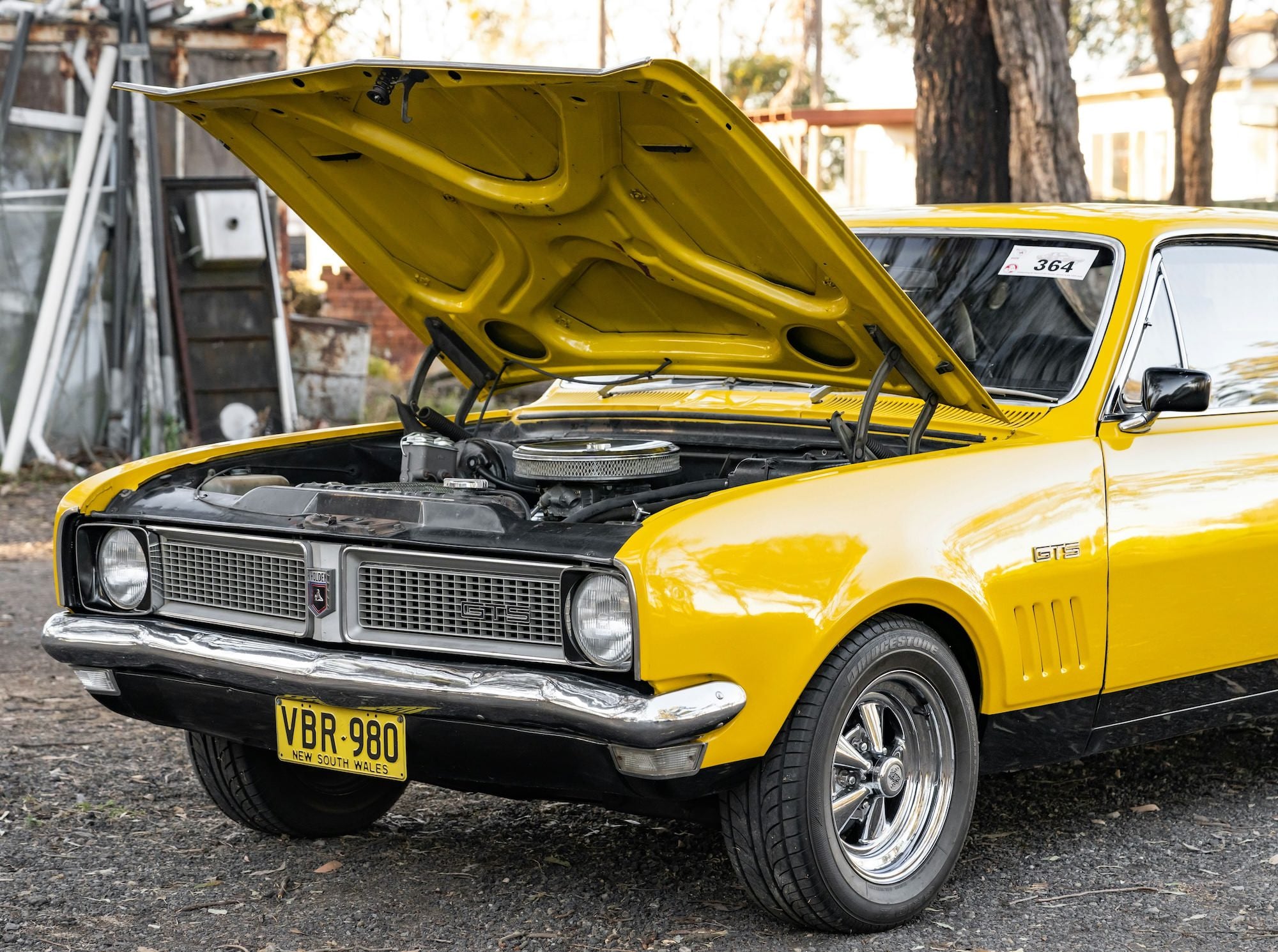
Long before anyone in Detroit had heard of Bathurst, a two-door coupe from Melbourne was busy proving that Australia could build a pony car of its own. The 1971 Holden Monaro GTS — the HG-series car pictured here — is the end point of that first burst of ambition, and it remains one of the most collectible machines ever to leave an Australian assembly line.
Under the bonnet sits the engine enthusiasts want most: the locally developed 308 cubic inch (5.0 liter) V8, reported to be the car’s original matching-numbers unit, backed by a three-speed automatic. Finished in Yellow Dolly over a black interior, it was repainted roughly two decades ago.
Fast Facts: 1971 HG Holden Monaro GTS · 308 ci (5.0L) Australian-built V8 · 3-speed automatic · Yellow Dolly over black · Repainted c. 2006
Born Out of Ford Envy
The Monaro’s origin story is really a story about losing. Ford’s XR Falcon GT had swept first and second at the 1967 Hardie-Ferodo 500 at Bathurst, and at Holden the pressure to respond came from the top. Managing director Max Wilson and marketing chief John Bagshaw pushed for a two-door version of the fresh HK sedan range.
The business case was straightforward. Sharing most of its bodywork with the sedan kept development costs down and the schedule short — and adding Chevrolet’s 327 V8 gave Holden something to fight the Falcon GT with, both on the grid and in showrooms.
Styling came out of Holden’s new Fishermans Bend design studio in Melbourne, where Ted Schroeder folded the roofline into the rear haunches in a way that nodded to the 1966 Oldsmobile Toronado. Back-seat passengers paid for it with near-zero rear visibility. Holden billed the result as the first sports car designed and engineered in Australia.
The Name Came From a Road Sign
Nine months before launch, the project still had no badge. Holden stylist Noel Bedford spotted one on a family holiday — a sign for the “Monaro County Council” near Cooma in New South Wales. The word is Aboriginal in origin, referring to a high plateau, and GM executives liked that it echoed Camaro, their own similarly sized coupe back home.
The press first saw the car at Surfers Paradise Raceway in Queensland on July 22, 1968. Eleven weeks later a privately entered Monaro GTS 327 won at Bathurst, with Monaros filling all three podium places. It was Holden’s first victory in the race, and the template for everything that followed.
A Halo Car That Earned Its Stripes
The early range split three ways. The base Monaro ran a 161 cubic inch straight-six with a column-shift manual and drums all round. The GTS added stripes, power-assisted front discs and the 145 bhp 186S six. The GTS 327 was the Bathurst weapon: a 250 bhp Chevrolet V8, a close-ratio Saginaw four-speed, limited-slip diff, twin exhausts and a 25 imperial gallon tank.
- Sandown three-hour, September 1968: a GTS 327 won the model’s very first race — with its brakes practically gone by the flag
- Bathurst, October 1968: Bruce McPhee took pole, fastest lap and the win without changing tyres or pads; co-driver Barry Mulholland completed just one of 130 laps
- 1969: the facelifted HT arrived with Holden’s own 253 and then 308 V8s, replacing the Chevrolet 307, while the GTS 327 became the GTS 350
- 1970: Norm Beechey’s HT delivered Holden’s first Australian Touring Car Championship
McPhee’s approach at Bathurst was pure pragmatism. The Monaro’s weak point was always stopping — small solid front discs and 10-inch rear drums on a 3,300 lb car. The 41-year-old privateer from Wyong built his entire race around that, fitting hard sintered rear linings, shifting brake bias rearward and holding the engine to around 4,000 rpm. It worked.
Why It Still Matters
By mid-1970 the HG Monaro was the last of the first generation, and Holden had already moved its works racing effort to the smaller Torana GTR XU-1. The HQ that followed in July 1971 brought an all-new body, a Monaro LS and, from 1973, a four-door GTS sedan. The badge eventually vanished before returning in 2001.
What survived is the reputation. A Monaro was Australia’s answer to the Mustang, Camaro, Javelin and Barracuda — and unlike plenty of imitators, it beat the imports at their own game on home soil. Survivors are now firmly in collector territory, and a matching-numbers 308 GTS in a factory colour is about as good as it gets.
Source: Silodrome
What do you think?