
1962 Rochdale GT Hits the Market With Its Own Matching Camping Trailer
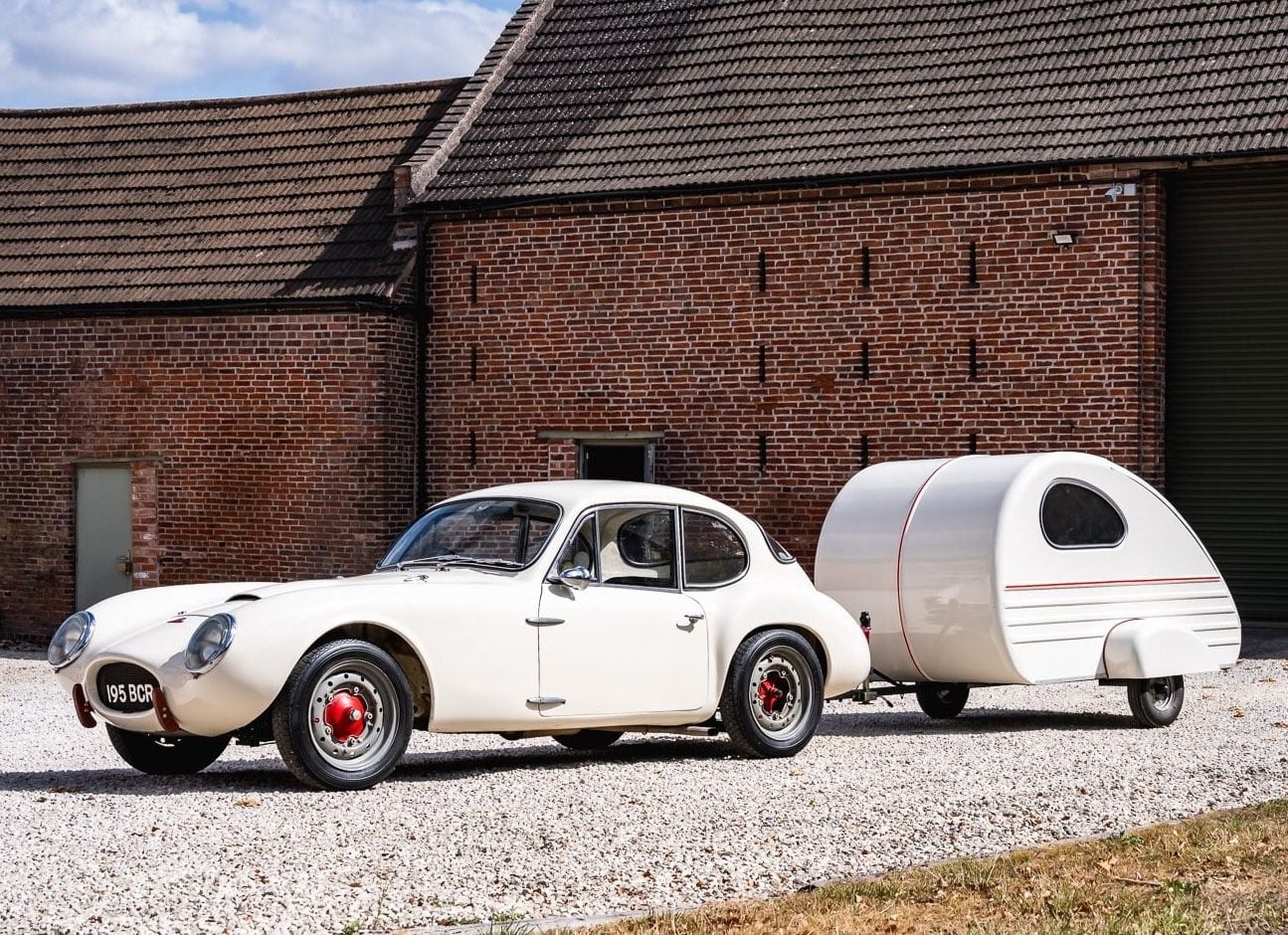
A fiberglass-bodied British sports car most enthusiasts have never laid eyes on is up for sale in Britain — and it comes with a tiny camping trailer built to match. Only around 80 Rochdale GTs are thought to survive, which makes any example noteworthy. This one, a 1962 car, has been through a full nut-and-bolt restoration.
A Kit Car With Real Refinement
The GT arrived in 1957, the work of Frank Butterworth, Harry Smith and Richard Parker. Rochdale Motor Panels had started out in a Hudson Street mill in Rochdale, England, beating aluminium panels for Austin Seven racers before switching to fiberglass in 1954. Roughly 1,350 GTs were sold, making it the company’s best-selling model.
What set the GT apart from rival specials was how much of the tedious work had already been done. Most kit shells of the era arrived as bare moldings — the builder cut out the doors and hood and shaped the wheel arches himself. Rochdale bonded in the inner arches, bulkhead and part of the floor, fitted a curved windshield, and used the tops of Morris Minor doors to give the car opening windows and quarter lights.
The body carried a 2+2 layout, room for two adults and, at a squeeze, two children. A shell with doors, windows and hood fitted cost £140 at the time, roughly $390.
The survivor count: Around 1,350 built · fewer than 80 believed to remain · one factory fire in 1961 that destroyed every mold
What Sits Underneath
Buyers supplied their own running gear, usually from a tired Ford. A Popular 103E donor brought a steel ladder frame, rigid axles on transverse leaf springs and rod-operated drum brakes, along with a 1,172cc sidevalve four rated at 30 bhp. The gearbox was a three-speed with synchro only on second and third.
From early 1960 Rochdale offered its own chassis: two large-diameter steel tubes with a bonded fiberglass floor pan. Buyers could specify swing-axle independent front suspension, a Watt’s linkage at the rear and telescopic spring-dampers all round. Handling improved markedly, and the company could now call itself a proper automaker rather than a body supplier.
Fire, Then a Change of Trade
The range grew with the open-top Riviera in 1959 — 42 sold, split between 19 two-seaters and 23 2+2s — and the Olympic in 1960, which used a one-piece fiberglass monocoque and followed the Lotus Elite down that road. A February 1961 fire at the Hudson Street works wiped out every mold on the premises. The ledger shows five more GT shells supplied after the blaze, the last in mid-1961, and then the model was dropped. Rochdale later left car manufacturing altogether for heating engineering.
This Particular Car
The example on offer keeps its white bodywork with red accents. Its 1,172cc Ford sidevalve has Bellamy-style work — an alloy cylinder head and twin carburettors — mated to a four-speed manual. The restoration was carried out by the current owner’s father and is backed by photographs, invoices and a thick history file. The matching mini trailer rounds out a package that looks ready for a long weekend away.
For anyone who has tired of seeing the same MGB at every show, this is a rare chance at something genuinely obscure. Word of warning: parts sourcing will be an adventure of its own.
Source: Silodrome
What do you think?