
- List the categories of data a connected EV collects and why each category is collected.
- Trace the data path from vehicle sensors through the TCU to a manufacturer's cloud backend.
- Explain the purpose and mechanics of over-the-air (OTA) updates.
- Describe how fleet telematics data supports commercial vehicle operations.
- State the core privacy principles (data minimization, consent, anonymization) that apply to vehicle data.
- Explain why the telematics channel is treated as a cybersecurity attack surface, not just a data pipe.
EV-49 — EV Data / Telematics
ASSUMPTION — This lesson introduces the connected-EV data architecture conceptually. It does not describe any specific manufacturer’s data-collection practices or policies; those must always be checked against the vehicle’s actual documentation and applicable local law.
1. Why a Modern EV Is Also a Data Platform
A modern EV is not just a mechanical and electrical system; it is also a rolling sensor platform that is continuously connected to a manufacturer’s backend. This is a direct consequence of the same trends covered in EV-16 (centralized/zonal E/E architecture) and EV-47 (the software-defined vehicle): once a vehicle has meaningful onboard compute and a persistent connection, collecting and transmitting operational data becomes both technically easy and commercially useful — for improving the product, supporting the owner, and in some business models, generating new revenue streams. This lesson focuses on what is collected and how, not on any manufacturer’s specific business practice.
2. Categories of Collected Data
Different categories of data serve different purposes, and it helps to keep them conceptually separate rather than treating “vehicle data” as one undifferentiated blob:
- Battery and powertrain data (SOC, SOH, temperature, cell-level statistics) — used for range estimation, warranty support, and improving future BMS algorithms (see BMS-13 for the underlying degradation models this data feeds).
- Charging history — where, when, and how fast the vehicle charges; useful for infrastructure planning and, with the owner’s charging network, for billing.
- Location / GPS data — supports navigation, roadside assistance, and theft recovery, but is also the single most sensitive category from a privacy standpoint because it can reveal detailed patterns of a person’s daily life.
- Driving telemetry (speed, acceleration, energy consumption) — used for efficiency features, driver-assistance system tuning, and in some commercial contexts, insurance or fleet-performance scoring.
- Diagnostic / fault data — trouble codes and system health signals that support remote diagnostics and predictive maintenance, letting a service center sometimes anticipate a failure before the driver notices a symptom.
- Fleet data — an aggregation layer specific to commercial operators, discussed separately in Section 4.
FACT — Not every vehicle collects every category above, and the exact set depends on the manufacturer, the model’s equipment level, and the regulatory environment it is sold into. This lesson describes the general architecture, not a universal specification.
3. The Data Path: Sensors → TCU → Cloud → OTA
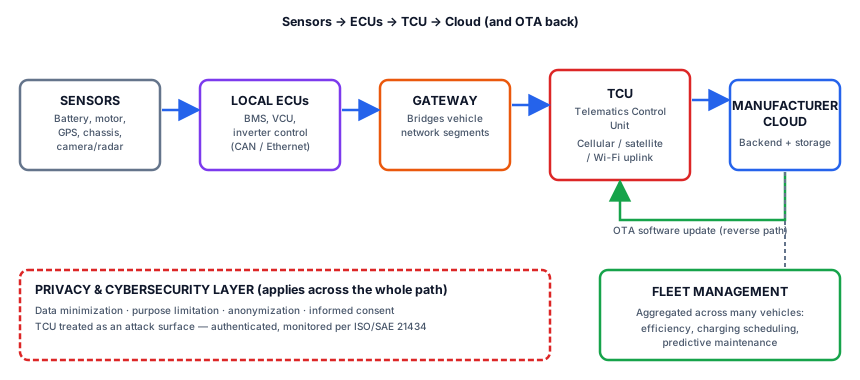
The physical and logical path this data takes typically looks like this: sensors throughout the vehicle (battery cells, motor, chassis, cameras/radar where fitted) report to their local control units, which communicate over the vehicle’s internal network (CAN, Ethernet — see EV-15) to a central gateway. The TCU (Telematics Control Unit) is the component that bridges this internal vehicle network to the outside world via a cellular (and sometimes satellite or Wi-Fi) connection, packaging selected data for transmission to the manufacturer’s backend and, in the other direction, receiving commands, configuration, or software updates.
Over-the-air (OTA) updates use this same channel in reverse: a software package is transmitted from the backend to the TCU, staged locally on the vehicle, and then applied to one or more control units, often during a period when the vehicle is parked and not actively being driven, and with safeguards (such as keeping a previous known-good version available) in case the update fails. OTA is what allows a vehicle’s software-defined features — described conceptually in EV-47 — to improve or change after the vehicle has already been sold, which is a meaningful departure from how purely mechanical vehicle systems have historically been updated (only through a physical service visit).
FACT — Not every OTA update is equally significant: some update infotainment content or minor software behavior with low risk, while others touch safety-relevant systems (such as inverter control firmware) and are typically subject to much stricter validation, staged rollout, and sometimes regulatory notification before being pushed to vehicles.
4. Fleet Telematics
For a commercial operator running many vehicles (delivery vans, buses, trucks), telematics data is aggregated across the whole fleet rather than viewed one vehicle at a time. This supports operational decisions that a single private owner would never need to make: comparing energy efficiency across drivers or routes to identify optimization opportunities, scheduling charging across a depot’s vehicles to avoid overloading the site’s electrical connection, predicting which vehicles are approaching a maintenance need based on aggregated diagnostic trends rather than waiting for an individual fault, and tracking overall fleet utilization and uptime. Fleet telematics is, in effect, the same underlying data architecture as single-vehicle telematics, but consumed through fleet-management software rather than a personal owner’s app.
5. Privacy Principles
Because location, driving behavior, and usage patterns are personal information, vehicle telematics data handling is generally expected to follow a few core principles, conceptually aligned with data-protection frameworks such as the GDPR: data minimization (collecting only what is needed for a stated purpose, not everything technically possible to collect), purpose limitation (using data only for the purpose it was collected for, or a compatible one), anonymization or pseudonymization where individual identification is not actually required for the intended use (for example, aggregate fleet efficiency statistics do not need to be tied to an identifiable driver), and informed consent, particularly for data uses beyond the vehicle’s core safety and operational functions. How these principles are implemented in practice varies significantly by jurisdiction and manufacturer, which is why this lesson states the principles rather than a specific compliance checklist.
6. The Telematics Channel as an Attack Surface
Because the TCU provides a persistent, remote connection into the vehicle’s internal network, it is treated in automotive cybersecurity practice not just as a convenience feature but as an attack surface — a potential entry point an attacker could try to exploit to reach safety-relevant systems if the connection, its authentication, or its update mechanism were not properly secured. This is a central concern of EV-35 (automotive cybersecurity) and one of the reasons standards such as ISO/SAE 21434 exist: they require manufacturers to treat cybersecurity as a lifecycle engineering discipline, not an afterthought bolted onto a connectivity feature.
7. FAQ
What is EV telematics data actually used for?
FACT — Battery health, charging, driving, and diagnostic data support functions such as range estimation, predictive maintenance, remote diagnostics, OTA updates, and — for commercial operators — fleet management.
Why does data privacy matter specifically for vehicle data?
FACT — Location and driving-behavior data can reveal detailed, sensitive patterns of a person’s daily life, which is why data minimization, purpose limitation, anonymization where possible, and informed consent are treated as core principles rather than optional practices.
Is every OTA update the same level of risk?
INTERPRETATION — No. Updates that touch safety-relevant systems are generally subject to much stricter validation and staged rollout than updates limited to infotainment or minor convenience features.
8. Summary
- A connected EV collects several distinct categories of data (battery/powertrain, charging, location, driving telemetry, diagnostics), each serving a different purpose.
- Data flows from onboard sensors through internal control units and a central gateway to the TCU, which bridges to the manufacturer’s backend; OTA updates use the same channel in reverse.
- Fleet telematics aggregates the same underlying data architecture across many vehicles to support operational decisions a single owner would not need.
- Data minimization, purpose limitation, anonymization, and informed consent are the core privacy principles that should govern vehicle data handling.
- The telematics channel is treated as a cybersecurity attack surface, which is why standards like ISO/SAE 21434 require lifecycle-level security engineering rather than a bolted-on feature.
9. Sources and Verification Note
Standards references are conceptual. Specific manufacturer data-collection practices, retention periods, and consent mechanisms must be verified against actual product documentation and applicable local regulation before publication.
- ISO/SAE 21434 — automotive cybersecurity engineering standard.
- ISO 15118 — vehicle communication interface standard (relevant where telematics and charging communication overlap).
- GDPR (general framework, for context on data-protection principles) — conceptual reference, not a claim of universal applicability.
ASSUMPTION — Source versions/titles may change; every source must be re-verified before publication.
Next Lesson
- EV-50 — Case Studies: fault → root cause → lesson learned.
Technical Diagrams
Quiz
What does telematics collect?
Telematics collects battery, charging history, and GPS data.
What is OTA?
OTA (Over-The-Air) is a wireless software update.
What does remote monitoring provide for a fleet?
Remote monitoring tracks battery/vehicle status for fleet management.
Why do location and usage data matter?
Location/usage data must be protected for privacy.
In what sense is the telematics channel risky?
The telematics channel is a cyber attack surface.