
- Distinguish V1G, V2L, V2H, and V2G by direction of power flow and use case.
- Explain what hardware and communication changes bidirectional charging requires compared with one-way charging.
- Describe how V2G could provide grid services and where the economic value actually comes from.
- State the main technical constraint bidirectional use places on battery life.
- Summarize the standards and infrastructure gaps that currently limit V2G deployment, without overstating adoption.
- Explain why V2G is best understood as an emerging capability rather than a mainstream, universally available feature.
EV-48 — Vehicle-to-Grid
ASSUMPTION — This lesson introduces V1G/V2L/V2H/V2G concepts at an engineering level. Standards maturity, regulatory approval, and real-world deployment scale vary by market and change over time; no specific adoption numbers are stated here.
1. From One-Way Charging to Bidirectional Charging
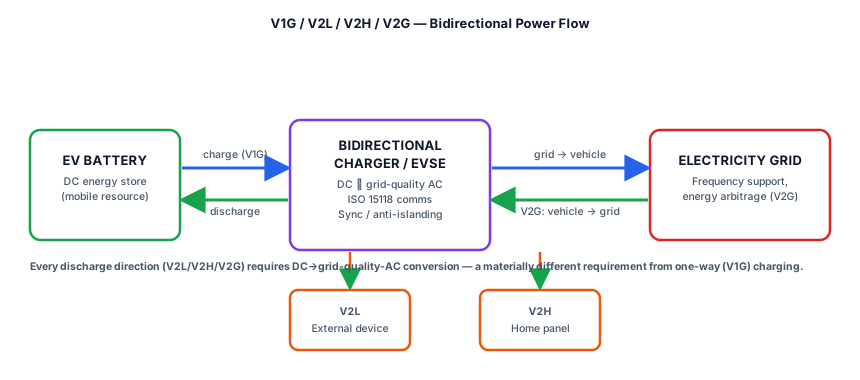
Ordinary EV charging moves energy in one direction only: from the grid (via an EVSE and the vehicle’s OBC) into the battery, as covered in EV-13. Bidirectional charging changes this by allowing the same physical connection to also carry energy out of the vehicle — either to something plugged into the car, to a home’s electrical panel, or back into the public grid. The four concepts below sit along a spectrum from “smarter one-way charging” to “full grid interaction,” and each has meaningfully different hardware and regulatory requirements.
| Concept | Direction | Typical use case |
|---|---|---|
| V1G | Grid → vehicle only, but timing/rate controlled | Shifting charging to off-peak hours or cheaper tariff windows |
| V2L (vehicle-to-load) | Vehicle → external device | Powering tools, camping equipment, or appliances directly from the car |
| V2H (vehicle-to-home) | Vehicle → home electrical panel | Backup power during a grid outage, or reducing home peak demand |
| V2G (vehicle-to-grid) | Vehicle → public grid | Grid balancing, frequency support, energy arbitrage |
FACT — V1G requires no special hardware beyond a smart charger and a communication link that can schedule charging — it is “smart” in timing only, not in direction. V2L, V2H, and V2G all require the vehicle and/or the charging equipment to actively convert battery DC back into usable AC power, which is a materially different hardware requirement.
2. What Bidirectional Hardware Actually Requires
Converting AC to DC (charging) is a one-way problem that automotive OBCs have solved for years; converting DC back to grid-quality, synchronized AC (discharging) is a different and generally harder problem, because the output must match the grid’s voltage, frequency, and phase precisely and safely disconnect if the grid itself goes down (to avoid dangerously back-feeding a line that utility workers may believe is de-energized). Depending on the system design, this bidirectional conversion can happen inside the vehicle’s own OBC or inside a specialized external bidirectional charger/inverter box. Either way, it also requires two-way digital communication between vehicle and charging equipment — standardized primarily through ISO 15118 — so that the amount, timing, and direction of power flow can be negotiated safely and, in the V2G case, coordinated with grid operator signals.
3. Where the Economic Value of V2G Comes From
V2G is often described loosely as “selling power back to the grid,” but the more precise framing is that a vehicle battery, when connected and available, can provide one or more grid services: absorbing excess renewable generation when it is abundant and cheap and releasing it back when demand is high (a form of energy arbitrage), or responding rapidly to short-term grid frequency deviations (a service traditionally provided by dedicated grid-scale batteries or fast-ramping generation). The economic value to the vehicle owner, where such programs exist, typically comes from a mix of reduced net charging cost and direct payment for providing these grid services — but the value is inherently tied to how the local electricity market and grid operator structure their compensation programs, which varies significantly by region and is not something this lesson can generalize into a fixed figure.
INTERPRETATION — The economic case for V2G depends on regulatory and market structures that are still developing in most places; a vehicle owner should treat any specific savings or earnings estimate as market- and program-specific rather than as a general property of V2G technology itself.
4. The Cost to the Battery
Every additional charge/discharge cycle a battery goes through, whether from driving or from grid services, contributes to its overall cycle-based aging (covered in BMS-13 for the underlying degradation mechanisms). V2G participation adds cycles the owner did not “need” for driving, so any V2G program has to weigh the grid-service value it provides against the incremental battery wear it causes. In practice, this is managed by limiting how deep and how frequent V2G-related discharge cycles are allowed to be, and by the BMS enforcing state-of-charge floors so the vehicle always retains enough energy for the owner’s actual driving needs — V2G is designed to use spare capacity and time, not to compete with the vehicle’s primary purpose.
5. Standards and Infrastructure Gaps
Bidirectional charging depends on alignment across several layers that do not always move at the same pace: the vehicle’s own hardware must support bidirectional flow, the charging equipment (EVSE) must support it too, the communication standard (ISO 15118 and related grid-interconnection standards such as the general framework referenced in IEEE 1547) must be implemented consistently by all parties, and the local utility or grid operator must have a program and metering approach that recognizes vehicle-based grid services. A gap in any one of these layers — for example, a vehicle that supports V2H but a home’s electrical panel that is not wired for it, or a utility with no V2G tariff program — is enough to prevent the capability from being usable in practice, even where the underlying technology exists.
6. FAQ
What does V2G actually let a vehicle do?
FACT — It lets the vehicle’s battery feed stored energy back into the public electricity grid, turning the car into a distributed, mobile energy resource when it is parked and connected.
What is required for V2G to work, beyond the car itself?
FACT — A bidirectional-capable charger/inverter, a communication standard (typically ISO 15118) implemented by both vehicle and charging equipment, and a utility or grid-operator program that supports and compensates vehicle-based grid services.
Does using V2G wear out the battery faster?
INTERPRETATION — It adds extra charge/discharge cycles beyond normal driving, which contributes to cycle-based aging; well-designed V2G programs manage this by limiting depth and frequency of grid-service cycles and preserving a state-of-charge floor for driving needs.
Is V2G widely available today?
FACT — Availability varies significantly by vehicle model, charging hardware, and local utility program; it should be treated as an emerging capability rather than a universally available, mainstream feature.
7. Summary
- V1G is smart, one-way charging; V2L, V2H, and V2G each add a different direction and destination for outgoing power.
- Bidirectional power conversion and two-way communication (ISO 15118) are the core hardware/software requirements that distinguish V2G from ordinary charging.
- V2G’s economic value comes from grid services (arbitrage, frequency support) and depends heavily on local market and regulatory structures, not a fixed universal figure.
- V2G cycling adds to battery aging, which is why programs limit discharge depth/frequency and preserve a driving-reserve state of charge.
- Standards, hardware, and utility-program alignment must all be in place simultaneously for V2G to work in practice — a gap in any one layer blocks the capability.
8. Sources and Verification Note
Standards references are conceptual; program availability and specific compensation figures vary by market and must be verified against current, local sources before publication.
- ISO 15118 — vehicle-to-grid communication interface standard.
- IEC 61851 — EV conductive charging system standard.
- IEEE 1547 (general grid-interconnection framework) — conceptual reference for distributed-resource grid interconnection.
ASSUMPTION — Source versions/titles may change; every source must be re-verified before publication.
Next Lesson
- EV-49 — EV Data / Telematics: connectivity, data, and privacy.
Technical Diagrams
Quiz
What does V2G mean?
V2G (vehicle-to-grid) returns energy from the vehicle to the grid.
What does V2H mean?
V2H (vehicle-to-home) gives energy to the home.
What does V2L mean?
V2L (vehicle-to-load) powers devices connected to the vehicle.
What is V1G?
V1G is controlled (smart) one-way charging.
What is required for V2G?
V2G requires bidirectional charging.