
- Explain the engineering rationale behind solid-state, sodium-ion, and silicon-anode battery development.
- Compare these emerging chemistries against today's liquid-electrolyte lithium-ion cells on energy density, cost, and safety trade-offs.
- Describe wireless and megawatt charging concepts and the engineering challenges each faces.
- State the difference between V1G/V2L/V2H/V2G at a conceptual level and point to the dedicated lesson for depth.
- Explain the software-defined vehicle concept and why it depends on E/E architecture choices covered elsewhere.
- Assess technology maturity honestly, distinguishing lab-stage from scaling-stage from mainstream deployment.
EV-47 — Future Technologies
ASSUMPTION — This lesson introduces technologies that are, as of this writing, at varying stages of research, pilot deployment, or early commercialization. Maturity and adoption timelines change quickly and are deliberately not stated as fixed dates or market-share figures here; treat every claim in this lesson as directional, not as a forecast.
1. Why Battery Chemistry Keeps Evolving
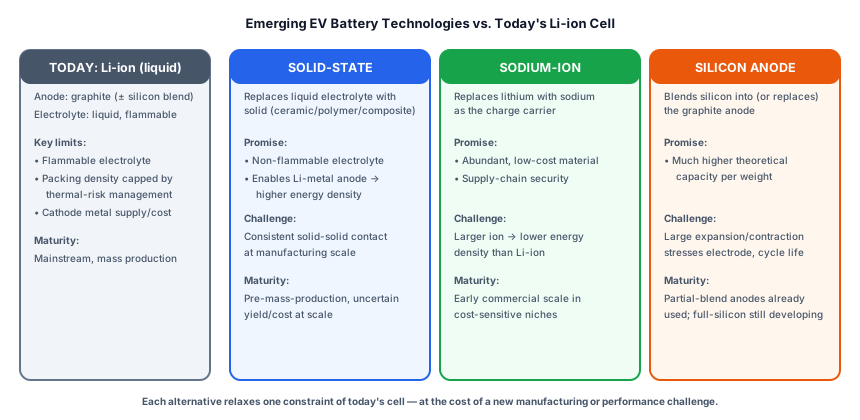
Today’s dominant EV battery technology uses a liquid electrolyte to carry lithium ions between a graphite (or graphite-silicon blend) anode and a metal-oxide cathode. This approach works well and is well understood, but it has known limits: liquid electrolytes are flammable, they constrain how densely cells can be packed before thermal risk becomes hard to manage (see EV-46), and the metals used in some cathode chemistries face supply-chain and cost pressure. Every emerging chemistry described below is, at its core, an attempt to relax one or more of these constraints — usually at the cost of introducing a different set of engineering challenges that must be solved before the technology can be produced at automotive scale and cost.
2. Solid-State Batteries
A solid-state battery replaces the liquid (or gel) electrolyte with a solid material — typically a ceramic, polymer, or composite — that still allows lithium ions to move between electrodes but does not burn the way a liquid electrolyte can. This is attractive for two connected reasons: a non-flammable electrolyte reduces one of the initiating pathways for thermal runaway, and a solid electrolyte can, in principle, allow a lithium-metal anode instead of graphite, which stores substantially more energy per unit of weight and volume — the main reason solid-state cells are associated with higher energy density claims.
FACT — The engineering difficulty is not the chemistry concept itself but manufacturing it consistently at scale: maintaining good, low-resistance contact between a solid electrolyte and solid electrodes across millions of charge cycles, without cracking or delamination, is substantially harder than doing the same with a liquid electrolyte that can flow into every microscopic gap. This is why solid-state technology is still considered pre-mass-production for automotive use, with meaningful uncertainty remaining around manufacturing yield and cost at scale.
3. Sodium-ion Batteries
A sodium-ion cell works on the same basic principle as lithium-ion — ions shuttle between electrodes during charge and discharge — but uses sodium instead of lithium as the charge carrier. Sodium is vastly more abundant and geographically distributed than lithium, which is the main motivation: it offers a potential cost and supply-security advantage, particularly for applications where maximum energy density matters less than cost and availability. The trade-off is that sodium ions are physically larger than lithium ions, which generally results in lower energy density per unit of weight and volume compared with today’s lithium-ion cells.
INTERPRETATION — Sodium-ion is best understood not as a lithium-ion replacement across the board, but as a candidate for cost-sensitive or stationary-adjacent applications (and possibly shorter-range vehicles) where its energy-density disadvantage matters less than its cost and supply advantage. It is moving from lab to early commercial-scale production in some markets, but it remains far less mature than mainstream lithium-ion chemistries for full-range passenger vehicles.
4. Silicon-Anode Technology
Rather than replacing the whole cell, silicon-anode technology targets one electrode: it blends silicon into or fully replaces the graphite typically used in the anode, because silicon can theoretically store many times more lithium per unit weight than graphite. The catch is that silicon expands and contracts dramatically as it absorbs and releases lithium — far more than graphite does — which mechanically stresses the electrode over repeated cycles and can degrade cycle life if not carefully managed. Most near-term commercial approaches therefore use a partial silicon blend rather than a pure silicon anode, trading some of the theoretical capacity gain for better durability.
5. Wireless (Inductive) Charging
Wireless charging transfers energy across an air gap using electromagnetic induction: a coil embedded in the ground (or a charging pad) generates an alternating magnetic field, and a matching coil on the vehicle’s underside converts that field back into electrical current to charge the battery — conceptually similar to wireless phone charging, but at vastly higher power and with a much larger, less precisely aligned gap to manage. The appeal is convenience (no cable to plug in) and the possibility of charging while parked briefly or even while driving over an equipped section of road (dynamic wireless charging). The engineering challenges are efficiency loss across the air gap compared with a direct conductive connection, sensitivity to vehicle-to-pad alignment and ground clearance, and the cost of embedding charging infrastructure into road surfaces or parking spaces at any meaningful scale.
6. Megawatt Charging
Megawatt charging targets a different problem than passenger-car fast charging: heavy commercial vehicles (trucks, buses) carry much larger batteries and need to recharge within limited driver rest periods, which requires charging power far beyond what typical passenger DC fast chargers deliver (see EV-27 for the heavy-vehicle context). Reaching megawatt-level power over a cable connector requires managing very high currents and the associated heat, which typically pushes designs toward higher system voltages, liquid-cooled charging cables, and correspondingly more demanding grid-connection infrastructure at the charging site itself — the electrical supply and site infrastructure question is often the harder constraint than the vehicle-side technology.
7. Bidirectional Charging: V1G, V2L, V2H, V2G
Bidirectional and smart-charging concepts extend what a charging connection can do beyond simply moving energy into the battery. This lesson introduces the terms only at a high level — full detail, including grid interaction and economic considerations, is in EV-48:
| Concept | What it does |
|---|---|
| V1G | Smart, controlled one-way charging (timing/rate optimized, no reverse flow) |
| V2L | Vehicle powers external devices plugged into it |
| V2H | Vehicle powers a home during an outage or for load management |
| V2G | Vehicle feeds energy back into the electricity grid |
8. The Software-Defined Vehicle
A “software-defined vehicle” is one whose behavior and features are increasingly determined by software running on centralized or zonal computing hardware, rather than being fixed by discrete, function-specific electronic control units installed at the factory. This shift depends heavily on the vehicle’s underlying electrical/electronic (E/E) architecture — moving from many distributed ECUs toward zonal controllers and central compute, a transition covered in depth in EV-16 — and it is what enables meaningful over-the-air feature updates, discussed further in EV-49. It is worth noting that this is primarily a software and architecture trend rather than a battery or charging technology, even though it is often discussed alongside them in “future of EV” conversations.
9. FAQ
Is solid-state battery technology ready for mainstream vehicles?
FACT — As of this writing it is not yet in mainstream mass production for full-range passenger vehicles; manufacturing consistency and cost at automotive scale remain open engineering challenges, even though the underlying chemistry has been demonstrated at lab and pilot scale.
Will sodium-ion batteries replace lithium-ion?
INTERPRETATION — Not across the board. Sodium-ion’s lower energy density makes it a better fit for cost-sensitive or shorter-range applications rather than a universal replacement for lithium-ion in long-range passenger vehicles.
Why is 800V-class architecture relevant to this lesson?
FACT — Higher system voltage, discussed in EV-06 and EV-12, reduces current for a given power level, which helps both fast charging and megawatt-charging feasibility — it is one of the enabling architectural trends alongside the battery-chemistry changes described here.
10. Summary
- Solid-state, sodium-ion, and silicon-anode technologies each relax a different limitation of today’s liquid-electrolyte lithium-ion cell, at the cost of a different manufacturing or performance challenge.
- None of these battery technologies should be described with fixed adoption dates or market-share numbers; they range from lab-stage to early-commercial, and that status changes over time.
- Wireless and megawatt charging solve different problems (convenience versus heavy-vehicle turnaround speed) and each faces its own infrastructure and efficiency challenges.
- V1G/V2L/V2H/V2G describe increasing levels of vehicle-grid interaction, detailed further in EV-48.
- The software-defined vehicle is an architecture and software trend, enabled by zonal/central E/E design (EV-16) rather than a battery technology itself.
11. Sources and Verification Note
This lesson deliberately avoids fixed dates, market-share figures, or brand-specific technology claims, since technology maturity and adoption change quickly. Every claim should be re-checked against current sources before publication.
- DOE AFDC — general EV technology reference.
- SAE J1715 — hybrid/EV terminology reference.
- IEA — general EV technology outlook (conceptual reference) — general industry-trend framing, not vehicle-specific data.
ASSUMPTION — Source versions/titles may change; every source must be re-verified before publication, and maturity statements in particular should be revisited regularly.
Next Lesson
- EV-48 — Vehicle-to-Grid: V1G, V2L, V2H, V2G.
Technical Diagrams
Quiz
What is used in a solid-state battery?
A solid-state battery uses a solid electrolyte instead of liquid.
What is a sodium-ion battery an alternative to?
Sodium-ion is an alternative chemistry to lithium-ion.
How does wireless charging work?
Wireless charging works via inductive (magnetic) energy transfer.
What does V2G mean?
V2G (vehicle-to-grid) returns energy from the vehicle to the grid.
What is the software-defined vehicle based on?
The software-defined vehicle is based on zonal + central compute.