
- Explain the chain of exothermic reactions that initiates thermal runaway.
- Describe how thermal propagation spreads a single-cell failure to a pack-level event.
- Summarize the respective roles of cell chemistry, pack design, cooling, and BMS in preventing and slowing runaway.
- State the common early-warning signals used for detection.
- Distinguish mitigation strategies at the cell, module, and pack level.
- Explain why no single safety layer is considered sufficient on its own.
EV-46 — Thermal Runaway
ASSUMPTION — This lesson covers thermal runaway at a theoretical/engineering level, to explain why it happens and how it is managed. It gives no amateur battery-abuse or dangerous-test instructions, and it does not describe any specific OEM incident.
1. What Thermal Runaway Actually Is
Thermal runaway is not simply “the battery overheating” — it is a self-sustaining chain reaction. A lithium-ion cell normally operates through a set of reversible electrochemical reactions. If a cell is pushed outside its safe operating envelope — by overcharging, physical damage, an internal short circuit, or sustained exposure to excessive external heat — a set of irreversible, heat-releasing (exothermic) side reactions can begin inside it. Because these reactions release heat, and that heat in turn accelerates the reactions further, the process can become self-feeding: once it passes a certain threshold, it no longer needs an external trigger to continue, only the heat it is already generating. That self-sustaining, accelerating quality is what distinguishes true thermal runaway from ordinary overheating that stops once the external cause is removed.
FACT — A common initiating step is breakdown of the separator — the thin insulating layer between a cell’s positive and negative electrodes. Once compromised (by heat, physical puncture, or an internal defect), it can no longer prevent an internal short circuit, which itself generates further heat and accelerates the reaction chain.
2. Initiation and Propagation
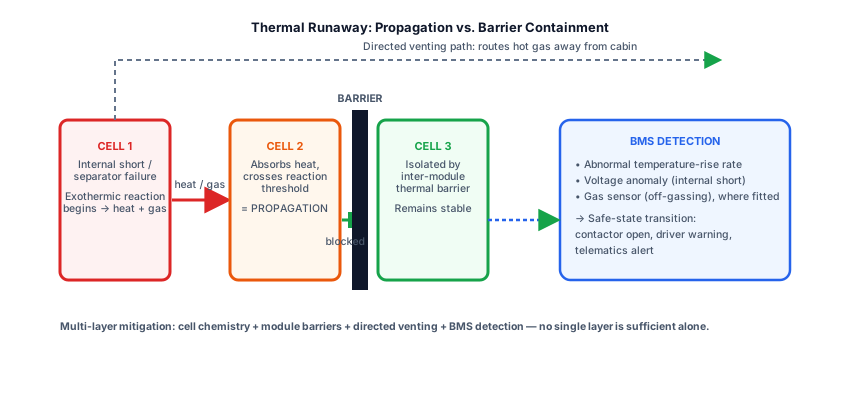
The event typically unfolds in stages: first, an initiating condition (overcharge, crush, puncture, internal defect, or external heat) damages one cell internally. Second, that cell’s internal temperature rises past a threshold where exothermic decomposition reactions begin, and the cell heats itself faster than it can dissipate that heat to its surroundings. Third, as the cell’s internal pressure builds from decomposing materials and generated gases, it may vent — releasing hot gas and, in more severe cases, expelling material — which itself now heats the immediately neighboring cells. If those neighbors absorb enough of that heat to cross their own reaction threshold, the same sequence repeats in them. This cell-to-cell spread is called thermal propagation, and it is what turns a single, potentially manageable cell failure into a much larger pack-level event.
FACT — Propagation speed and severity depend heavily on how much thermal isolation exists between cells and modules — this is precisely why pack-level design (not just cell-level chemistry) is a first-order safety lever, not an afterthought.
3. The Roles of Chemistry, Pack Design, Cooling, and BMS
No single subsystem is responsible for thermal-runaway safety; four different layers each contribute a different kind of protection.
- Cell chemistry sets the baseline thermal stability of the reactions involved. As a general engineering tendency, LFP (lithium iron phosphate) chemistries are considered more thermally stable than NMC (nickel-manganese-cobalt) chemistries at a given state of charge, largely because of differences in how their cathode materials decompose under heat — though this is a relative tendency among many design variables, not a guarantee that any given chemistry cannot experience runaway.
- Pack design provides physical thermal isolation — barriers, spacing, and insulating materials between cells and modules — specifically to slow or stop propagation once a single cell has already failed, and directed venting paths that route hot gas away from the passenger compartment rather than into it.
- Cooling systems remove heat continuously during normal operation, keeping cells within their intended temperature window so that everyday operating conditions never approach the initiating threshold in the first place.
- The BMS continuously monitors cell voltage, current, and temperature, enforces charge/discharge limits that keep cells inside their safe envelope, and — critically for this lesson — is often the first system to notice the early signature of a developing problem, before it becomes visible externally.
FACT — These four layers are deliberately redundant rather than sequential: chemistry and cooling try to prevent initiation altogether, pack design tries to contain propagation if initiation still happens, and the BMS tries to detect and respond before either stage becomes severe. Deep BMS-side detail on this topic continues in BMS-13.
4. Detection: What Early Warning Looks Like
Because thermal runaway accelerates once it begins, detecting it as early as possible — ideally before visible smoke or fire — is a major engineering goal. Typical signals monitored include a cell’s temperature rising unusually fast relative to its neighbors (rather than just being high in absolute terms), a cell’s voltage dropping or fluctuating abnormally as internal short-circuit paths develop, and, in more advanced designs, dedicated gas sensors that detect the specific off-gassing compounds released during early cell decomposition — often before a meaningful temperature rise is even measurable. Combining these signals, rather than relying on any one of them alone, is what allows a system to distinguish a genuinely developing thermal event from ordinary sensor noise or a benign temporary anomaly.
5. Mitigation at Different Levels
Mitigation strategies are typically layered by scale. At the cell level, internal design features (safety vents, current-interrupt devices, separator materials chosen for thermal stability) aim to limit how severely a single cell can fail. At the module level, thermal barriers and controlled venting paths aim to keep a single cell’s failure from propagating to its immediate neighbors, buying time and reducing the energy released into the rest of the pack. At the pack level, structural compartmentalization, directed venting away from the cabin, and BMS-triggered warnings or safe-state transitions aim to protect occupants even if propagation cannot be fully stopped internally. None of these levels is a substitute for the others — a design that only addresses the cell level, for example, would still be vulnerable to a propagation event once a fault has occurred.
FACT — This layered approach reflects a broader engineering principle also seen in EV-45 (crash safety): rather than trying to make any single failure impossible, the system is designed so that if one layer is defeated, the next layer still limits the consequences.
6. FAQ
What actually causes thermal runaway to begin?
FACT — A cell is pushed outside its safe operating envelope — through overcharge, physical damage, an internal short circuit, or sustained excessive heat — triggering irreversible exothermic reactions that generate more heat than the cell can dissipate.
Why does one cell’s failure sometimes become a whole-pack event?
FACT — Through thermal propagation: heat and hot gas from a failing cell can raise a neighboring cell above its own reaction threshold, repeating the process — unless pack-level thermal isolation and venting interrupt the chain.
Is LFP chemistry immune to thermal runaway?
INTERPRETATION — No single chemistry is immune. LFP is generally considered more thermally stable than NMC as a relative tendency, but thermal-runaway risk is managed through the combination of chemistry, pack design, cooling, and BMS — not through chemistry choice alone.
7. Safety Warning
FACT — Thermal runaway involves extreme heat, toxic gas release, and fire risk. This lesson is theoretical only, intended for engineering and design understanding. It does not describe, and must never be used as a basis for, any real battery-abuse testing, tampering, or intervention — such testing is performed only by qualified personnel in certified facilities under controlled, regulated conditions.
8. Summary
- Thermal runaway is a self-sustaining chain of exothermic reactions, not simple overheating, and it typically initiates with separator breakdown or another internal fault.
- Thermal propagation spreads a single-cell failure to neighboring cells through heat and hot gas unless pack-level barriers interrupt it.
- Chemistry, pack design, cooling, and BMS each provide a distinct, complementary layer of protection — no single layer is sufficient alone.
- Early detection relies on combining abnormal temperature-rise rate, voltage anomalies, and (in advanced designs) gas sensing.
- Mitigation is layered by scale: cell-level containment, module-level isolation, and pack-level structural/venting protection.
9. Sources and Verification Note
The concepts in this lesson are established battery-safety and electrochemistry engineering knowledge, not model-specific incident data.
- Gregory L. Plett — Battery Management Systems (Vol. I/II) — cell behavior and safety-relevant monitoring concepts.
- UNECE R100 — electric vehicle safety regulation, including thermal-event related requirements.
- SAE J2464 (general abuse-testing framework) — conceptual reference for how battery abuse tolerance is characterized in engineering practice.
ASSUMPTION — Source versions/titles may change; every source must be re-verified before publication.
Next Lesson
- EV-47 — Future Technologies: solid-state, sodium-ion, and V2G.
Technical Diagrams
Quiz
How does thermal runaway start?
Thermal runaway starts with an uncontrolled exothermic reaction in a cell.
What is thermal propagation?
Thermal propagation is heat runaway spreading to neighbors.
What does pack design do in thermal runaway?
Pack design includes barriers/insulation that slow propagation.
What is the BMS's role in thermal runaway?
The BMS provides limits, monitoring, and early detection.
How is thermal-runaway risk managed?
Chemistry, pack, BMS, and cooling provide multi-layer safety.