
- Explain the statistical nature of the 'Long-Tail' distribution and its direct relationship to AD-20's SOTIF 'Unknown Unsafe' (Area 3) concept.
- Classify concrete edge case examples across the categories of unusual road users, unusual road configurations, unusual vehicle behaviors, and sensor-confusing environmental artifacts.
- Evaluate why edge cases, despite being individually rare, are the region where statistical confidence is weakest and real-world incident risk disproportionately concentrates.
- Understand how fleet-scale 'Shadow Mode' and active learning discover edge cases, and how synthetic data generation complements that process.
- Relate graceful degradation to AD-17's fallback/MRM architecture, arguing why the safest response to uncertainty is recognizing it rather than confidently proceeding.
AD-24 — Edge Cases and Rare Events in Autonomous Driving
FACT — Nearly every one of the millions of kilometers an autonomous driving system logs in a year is uneventful: a straight lane, standard vehicles, rule-abiding pedestrians. But the moment that system is truly going to fail is a situation it may encounter only a handful of times across those millions of kilometers and has never seen before — a person in a wheelchair, an animal that suddenly bolts onto the road, a pedestrian in a costume, a bright reflective puddle that mirrors the road surface. This lesson covers autonomous driving engineering’s hardest problem: edge cases — statistically rare but disproportionately important for safety.
In this lesson, you will learn:
- The Long-Tail Distribution — and its relationship to AD-20’s SOTIF “Unknown Unsafe” area.
- Edge Case Taxonomy — unusual road users, unusual road configurations, unusual vehicle behaviors, sensor-confusing environmental artifacts.
- Why Disproportionately Important — this is exactly the region where statistical confidence is weakest.
- Shadow Mode and Active Learning — turning the fleet into a discovery instrument.
- Synthetic Data and Generative AI — rare-scene synthesis with NeRF and diffusion models.
- Graceful Degradation — the safest response when facing uncertainty.
1. The Long-Tail Distribution and the SOTIF Connection
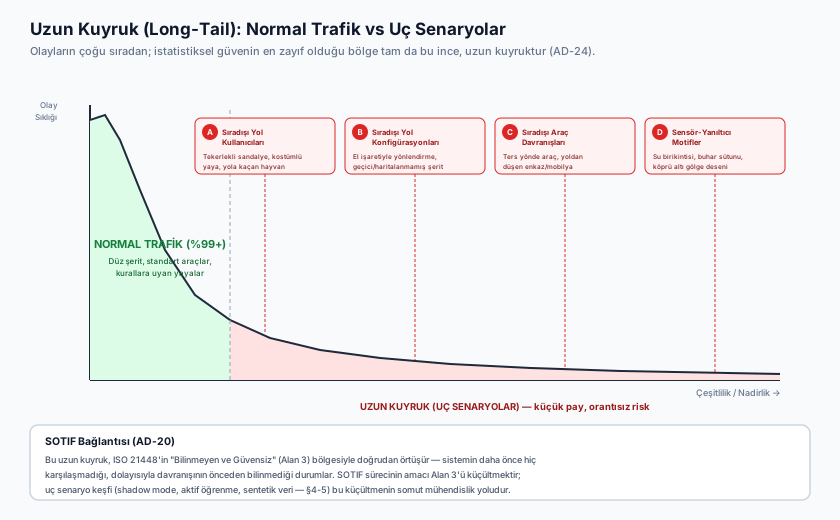
The frequency of events encountered in autonomous driving follows a heavy-tailed power-law distribution:
Event
Frequency ^
          |  [NOMINAL TRAFFIC — 99%+]
          |  *
          |  * (Straight lane-following, standard vehicles, rule-abiding pedestrians)
          |  *
          |   *
          |     *  [THE LONG TAIL — EDGE CASES]
          |       * * * * * * * * * * * * * * * * * * * * * * * * * * * * *
          +------------------------------------------------------------>
Diversity / Rarity- Nominal traffic (roughly 99%+): The overwhelming majority of data gathered across millions of kilometers consists of clean lane markings, standard sedan/SUV silhouettes, and rule-abiding road users.
- The long tail (the remainder): High-entropy events, individually extremely rare but collectively unavoidable — furniture falling off a truck, a horse-drawn cart traveling the wrong way, a chrome tanker surface reflecting the sky.
CRITICAL — This long tail maps directly onto the four scenario areas defined in AD-20 — SOTIF (ISO 21448): Safety of the Intended Functionality. SOTIF’s Area 3 (Unknown Unsafe) — situations engineers have never encountered before, and whose system behavior is therefore unknown in advance — largely is this long tail. The core goal of the SOTIF process (systematically shrinking Area 3 and moving it into Area 1/Area 2) is, in practice, exactly the edge case discovery and mitigation activity this lesson covers — AD-20 answers “why,” this lesson answers “how.”
FACT — If raising a perception model’s accuracy from 90% to 99% takes units of engineering effort, raising it from 99% to the 99.9999% level targeted for driverless commercial operation takes well over effort, because of the near-unbounded combinatorial diversity of the long tail. This is the mathematical core of why the “last few nines” are disproportionately expensive.
2. Edge Case Taxonomy
Edge cases can be classified into four categories by root cause.
A. Unusual Road Users
Human/animal forms that are underrepresented or entirely absent from a perception model’s training distribution (Out-of-Distribution — OOD):
- A person traveling in a wheelchair — a geometry and motion profile that doesn’t cleanly fit either the “pedestrian” or “vehicle” class.
- A person carrying a large, unusual object — a ladder over the shoulder, a large pane of glass, or pushing an oversized cart.
- An escaped domestic animal on the road — unpredictable, erratic, high-acceleration motion patterns.
- A person in a costume — a human silhouette that deviates from the typical human form the classification model learned.
B. Unusual Road Configurations
Situations where standard map/signage assumptions no longer hold:
- A temporary construction detour where a worker directs traffic with hand signals instead of standard signage.
- A police officer manually waving traffic through a red light — the system must decide which authority (the electronic signal or the human) to obey.
- Unmapped or map-deviating temporary lane configurations (a lane closed by snow, temporary concrete barriers).
C. Unusual Vehicle Behaviors
Situations where other vehicles violate physical or behavioral expectations:
- A vehicle traveling the wrong way on a highway.
- Debris falling from a truck ahead.
- A vehicle carrying an improperly secured, swaying mattress or piece of furniture — behaving as both a static obstacle and a dynamic hazard.
D. Sensor-Confusing Environmental Artifacts
Physically harmless visual or geometric patterns that mislead a specific sensor modality:
EXAMPLE — A large, reflective puddle can be interpreted by a camera as “an empty, obstacle-free road surface” — when in reality the puddle’s depth or the road defect beneath it is unknown. A sharp shadow pattern under a bridge can be mistaken for a lane marking. A plume of steam or exhaust rising from a vent or manhole can be perceived by some sensor modalities (especially LiDAR, because steam scatters laser returns) as a solid obstacle — a typical root cause of the “ghost braking” failure mode we’ll revisit in AD-06.
INTERPRETATION — What these four categories share is that none of them are “the system breaking down” — the sensor is functioning, the code has no bug. The problem is that the system misinterprets an input it never encountered during training/design. This is exactly the concrete manifestation of the distinction AD-20 draws between “hardware failure” (ISO 26262) and “performance insufficiency” (SOTIF).
3. Why They Are Disproportionately Important
Edge cases make up a tiny fraction of total driving time — so why does so much engineering effort go into them?
CRITICAL — The answer lies in how classical statistical confidence is built. A claim that a perception model is “99.9% accurate” is computed over the data distribution it was trained and tested on — which is almost entirely nominal traffic data. When the model encounters an input it has never seen (out-of-distribution), that 99.9% figure offers no guarantee whatsoever for that specific situation — the model has, by definition, stepped outside its training distribution, and its behavior is unpredictable. In other words: statistical confidence is weakest exactly where it is needed most — in never-before-seen situations. Real-world safety incidents (crashes, near-misses) are also observed to be disproportionately drawn from this long tail — while the incident rate during routine driving is low, edge cases carry a compounded risk of the system operating in territory where it “doesn’t know that it doesn’t know.”
This also explains why the scenario-based testing approach covered in AD-22 and AD-23 is never considered “complete”: no matter how large a scenario library grows, it covers, by definition, only known scenarios; the job of edge case engineering is finding new situations not yet in the library and adding them to it.
4. Shadow Mode and Active Learning
Imagining edge cases at a desk is impossible — the real world’s diversity systematically exceeds engineers’ imagination. The most effective method is turning every vehicle in a large production fleet into a data-collection instrument.
+--------------------------------------------------------------------------+
|                     IN-VEHICLE SHADOW MODE                               |
+--------------------------------------------------------------------------+
|  Human Driver in Control (Active)   |  Candidate Algorithm (Dormant)     |
|  - Steering angle: theta_human      |  - Model prediction: theta_model   |
|  - Braking/accel: a_human           |  - Model prediction: a_model       |
+--------------------------------------------------------------------------+
                                    |
          [ Discrepancy Gate: |theta_human - theta_model| > Threshold ]
                                    |
                                    v
+--------------------------------------------------------------------------+
|  Trigger: Cache T - 10s to T + 5s of Multi-Modal Sensor Data            |
|  - Raw camera frames + LiDAR point clouds + CAN telemetry               |
+--------------------------------------------------------------------------+
                                    |
                                    v (uploaded over Wi-Fi / LTE)
+--------------------------------------------------------------------------+
|  Cloud Data Lake -> Automated Labeling -> Active Learning & Retraining  |
|  -> New scenario added to the AD-23 scenario library                    |
+--------------------------------------------------------------------------+
Automated discrepancy triggers:
- Driver Override / Disengagement: The driver abruptly braking or wrenching the steering wheel while the automated system is active — a strong signal of a situation the system missed or misjudged.
- Model Epistemic Uncertainty: The deep network’s classification confidence sitting in a mid-band (e.g., ) — the model can say neither “I’m sure that’s a pedestrian” nor “I’m sure there’s nothing there.”
- Fusion Disagreement: The camera reporting an object with high confidence while radar/LiDAR do not (or vice versa) — exactly the point where the sensor fusion architecture covered in AD-07 comes into play.
ASSUMPTION — Publicly disclosed reports from developers operating at fleet scale indicate that shadow-mode discrepancies of this kind are continuously collected across millions of vehicle-kilometers and regularly fed into a retraining/regression loop; however, exact trigger thresholds and the volume of data collected vary by company and model year — for current figures, consult the relevant company’s safety reports.
5. Synthetic Data and Generative AI
Rather than waiting for the fleet to naturally encounter rare events, generative AI techniques can synthetically multiply them:
- Neural Radiance Fields (NeRF) and 3D Gaussian Splatting: Reconstruct a 3D representation of a genuinely recorded drive, making it possible to alter the camera’s position and inject virtual pedestrians, overturned objects, or a different vehicle geometry into the scene — dozens of variations can be derived from a single real recording.
- Diffusion Models: Transform a drive recorded on a dry summer day into photorealistic rain, snow, or nighttime conditions, letting engineers test how the perception model behaves under those conditions without waiting for an actual snowy day.
WARNING — Edge cases produced via synthetic data carry the risk of “mode collapse” or the model memorizing the generative model’s own artifacts rather than real-world diversity — that is, the model may learn the generative pipeline’s idiosyncratic limitations instead of genuine variation. Synthetic data must therefore be validated for statistical diversity and realism against real track/fleet data before being admitted into a training set — this is the synthetic-data counterpart of the sim-to-real gap problem touched on in AD-22.
6. Graceful Degradation: The Safest Way to Face Uncertainty
When a system encounters an input it has never seen before, it has two basic options: (1) confidently act on its most likely interpretation, or (2) acknowledge its own uncertainty and fall back to a conservative response.
CRITICAL — The second option is almost always safer. The fallback architecture covered in AD-17 — Fallback Strategies, MRM and Minimal Risk Conditions (MRC) rests on exactly this principle: when a system cannot confidently classify a situation, or encounters conflicting sensor inputs, the safest response is usually not to proceed on a confident guess, but to slow down, expand the safety margin, or, if necessary, trigger a Minimal Risk Manoeuvre (MRM) to reach a Minimal Risk Condition (MRC). A system that “knows what it doesn’t know” is structurally safer than one that “thinks it knows but is wrong.”
This philosophy is the natural conclusion of the story this lesson tells together with AD-22 and AD-23: the verification pyramid (AD-22) and scenario libraries (AD-23) build the system’s confidence across its known state space; edge case engineering (this lesson) systematically shrinks the unknown state space; but the long tail, by definition, never reaches zero — so the final safety layer is the system’s ability to recognize its own ignorance and retreat safely.
Frequently Asked Questions (FAQ)
Q: Why is “ghost braking” an edge case example in this lesson’s context? A: A human silhouette on a roadside billboard, a harsh shadow under a bridge, or a plume of steam is a visual motif underrepresented in the system’s training data (§2.D), and can cause the model to mistake it for a hazardous obstacle and brake hard. This creates serious rear-end collision risk from trailing vehicles at highway speed and is one of the failure modes that most erodes user trust.
Q: How is an edge case confirmed as “resolved”? A: Through regression testing. Every new edge case discovered via shadow mode or synthetic generation is added as a concrete test case to the persistent scenario library defined in AD-23. Every subsequent software update re-runs the entire library — so an edge case, once resolved, never has to be “rediscovered.”
Q: Can synthetic data generation fully replace the real-world fleet (shadow mode)?
INTERPRETATION — No, the two are complementary. Synthetic generation can cheaply multiply variations of an already-known scenario family (e.g., “a pedestrian seen in the rain”), but it cannot invent an entirely new scenario family that was never previously imagined — generative models are derived from the distribution of their own training data. Discovering genuinely new, unforeseen edge cases still depends largely on real events the real-world fleet actually encounters.
Summary
- Events encountered in autonomous driving follow a heavy-tailed distribution; nominal traffic accounts for the overwhelming majority of data, while edge cases (the long tail) form a small but disproportionately safety-critical share.
- This long tail maps directly onto AD-20’s SOTIF Area 3 (Unknown Unsafe) — edge case engineering is the “how” to SOTIF’s “why.”
- Edge cases fall into four categories: unusual road users, unusual road configurations, unusual vehicle behaviors, and sensor-confusing environmental artifacts.
- Edge cases are disproportionately important because classical statistical confidence is weakest exactly in this region — in situations a model has never seen before — and real safety incidents are disproportionately drawn from this tail.
- Shadow mode and active learning turn large fleets into a discovery instrument; NeRF/diffusion-based synthetic generation complements this discovery but cannot replace it.
- Graceful degradation (AD-17’s fallback/MRM architecture) is the final line of defense, letting a system recognize its own uncertainty and retreat safely rather than confidently proceeding on a possibly-wrong interpretation.
Sources and Verification Note
The long-tail distribution and edge case taxonomy are grounded in the ISO 21448 (SOTIF) framework and the scenario discovery methodology of the PEGASUS research consortium; for the distinction between functional safety limits and performance insufficiency, see AD-19/AD-20. For the graceful degradation and fallback connection, see AD-17. UL 4600 provides a general safety case framework that includes edge case management (see AD-28). Figures relating to large-scale fleet/shadow-mode practice are drawn from publicly disclosed company reports and are marked as ASSUMPTION.
Next Lesson
- AD-25 — Adverse Weather and Environmental Conditions: Rain, Snow, Fog, Glare: We take a deep dive into an important subset of the sensor-confusing edge cases introduced here — the systematic effects of weather and environmental conditions on camera, radar, and LiDAR physics.
Technical Diagrams
Quiz
What does the 'Long-Tail' problem describe in autonomous driving engineering?
The Long-Tail problem formalizes how the vast majority of driving events are nominal, whereas high-risk edge cases are statistically rare yet structurally infinite in variety.
How does in-vehicle 'Shadow Mode' operate across production automotive fleets?
In shadow mode, production vehicles are driven manually while candidate models execute silently. Discrepancies between driver actions and model predictions trigger edge-case data capture.
What is the primary root cause precipitating 'Ghost Braking' events?
Ghost braking is triggered by perceptual false positives, where vision or radar networks misclassify benign environmental signatures as immediate collision threats.
What is the primary engineering utility of deploying Generative AI (NeRF / Diffusion) in automated driving validation?
Generative AI enables high-fidelity synthetic scenario synthesis, allowing engineers to systematically generate hazardous, rare edge cases without risking physical vehicles.
Glossary
| English Term | Definition |
|---|---|
| SOTIF (ISO 21448) | The standard (ISO 21448) addressing safety hazards resulting from functional insufficiencies, sensor limitations, and unexpected environmental conditions in the absence of E/E component faults. |
| SOTIF (Safety of the Intended Functionality) | The subject of the ISO 21448 standard; addresses the risk that a system may produce an unsafe outcome due to perceptual/functional limitations even while operating exactly as designed with no fault present (a different lens from ISO 26262's fault-driven risk). |