
Valeo Teams Up with KE:SAI to Release an Open-Source AI Driving System
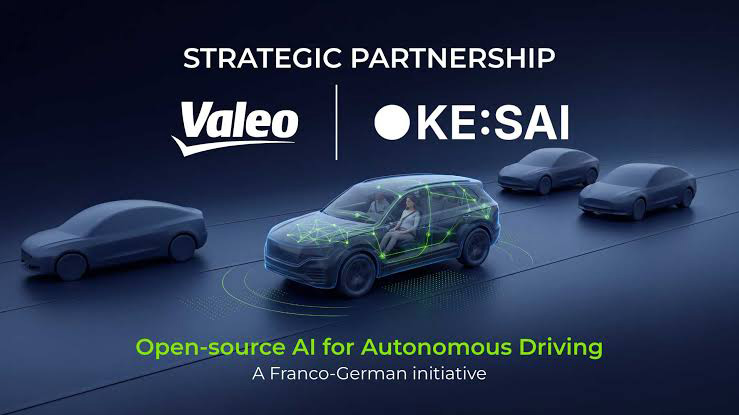
Valeo is placing a significant bet on the idea that autonomous driving technology will evolve more quickly when it is developed in the open, rather than behind closed doors. The French supplier has joined forces with KE:SAI, a non-profit research lab established by Kyutai and the ELLIS Institute Tübingen, to create a generalist AI driving system whose code, trained models and datasets will all be released publicly. The partners envision this as a reproducible reference point that automakers, suppliers and academic researchers can use to evaluate their own systems.
A central motivation behind the project is the fact that virtually every driving model currently in production is proprietary, which leaves carmakers dependent on software they cannot inspect, alter or reproduce. Valeo and KE:SAI intend to match — and ultimately surpass — the leading scores on major public driving benchmarks, offering an alternative to that closed ecosystem. The collaboration brings together valeo.ai, Valeo’s Paris-based research lab responsible for the DrivoR and VaVAM models, and a Tübingen team recognised for its work on the KITTI and NAVSIM benchmarks. Marc Vrecko, Chief Executive of Valeo Brain, described the initiative as a strategic milestone both for the company and for Europe’s automotive industry.
The technical goal is a single compact model capable of driving a wide range of vehicles, sensor configurations and driving environments. Training will begin with real-world driving data, after which simulation-based reinforcement learning and learned world models will be used to expose the system to rare, safety-critical scenarios that recorded data seldom captures. Andreas Geiger, Chief Executive of KE:SAI, drew a parallel with the language model world, noting that open source compressed years of progress into months while frontier physical AI remains largely closed. He said Valeo shares the lab’s conviction that open foundations generate more innovation than closed systems, and pledged that everything they develop will be open, with each step forward benefiting everyone.
The move carries broader strategic weight. By openly releasing driving models, code and weights, the partners give European OEMs an alternative to proprietary stacks from Tesla, Nvidia and Chinese developers — reinforcing the sovereignty argument that has become a recurring theme in European industrial policy. There is also a commercial logic at play: giving away the model layer could allow Valeo to compete where it is strongest, in sensors, compute and integration, while eroding the advantage of rivals that sell closed driving software.
Still, benchmark success does not automatically translate into road-ready safety. Leading public benchmarks such as NAVSIM say little about the production safety validation and liability questions that OEMs adopting open models would still have to shoulder themselves. That gap means the open-source approach may accelerate research and comparison, but it does not remove the burden of proving a system safe for public roads.
What do you think?