
Toyota Unveils Second-Generation Sora Hydrogen Bus, Co-Developed with Isuzu
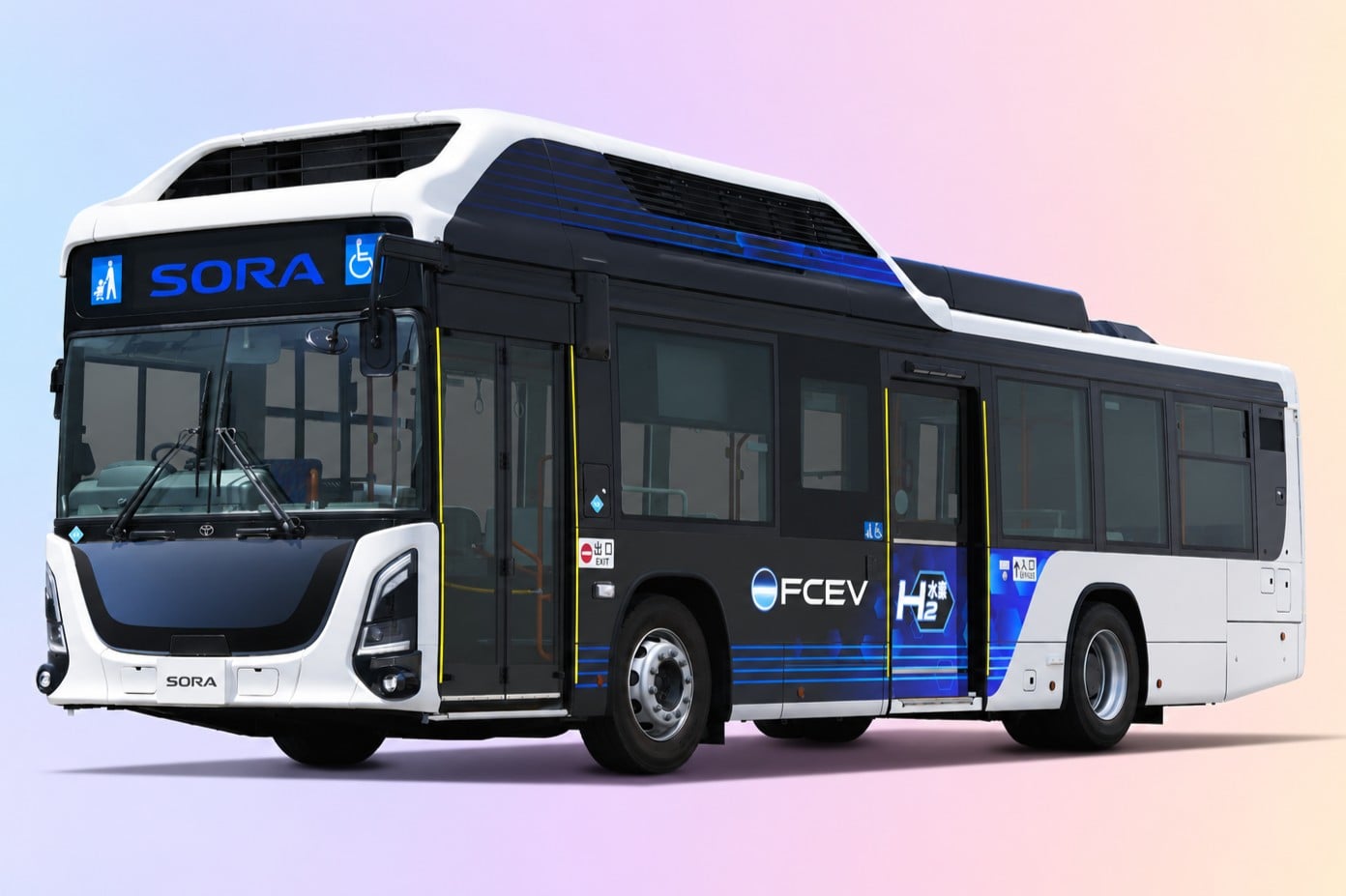
Toyota has pulled the wraps off the all-new Sora, the second iteration of its hydrogen fuel-cell city bus, developed in partnership with Isuzu for the Japanese market. While the first Sora was a Toyota-only effort, this latest model draws on Isuzu’s flat-floor battery-electric route bus platform as its foundation, with Toyota supplying the fuel-cell stack that gives the vehicle its hydrogen-electric drivetrain. The result is a collaboration that leans on each company’s strengths: Isuzu’s commercial-vehicle chassis expertise and Toyota’s hydrogen technology.
The most visible engineering change is where the fuel-cell stack sits. Toyota continues to roof-mount the stack, but has shifted it from the rear of the bus to the front, nudging the hydrogen tanks slightly backward to accommodate the move. The tank setup itself has been completely rethought. Gone are the ten 70 MPa cylinders of the previous generation, arranged in a staggered, diagonal layout. In their place are three larger-capacity tanks laid out transversely in a single row. Despite fuel capacity dropping by 129 litres — a 21.5 per cent reduction, to 471 litres — Toyota claims range has grown by roughly 100 kilometres, now exceeding 300 kilometres. Refuelling takes about ten minutes, and Toyota says that figure could be halved once faster-filling hydrogen stations come online.
Toyota credits the range improvement to more efficient use of the fuel-cell stack and the switch from a nickel-metal hydride battery to a lithium-ion pack, though it has not disclosed the new battery’s storage capacity. Two AC induction motors drive the wheels, each delivering 110 kW and 485 Nm of torque. Compared with the previous model’s AC synchronous motors, that means 3 kW less power per motor but 150 Nm more torque. Measuring 10.5 metres long, 2.5 metres wide and 3.4 metres tall, the new Sora adopts a fully flat cabin floor, eliminating the internal steps of its predecessor — a change that should make boarding easier for passengers with mobility challenges or those travelling with strollers.
The bus will be offered in four variants, split evenly between urban and suburban duty. One urban version is rated for up to 69 passengers, with 19 seated and 50 standing, a decrease from the old model’s 78-passenger capacity (22 seated, 56 standing). Safety equipment has been expanded as well: an Emergency Driver Stop System works alongside a Driver Status Monitor to detect driver impairment, automatically decelerating, stopping and engaging the parking brake if needed, while a front blind-spot monitor watches for pedestrians and cyclists ahead.
Toyota has stayed quiet on pricing, detailed commercial rollout plans in Japan and any export ambitions for the new Sora. In Europe, the company has so far leaned on Portuguese partner Caetano for its hydrogen bus offerings, with jointly branded vehicles already operating in Vienna.
What do you think?