
Toray Pushes Film Capacitors to 150° C, Opening Door to Air-Cooled EV Power Units
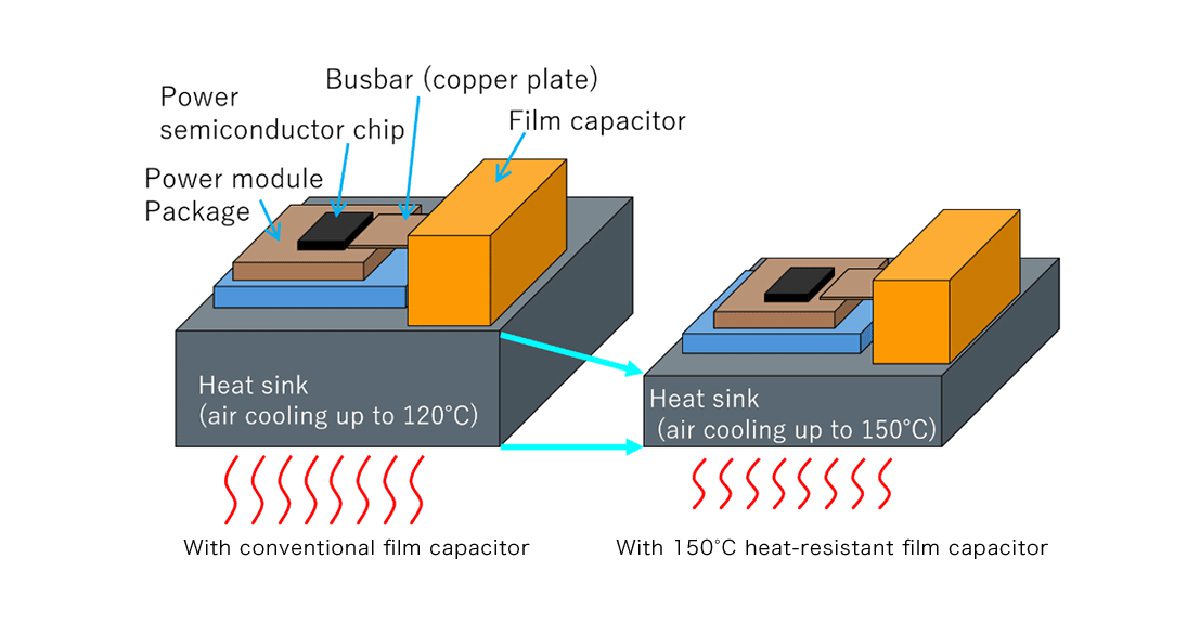
Japanese materials specialist Toray has completed testing of a prototype film capacitor inside an inverter operating at 150° C, a milestone the company says could clear the way for air-cooled power control units in electric vehicles and flying cars.
The capacitor relies on a proprietary dielectric film engineered to withstand heat far beyond what conventional film capacitors tolerate. In a typical EV inverter, film capacitors act as the stabilizing element that smooths the power flowing between the battery and the motor. Because standard films degrade or drift when temperatures climb, engineers have historically been forced to design inverters around liquid-cooling loops and bulky thermal management hardware — a constraint that eats into space, weight and cost.
By proving that its film can function at 150° C inside a working inverter, Toray is signaling that the cooling burden could be reduced or eliminated altogether. Air-cooled power control units would be simpler, lighter and easier to package, an especially attractive proposition for electric aircraft, where every kilogram matters and liquid cooling systems add complexity. Toray specifically names flying cars as a target application alongside road-going EVs.
The announcement is the latest sign that the EV supply chain’s attention is shifting toward the less glamorous components beneath the surface — capacitors, dielectrics and thermal materials — where incremental gains can unlock broader architectural changes. Toray has not disclosed production timelines, cost targets or which automakers might adopt the film, and the test remains a prototype demonstration rather than a commercial product. Still, the result points to a future in which inverter design is freed from the assumption that high heat always demands liquid cooling.
What do you think?