
Fraunhofer Tames Aluminium Anodes, Opening a Graphite-Free Path for Lithium-Ion Cells
Aluminium has tempted battery researchers for years: it is cheap, abundantly available and stores a lot of charge. What has kept it out of commercial lithium-ion cells is mechanical behaviour. As the electrode charges and discharges, the aluminium swells and shrinks, and that repeated movement eventually cracks, pores and finally pulverises the material, draining capacity and shortening cell life.
Researchers at the Fraunhofer Institute for Manufacturing Engineering and Automation IPA and the Institute for Photovoltaics at the University of Stuttgart say they have patented a cell and electrode design that keeps those ageing effects in check. Their approach holds the material stable through many cycles and preserves electrical contact inside the electrode. “We are making a battery technology that has been known for a long time but has been difficult to control practically usable,” said Kai Peter Birke, Scientific Director for Battery and Hydrogen Systems and Storage at Fraunhofer IPA, in a German-language release.
The architecture departs from conventional thinking in two notable ways. Graphite and silicon are removed from the anode entirely, easing pressure on graphite, a raw material the European battery industry regards as critical. In addition, the starting point is an ordinary alloyed aluminium foil that doubles as both active material and current collector, which makes the copper foil of a typical anode unnecessary and removes a separate coating step. That should trim process costs and the energy needed to build the electrode.
On the cathode side, the team points to lithium manganese oxide as a candidate. Paired with the aluminium anode, the chemistry promises competitive energy density while avoiding phosphates, positioning it as a lower-cost alternative to lithium iron phosphate cells. Combined with a high-flash-point electrolyte solvent and a fluorine-free LMO cathode, Fraunhofer says a cell free of fluorine — and therefore PFAS — becomes conceivable, sidestepping the hydrogen fluoride risk that can arise when a battery burns.
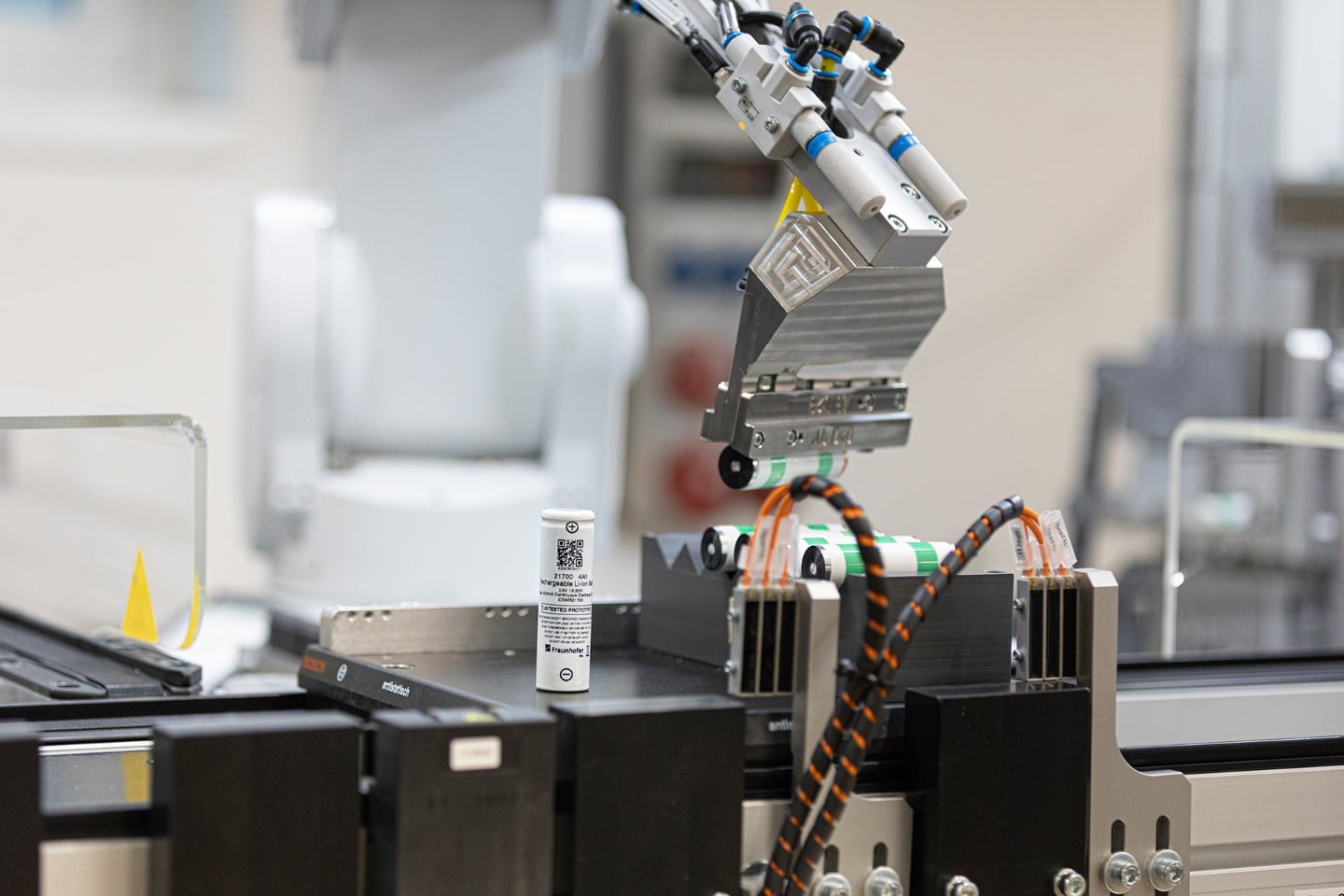
First targets are applications where safety, ruggedness and tight packaging matter most, such as air freight, tracking devices for transport containers and specialised medical equipment. For eventual scale-up, the researchers note that existing production lines could be adapted rather than rebuilt from scratch. Several prototypes are already running at the Centre for Digitalised Battery Cell Production, though the institute has not yet published cycle counts or gravimetric and volumetric energy density figures. Fraunhofer is pursuing parallel material and architecture work, including a September cell design from Fraunhofer ISE with much thicker electrodes that it says could lift energy density by ten to 15 per cent, pending industrial scalability.
What do you think?