
The World's Biggest Electric Ship Has Clocked In for Duty in South America
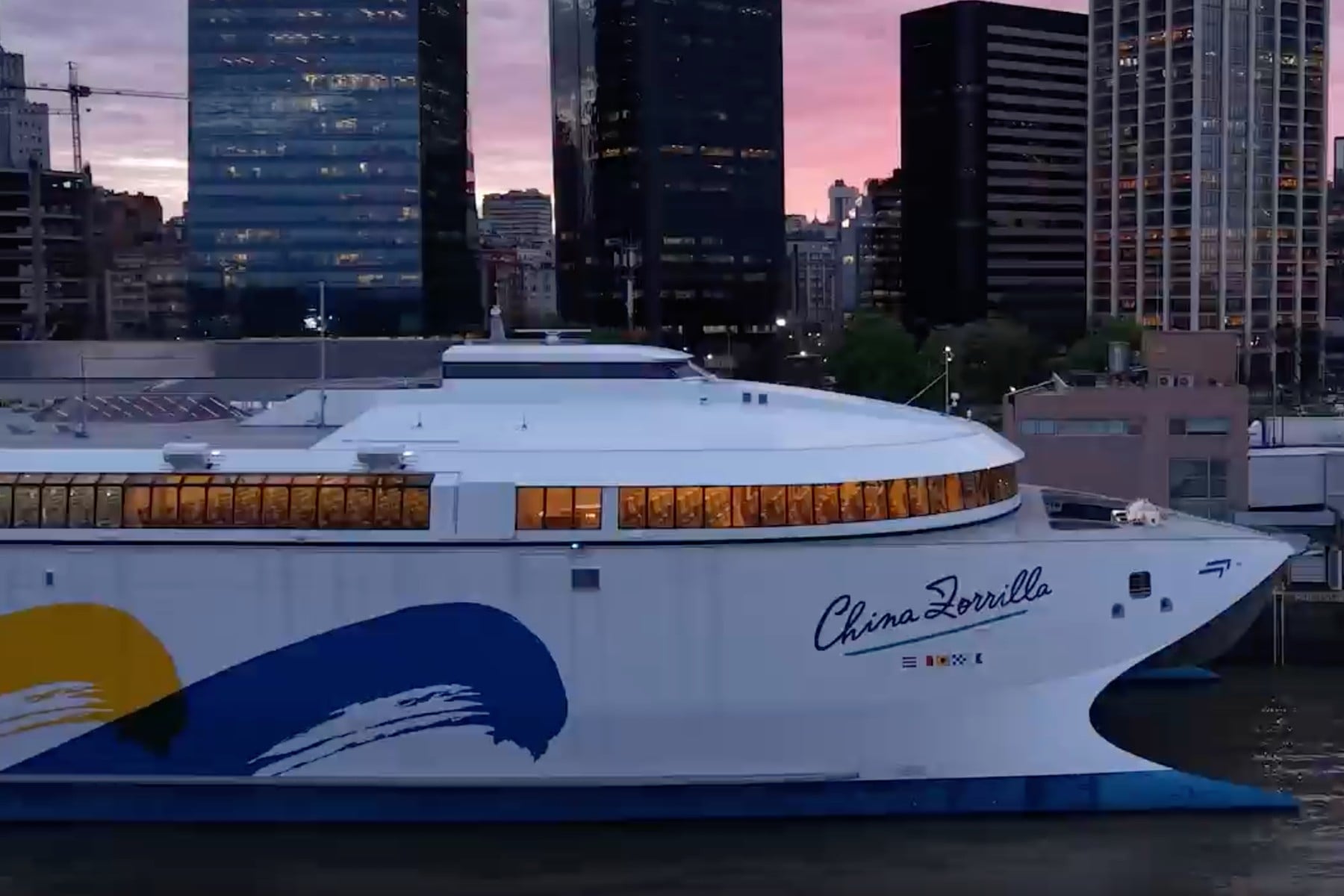
The largest battery-powered vessel ever built is no longer a shipyard curiosity. The 130-metre China Zorrilla has started carrying paying passengers and their cars across the Río de la Plata, linking Buenos Aires in Argentina with Colonia del Sacramento in Uruguay.
Built in Tasmania and named after a much-loved Uruguayan actress and director, the aluminium catamaran was handed to South American ferry operator Buquebus after completing its sea trials under the provisional label Hull 096. Its first commercial crossing marks the point where electric shipping stops being a concept and starts being a timetable entry.
What the numbers say
The most striking part of the vessel isn’t her lines but what sits in her hull.
Key Specs: 130 m catamaran · Over 40 MWh energy storage · 250+ tonnes of batteries · 8 electric waterjet drives · Up to 2,100 passengers · Up to 225 vehicles
Propulsion comes from eight electrically driven waterjets, and the battery pack is spread across the hull in a way that keeps the aluminium platform stable at speed. Incat says the layout solves thermal and weight problems that had previously kept vessels of this size out of the pure-electric bracket.
The company’s chief executive, Robert Clifford, framed the launch in terms that go well beyond one ferry. He called it a milestone for the shipyard in Hobart, for Tasmania, and for the wider maritime sector, noting the technical hurdles overcome and the scale of what has been produced.
A ferry that began life as an LNG project
The electric drivetrain wasn’t the original plan. When Incat took the order in summer 2023, Buquebus was heading toward a liquefied natural gas setup. The concept was later rebuilt around batteries instead — a change of direction that says something about how quickly the economics of marine electrification have shifted.
For passengers, the practical upside is a crossing without the low-frequency diesel thrum and vibration that usually defines short-sea ferry travel. There are no direct tailpipe emissions on board either.
- Quieter decks: No combustion engine means no engine noise or vibration in the passenger areas.
- Zero on-board emissions: The crossing produces no direct exhaust output.
- Proven capacity: The vessel shows high-volume routes can go fully electric, not just small harbour shuttles.
The order book is filling up
Incat wasn’t waiting for the first voyage to prove the concept. While the China Zorrilla was still taking shape, the Hobart yard won work for three more electric ferries of roughly the same size — 129 metres each — for Danish operator Molslinjen, destined for the Kattegat route.
That second contract matters as much as the launch itself. One electric ferry can be written off as a demonstration; a repeatable design attracting genuine commercial orders is a different story. The Río de la Plata crossing is short and busy, which makes it a useful proving ground for battery vessels — sustained daily cycles rather than occasional showcase runs.
Whether the model transfers to longer sea routes is another question, and one the industry will be watching closely over the next few years.
Source: electrive.com
Curious how this compares to other EVs? Try our comparison tool →What do you think?