
The Second-Generation Mercury Montego Was a 1970s Success Story That Ran Out of Road
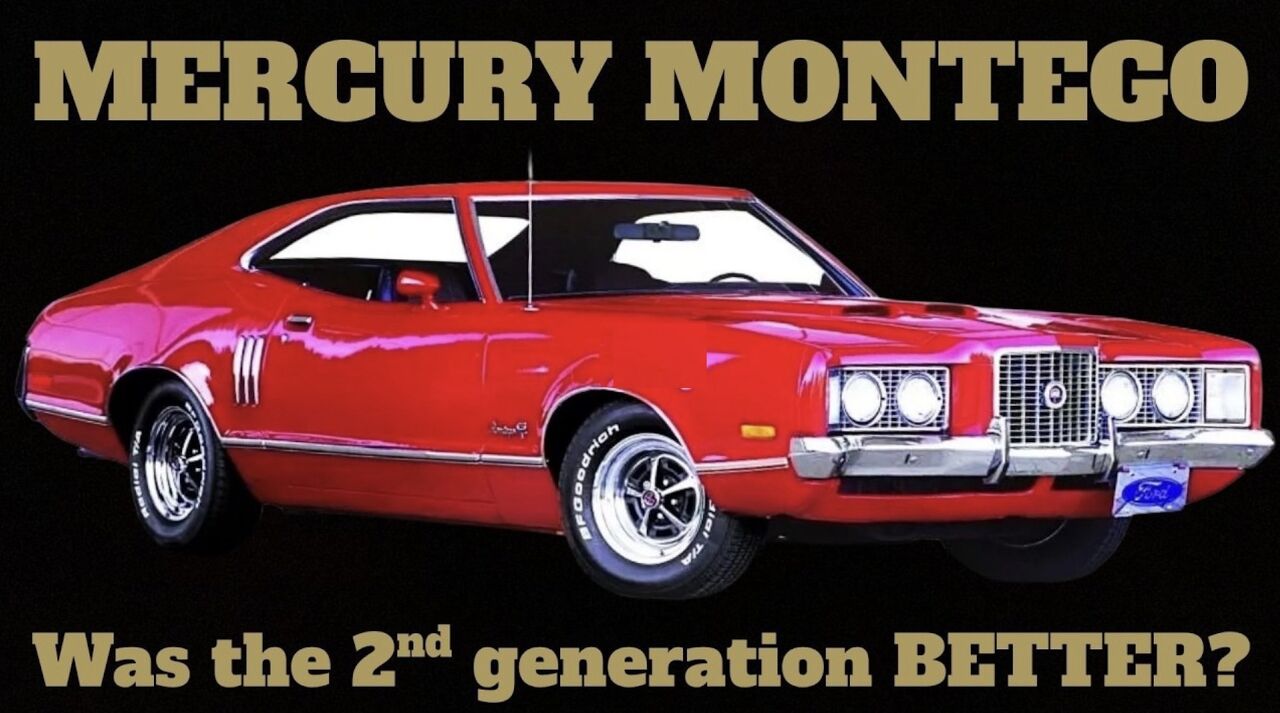
Mercury’s mid-size Montego arrived in showrooms in September 1971 as a 1972 model, and the redesign traded the original’s unibody shell for a body-on-frame platform aimed squarely at buyers who wanted a big-car ride. For a while, it worked.
The first Montego had been a steady performer, moving around 100,000 units a year — roughly a third of everything Mercury sold. The question facing Dearborn was whether a bigger, softer car could hold that line. The answer, at least initially, was yes.
A Clean-Sheet Redesign
Underneath, the new Montego shared its bones with the Ford Torino, but Mercury’s take leaned harder into traditional American luxury. Two-doors sat on a 114-inch wheelbase; four-door hardtops and wagons stretched to 118 inches. Styling cues included a bold egg-crate grille, quad headlamps, flat slab sides, recessed door handles, thicker C-pillars, and a rear bumper that swallowed the taillights, indicators, and reverse lamps.
Mercury fielded five distinct flavors:
- Montego: the no-frills base car
- Montego MX: extra exterior brightwork and better sound deadening
- Montego MX Brougham: deluxe wheel covers plus a bench seat with a fold-down armrest
- Montego GT: the sporty pick, offered as a two-door fastback or wagon with bucket seats and extra gauges
- Montego wagons: MX and the plusher MX Villager, the latter wearing woodgrain siding and a dressier cabin
Engine choices ran from a 250-cubic-inch inline-six rated at 95 horsepower all the way up to a pair of V8s worth talking about: the 351 Cobra Jet at 262 horsepower and the 429 Thunderjet at 205. Gearboxes included a three-speed manual, an optional four-speed with a Hurst shifter, and the Select-Shift automatic.
The Cyclone badge came back too — but only as an option package for the MX and GT, adding decals, rocker stripes, and a restricted menu of either the 351 Cobra Jet or the 429 Thunderjet. Just 29 Cyclone-option cars were built for 1972, making it one of the rarest performance packages Mercury ever offered.
1972 Montego at a glance: 95 hp (250 inline-six) to 262 hp (351 Cobra Jet) · 114-in wheelbase (two-door) · 118-in wheelbase (four-door, wagon) · 135,092 units sold · 29 Cyclone packages built
The press liked what it drove. Road Test magazine handed the Montego MX Brougham its Car of the Year nod and named the GT its enthusiast pick. Buyers agreed: 135,092 Montegos found homes in 1972, comfortably ahead of the first-gen car’s usual pace.
Bumpers, Compression, and a Record Year
For 1973, Washington stepped in. New rules demanded that passenger cars shrug off low-speed impacts without wrecking safety or lighting hardware, so Mercury reworked the front bumper, grille, and fascia. Compression ratios dropped across most of the lineup, pulling horsepower down with them — the 351 Cobra Jet escaped the cuts thanks to its higher compression.
Despite the detuning, sales climbed to 156,805 units, the high-water mark of the generation.
Platform Sharing Starts to Bite
1974 brought bigger shifts. The Montego’s architecture now underpinned the Mercury Cougar and Ford Elite as well, which only added to the overlap inside Ford Motor Company’s mid-size and personal-luxury showrooms. Federal five-mph rear bumper rules forced another styling pass.
Mercury also killed the GT fastback. In its place came an optional Sports Appearance Group: simulated hood scoops, racing mirrors, body stripes, raised-white-letter tires, a leather-wrapped wheel, and full instrumentation. The engine roster thinned out — the inline-six, 351 Cobra Jet, and 429 Thunderjet all went away. A new 460-cubic-inch V8 made 220 horsepower, while the replacement 351 four-barrel managed just 163.
Sales slid to 91,458.
Luxury Drift and a Quiet Exit
By 1975 the Montego had been pushed firmly upmarket. The Sports Appearance Group vanished, and the lineup narrowed to a standard 351M two-barrel V8 at 148 horsepower, with 400- and 460-cubic-inch units as options. Volume fell to 55,835, then to 33,739 for 1976 — a year with no meaningful changes.
That was the end of the second-generation Montego. The nameplate wouldn’t reappear on a Mercury passenger car until 2005.
Why It Fell Apart
Three forces did the damage. The 1973 fuel crisis hit a heavy car with mediocre economy at exactly the wrong moment. Product overlap meant the Cougar and Elite competed for the same buyers, while other Ford and Mercury models looked and drove much the same. And the slow migration from sporty to plush cost the Montego its identity.
For 1977, Mercury folded the Montego into the Cougar line. The Cougar grew four-door and wagon variants, and the wagon carried over much of the Montego’s bodywork aft of the front doors with a Cougar nose grafted on.
The Montego’s arc is a tidy snapshot of 1970s Detroit: a well-judged redesign that sold strongly, then got squeezed by regulation, fuel prices, and a corporate portfolio that competed with itself.
Photo: Mercury / The Truth About Cars · Official Press Kit / Editorial (Editorial / Press Kit)
Source: The Truth About Cars
What do you think?