
The 1964 Lightburn Zeta Sports: Australia's Almost-Forgotten Micro Roadster
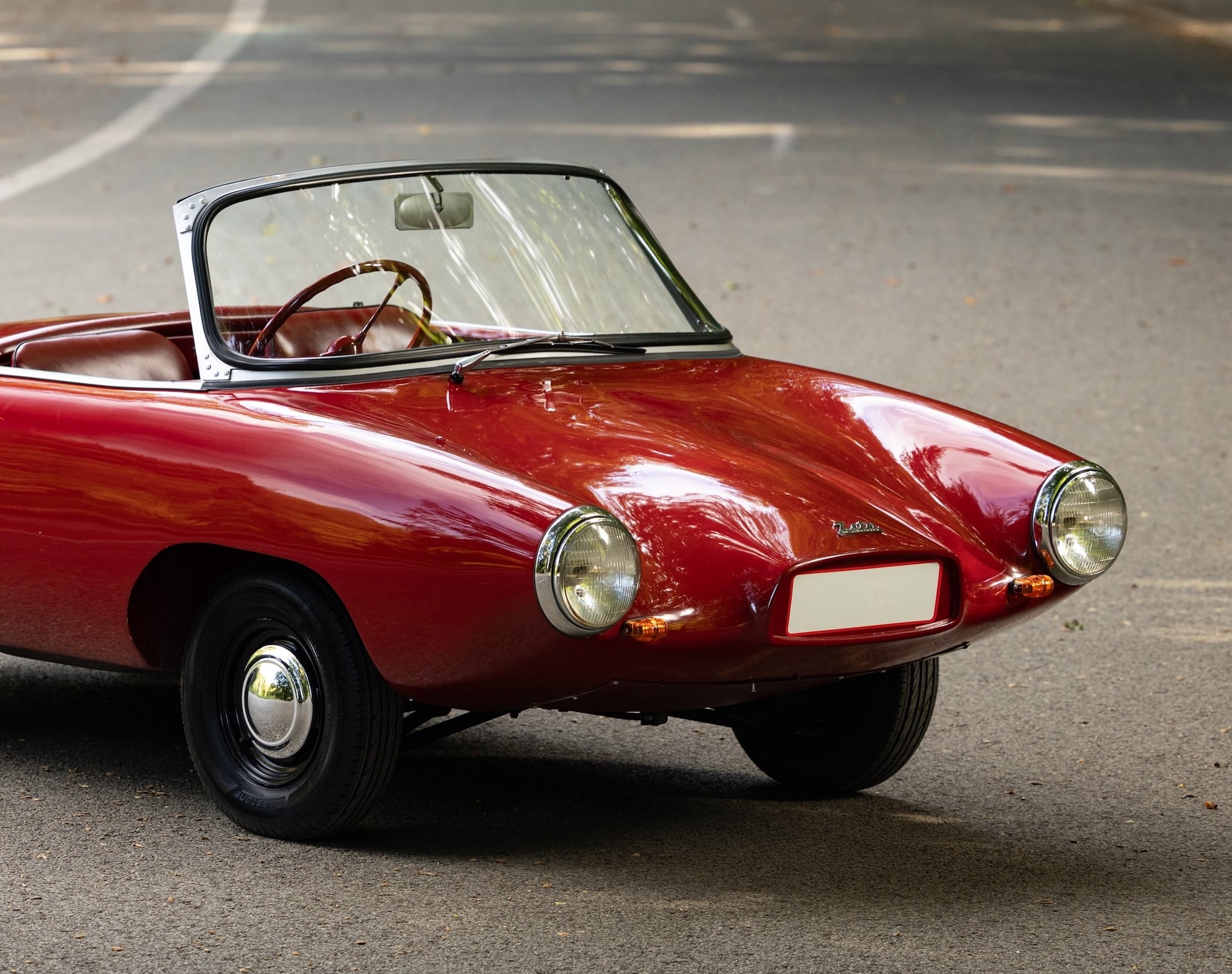
Australia has given the world plenty of oddball cars, but few are as quietly strange as the 1964 Lightburn Zeta Sports — a doorless, fiberglass-bodied pocket roadster built by a company whose day job was washing machines and cement mixers.
Just 28 to 50 were ever assembled, depending on whose figures you trust. Survivors? Possibly fewer than ten. Even in its homeland, this one is close to a ghost.
From Wolverhampton to Adelaide
The Zeta Sports didn’t start life in Australia at all. Its blueprint was the British Frisky Sprint, a tubular-chassis roadster shown at Earls Court in October 1958, engineered by Gordon Bedson — a former Vickers aircraft man who had drawn Stirling Moss’s 500cc Formula 3 Kieft — alongside development engineer Keith Peckmore.
Harold Lightburn saw the Sprint at the show and liked it enough to hire both men, who decamped to Adelaide in March 1959. Frisky folded later that year and the Sprint never made it to UK production. Australia got it instead.
What the Zeta Sports actually was
The recipe was simple and light: a steel chassis under a fiberglass shell, independent suspension at each corner, and 10-inch wheels with drum brakes. Curb weight sat at just 400 kg (880 lbs).
- Engine: rear-mounted 493cc air-cooled two-stroke twin from Fichtel & Sachs, around 19 bhp
- Gearbox: four-speed manual, shared with the Messerschmitt Tg500
- Doors: none — deleted for bodyshell rigidity
- Performance: roughly 0–50 mph in 12 seconds, top speed near 75 mph (120 km/h)
Those numbers were respectable for a microcar of the era. The cabin was spartan to the point of comedy: two bucket seats bolted flat to the floor, no bumpers, and an engine access panel fastened with quarter-turn clips. In New South Wales, the headlights sat below the legal height, so some cars wore a second pair on the hood — a look that has aged badly.
Key Specs: 493cc two-stroke twin · ~19 bhp · 400 kg · 4-speed manual · ~120 km/h top speed · 28–50 units built
The Michelotti question
Lightburn’s brochure credited the styling to Giovanni Michelotti, a name that sold cars in the early Sixties. The Frisky Register disagrees outright, crediting Bedson alone — and noting Michelotti had no hand in either the Sprint or the Zeta Sports. Bedson had already walked away before customer cars arrived, after clashing with Harold Lightburn over design and other matters.
A sales story that never took off
The Zeta Sports was developed before Lightburn’s other cars but reached buyers last. The Zeta Runabout sedan and Zeta Utility pickup came first — the Runabout, notably, had no reverse gear at all. To back up, you switched off the 324cc Villiers twin and restarted it running backwards.
By 1964 Lightburn was also Alfa Romeo’s Australian distributor, with dealers lined up to move the Sports. Orders stayed thin anyway. The Alfa arrangement ended in August 1965 with only about 65 cars sold, and the whole Zeta line died that same year — roughly 400 vehicles across all three models.
The obvious rival was the Goggomobil Dart, Bill Buckle’s Sydney-built fiberglass two-seater, which shifted around 700 units before the locally made Mini crushed it in 1961. The Zeta Sports arrived into a market that had already moved on.
The one coming up for sale
This particular red car carries a 1961 build date but wasn’t registered until September 1964. It spent time in the Bruce Weiner Microcar Museum collection in Georgia before being bought in February 2013 and shipped to Belgium.
It’s now offered without reserve, guided at £25,000–£35,000 ($34,000–$47,500). For a car almost nobody remembers, that’s a serious number — and a reminder that obscurity and value don’t always move in opposite directions.
Source: Silodrome
What do you think?