
This 695-Mile Panoz Roadster Was Built for the Boss Himself
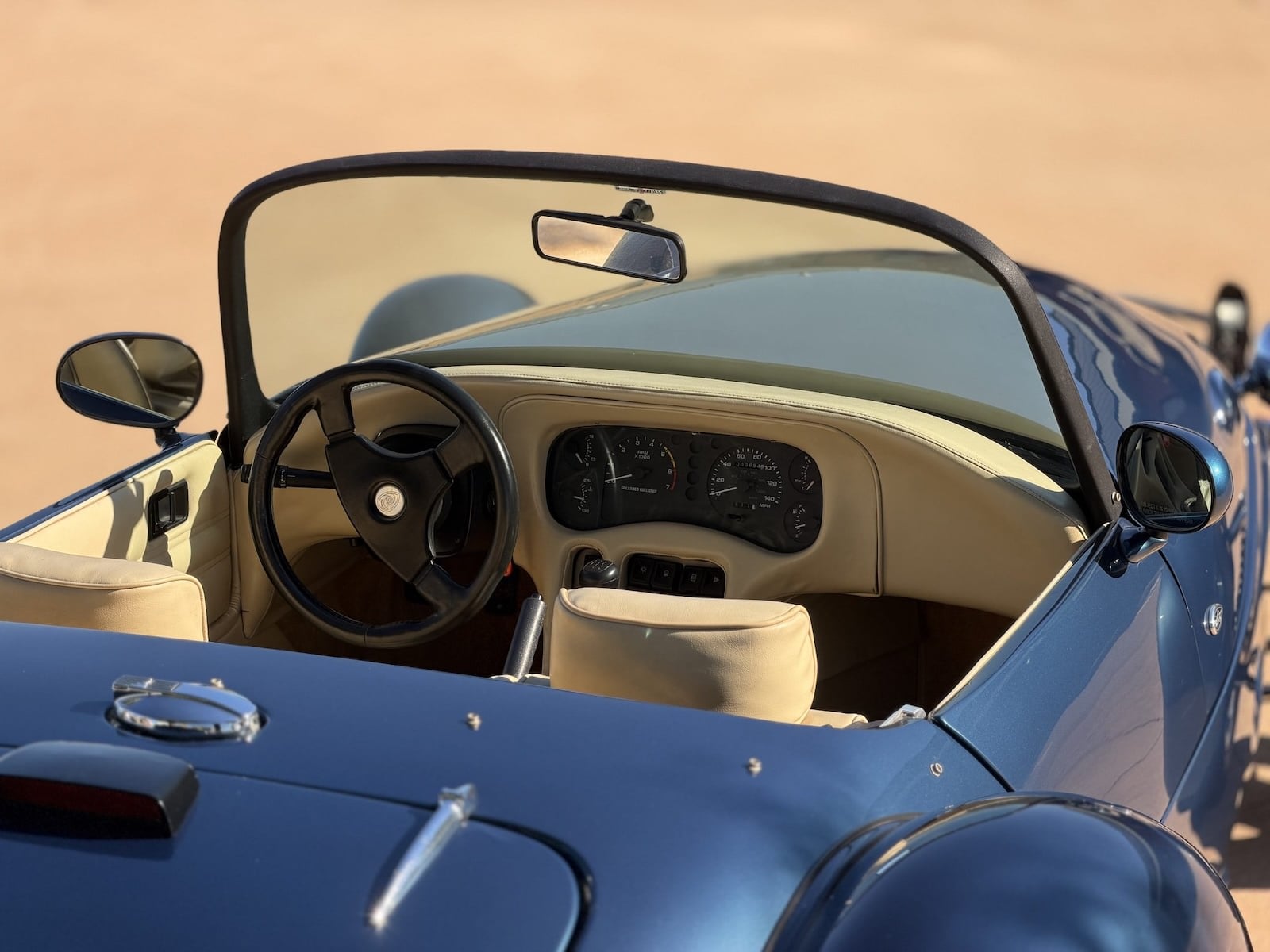
A 1993 Panoz Roadster with just 695 miles showing on the clock is up for sale out of Oklahoma — and unlike most low-mileage garage queens, this one has a genuine story behind it. It was assembled for Dan Panoz, the company’s founder, and spent much of its life as a promotional prop rather than a weekend toy.
That helps explain the odometer. Almost nothing else in American sports car history quite matches this thing for oddity, either. Panoz Auto Development turned out only 44 examples of the original Roadster between 1992 and 1995, making survivor sightings rare.
An Irish Idea, Rebuilt in Georgia
The Roadster didn’t start life in the United States. Its roots trace to the TMC Costin, a low-volume sports car built in Wexford, Ireland, around a chassis drawn up by British engineer Frank Costin. When that operation slid into receivership in the late 1980s, Dan Panoz bought the rights, drawings and tooling and shipped the lot to Georgia.
His first workshop? A former state salt shed. Two TMC staff came along — though the engineer soon went home, unhappy that the original 1.6-liter engine was being swapped for a Ford V8. Fabricator Mick Murphy stayed for the long haul.
That V8 decision was deliberate. Panoz wanted the dependability small-volume sports cars usually lacked, so he lifted the driveline wholesale from a Ford Mustang: the 5.0-liter pushrod V8, the clutch, cooling system, Borg-Warner T-5 five-speed, rear axle and brakes. A shortened driveshaft and a fuel tank were reportedly the only non-Ford pieces required.
Key Specs: 5.0-liter Ford V8 · 215 bhp · 5-speed manual · 695 miles from new · 1 of 44 built
Costin’s chassis principles survived the rework, but the wheelbase grew and the track widened. The production frame was TIG-welded stainless steel tube, with independent front suspension, a Ford-based steering rack and the Mustang’s live rear axle. Weight distribution landed at a neat 50/50.
Freeman Thomas and the Aluminum Skin
For the bodywork, Panoz turned to Freeman Thomas — a former Porsche stylist who was, at that point, writing design critiques for a magazine. Thomas later had a hand in the Volkswagen Concept 1 that became the New Beetle and was a key figure behind the Audi TT. Superform USA tooled the superplastic-formed aluminum panels.
Dan Panoz and Murphy reportedly towed two chassis to California on a trailer, the second tack-welded upside down on top of the first. A running prototype appeared publicly on July 27, 1990, and early cars sold as component vehicles until federal certification arrived in 1992.
The recipe was deliberately stripped back: no roof, no radio, no air conditioning. At roughly $45,000 it cost a little more than a Corvette convertible — a tough sell, but few American cars offered a purer driving experience.
What Replaced It
Development of a successor began in 1994, and the AIV — Aluminum Intensive Vehicle — launched in 1996. Its twin-tiered extruded aluminum space frame used a central backbone with steel suspension subframes, and the aluminum body was bonded on with adhesives. Roughly 70% of the car was aluminum, which was advanced thinking for a boutique builder.
Power came from the 1996 Mustang SVT Cobra’s all-aluminum 4.6-liter V8 — four cams, 32 valves, 305 bhp at 5,800 rpm and 300 lb ft at 4,800 rpm. A T45 five-speed and limited-slip differential completed the package, and suspension went independent at both ends. Air conditioning and a soft top became standard, though raising the roof took the better part of 15 minutes. Curb weight stayed lean at 2,570 lbs.
Period testing recorded a 0-60 mph run of 4.5 seconds. In a May 1998 magazine comparison, an AIV beat a Chevrolet Corvette through the slalom and lapped a road course faster than a supercharged Aston Martin DB7. Only 176 AIVs were built, and the final ten wore Titanium paint as the Signature Edition 2000.
The Esperante road car took over from there, with the first customer delivery in February 2001. As for the blue-over-beige Roadster now on the market, it pairs its 215 bhp Ford V8 with a five-speed manual — and a history that’s hard to replicate.
Source: Silodrome
What do you think?