
Thailand Green-Lights Toyota's Hydrogen Hilux Plant With €39M Approval
Thailand’s Board of Investment has cleared the way for Toyota to build a hydrogen fuel-cell version of its workhorse pickup, signing off on a 1.49 billion baht (roughly €39 million) investment at the Ban Pho factory in Chachoengsao Province. It marks the first fuel-cell electric vehicle ever assembled in the country.
Toyota is adding a dedicated line at Ban Pho, which already turns out the ninth-generation Hilux in combustion, mild-hybrid and battery-electric forms. Serial production of the FCEV is pencilled in for December 2027, and the site will gain its own hydrogen refuelling station to handle build and testing work.
A niche play by design
The numbers say a lot about how Toyota sees this truck. Output is planned at just 3,000 units a year, and the first batch won’t stay home — early cars are earmarked for export, with Europe, Australia and New Zealand at the front of the queue.
That’s an interesting reversal. Thailand got the Hilux BEV before any other market on earth, yet the hydrogen variant starts life as an export-only proposition.
Key Specs (targets): More than 400 km driving range · Up to 2.5-tonne towing capacity · 3,000 units per year · Production from December 2027
What the teasers revealed
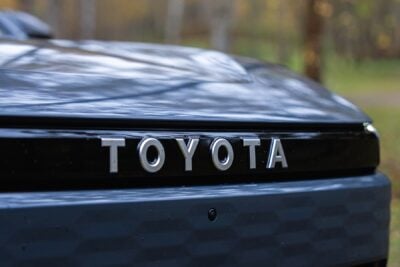
At IAA Transportation 2026, Toyota showed the first official glimpses of the truck. The styling tweaks are modest: a fresh daytime running light signature split into three segments along the top edge of each headlamp, plus what looks like a blanked-off upper grille in the same vein as the Hilux BEV.
The show truck wore a shade close to Force Blue, the colour Toyota uses on the Mirai sedan.
Dakar as a proving ground
The new model is slated for a 2028 market launch, but the technology gets a public stress test before then. Toyota’s Gazoo Racing division is expected to campaign a hydrogen Hilux in the Dakar Rally’s Future Mission 1000 class in 2027.
That competition build is a serious piece of kit — two fuel-cell stacks combining for 400 kW, fed by four high-pressure tanks holding 8.4 kg of hydrogen in total. Whatever the team learns in the sand should feed straight back into the road-going Hilux FCEV.
Why it matters
Hydrogen pickups remain a tiny corner of the market, and Toyota’s low volume targets reflect that reality rather than any great optimism. Still, the Thai approval puts real public money behind the bet, and it gives Toyota a manufacturing foothold for fuel-cell vehicles in a region where it already dominates the pickup segment.
Whether buyers follow is another question entirely. For now, Toyota is keeping the door open — and keeping the volumes small.
Source: electrive.com
What do you think?