
Tesla's Flying Roadster Was a Spectacle — Not a Product
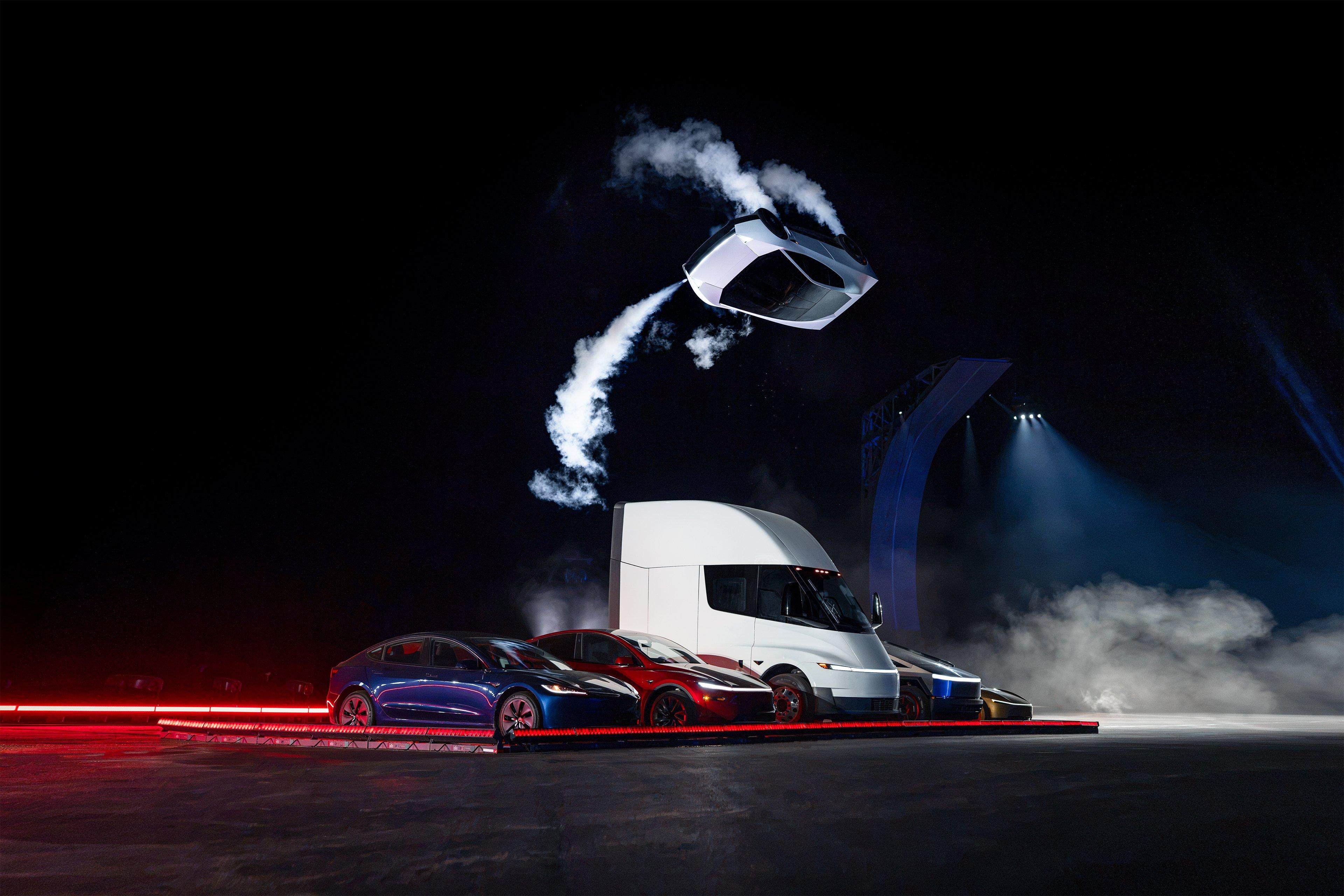
Tesla staged a late-night demonstration in Waco, Texas, in which a Roadster prototype climbed a multi-story ramp at a near-vertical angle, launched off the edge, performed a mid-air kickflip above a row of parked Teslas, and touched down using cold-gas thrusters. As pure spectacle, the stunt was genuinely striking: the car was fitted with roughly 600 liters of compressed air, ten directional cold-gas thruster nozzles, and a 2G suction-fan system that draws directly on SpaceX engineering. Tesla also claims a 0-to-60 mph time under one second.
The problem is what happens after the applause. The “Rocket” configuration shown on stage is described as invite-only, strips out the passenger seat to make room for high-pressure gas tanks, and trades everyday usability for brief bursts of thruster-powered levitation. Tesla itself concedes the setup will not be approved for public road use — which makes it difficult to call this a car reveal in any conventional sense of the phrase.
For buyers with the means to shop in this segment, the event also left out the basics. No pricing was announced, and no battery range figures were given. The Roadster’s range estimate has slipped from 600 miles to 300 miles, and the production timeline has been pushed out to 2028 — more than a decade after early reservation holders put down $50,000 deposits. Elon Musk has described the Roadster as a “small potato” project that will not move the needle financially the way mass-market models like the Model Y do, and has framed it as the last great driver’s car before autonomy reshapes Tesla’s lineup.
The stunt also lands in a segment that has not stood still. BYD’s Yangwang U9 Extreme uses four electric motors to produce a claimed 3,000 horsepower and reached 308 mph in testing, surpassing the 268 mph mark set by Rimac’s Nevera. The McMurtry Spéirling currently holds the quickest 0-to-60 record at 1.35 seconds. Tesla may beat that figure, but only independent testing will settle it. Meanwhile, Rimac, Porsche, and BYD keep delivering track-ready hypercars that customers can actually buy.
Some analysts have speculated that revisiting the Roadster is groundwork for a long-rumored Tesla-SpaceX merger, an idea Musk’s online following has actively encouraged. Whether or not that materializes, the demonstration served its apparent purpose: it dominated social feeds and reinforced Tesla’s self-image as a frontier technology company. As an engineering flex, it delivered. As a viable product, it remains out of reach.
What do you think?