
Tesla's Cybercab Touches Down in Australia as Unions and Uber Close Ranks
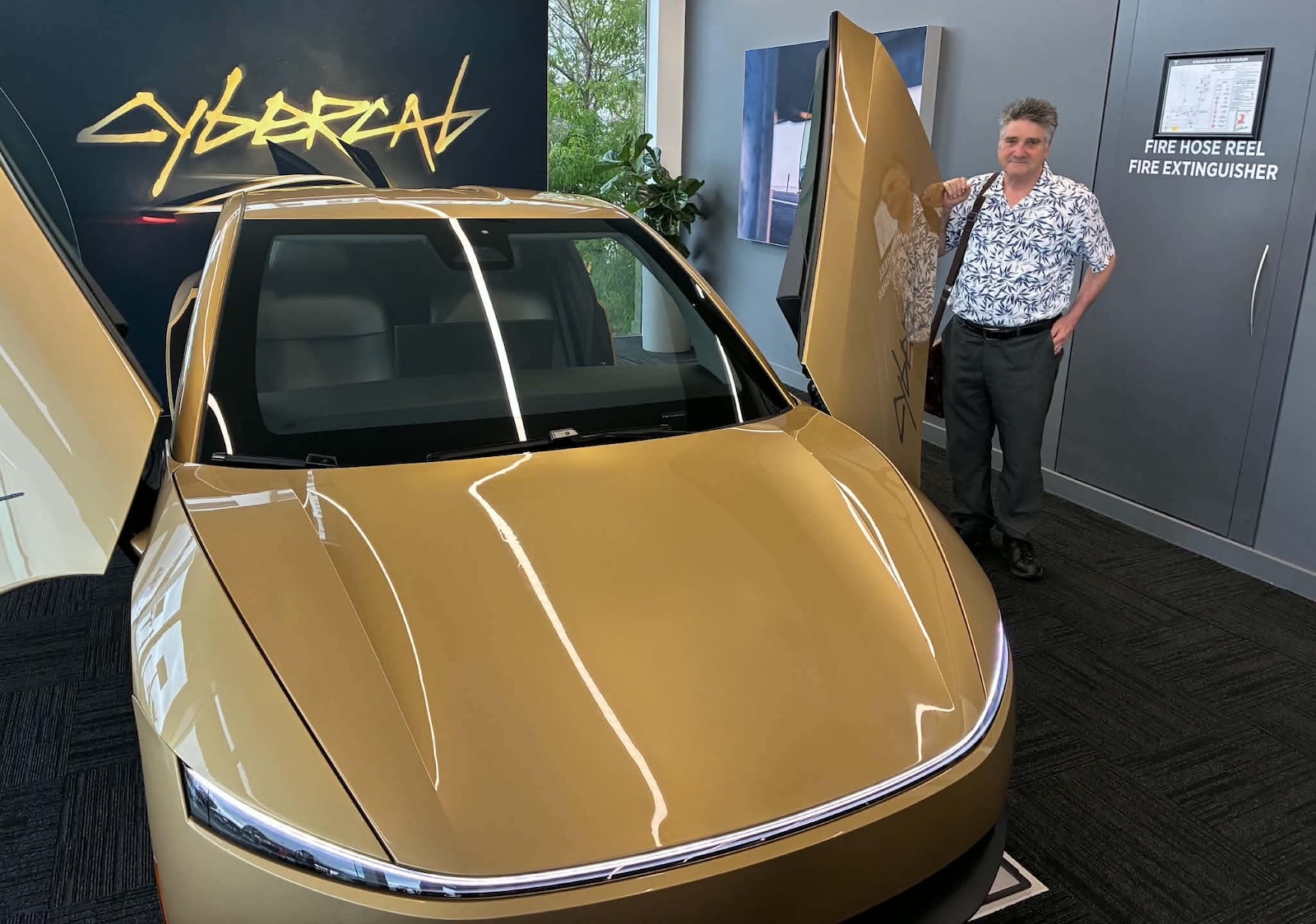
Tesla’s two-seat robotaxi is making the rounds Down Under. The Cybercab has been parked inside the Mt Gravatt showroom in Brisbane as part of a city-by-city tour, one week in each major population centre — roughly the same playbook Tesla ran with the Cybertruck a few years back. And we all know how that ended: the Cybertruck still isn’t on sale in Australia two years on, so nobody should read too much into a showroom appearance.
Staff at the Brisbane site said a steady parade of curious visitors had been filing through all week, though the crowd on the day we stopped by was thinner than expected. The car itself sat behind a barrier. Look, don’t touch. No steering wheel, no pedals — a detail that still stops people mid-step.
The Unlikely Alliance
While the Cybercab was drawing onlookers, the political weather was turning. The Transport Workers Union has thrown in its lot with Uber to shape how autonomous vehicles arrive in Australia. It’s a partnership that would have been unthinkable a decade ago, when the TWU fought Uber’s entry on behalf of taxi drivers. Now the two are on the same side of the table, lobbying state and federal lawmakers for tighter rules on driverless rollouts.
The union has around 60,000 members and claims seven in ten of them oppose driverless vehicles. It has also warned the Prime Minister about an electoral backlash. Uber, for its part, is pushing what it calls a hybrid network — a mix of autonomous platforms and human drivers rather than a pure robotaxi fleet. That position conveniently slows down rivals while keeping Uber in its familiar role as the middleman.
There’s a real-world consequence already. Melbourne-based toll road operator Transurban has paused scheduled autonomous commercial truck trials after union pressure over workforce consultation and safety.
Drivers Aren’t All Convinced They’re Doomed
Not everyone behind the wheel sees the robotaxi as the enemy. One Brisbane Uber driver who runs a Tesla Model Y reckons Tesla’s robotaxi network will be live in Australia within a year — and he intends to put his own car into it. Same income, less wear on his attention.
Another driver, Nathan Meritt, put the customer question bluntly: in his experience it’s still roughly a 50/50 split on whether riders would choose a driverless car or pay a premium for a human. He dismissed the union campaign as a loss leader.
Anecdotal cost comparisons are already circulating. One Australian EV owner who took the same trip in Florida on both a Tesla robotaxi and a Waymo came away struck by how much cheaper the Tesla option was. Hard numbers are scarce, though — if you’ve run that test yourself, the data would be worth seeing.
Regulation Is the Real Bottleneck
Sydney’s premier, Chris Minns, has said he’d ride in one and called it a good thing for the city, safety jitters notwithstanding. The ABC has reported that something like 700 regulatory hurdles stand between here and approval, with an expectation they could be cleared inside 18 months. That timeline feels optimistic to plenty of observers. My own guess, for what it’s worth, is approval landing somewhere just before Brisbane hosts the Olympics in 2032.
One driverless operator may end up smoothing the path for another. Waymo’s purely driverless commercial model is the thing spooking both Uber and the TWU, and whatever regulatory framework Waymo forces into existence will be there for Tesla to use too.
The road conditions themselves are a fair question. Anyone who has driven around Brisbane’s outer suburbs knows the line markings are not always cooperative. A cautious, geofenced start seems the likeliest scenario.
A Two-Seater and a Twelve-Year-Old’s Verdict
Plenty of people have grumbled that the Cybercab only seats two. The obvious answer is that those riders can hail a Model Y robotaxi instead, which is exactly the blended fleet the drivers I spoke to expect to see first — human safety operators establishing the reputation, then a mix of Cybercabs and Model Ys.
As for the shape of the thing: it looks like the future, which is presumably the point. If enough of them end up on Australian roads, the Cybertruck might stop looking so out of place.
The best take came from my twelve-year-old granddaughter. Asked a few years ago what car she’d buy when she was old enough, she said she wouldn’t buy one at all — she’d just call an Uber on her phone. Shown pictures of the Cybercab, she lit up at the missing steering wheel and pedals. Her future is coming into focus. Wait until she sees the Roadster.
Source: CleanTechnica
What do you think?