
Tesla on FSD Hits Parked CHP Cruiser in Fairfield, Driver Claims He Was Asleep
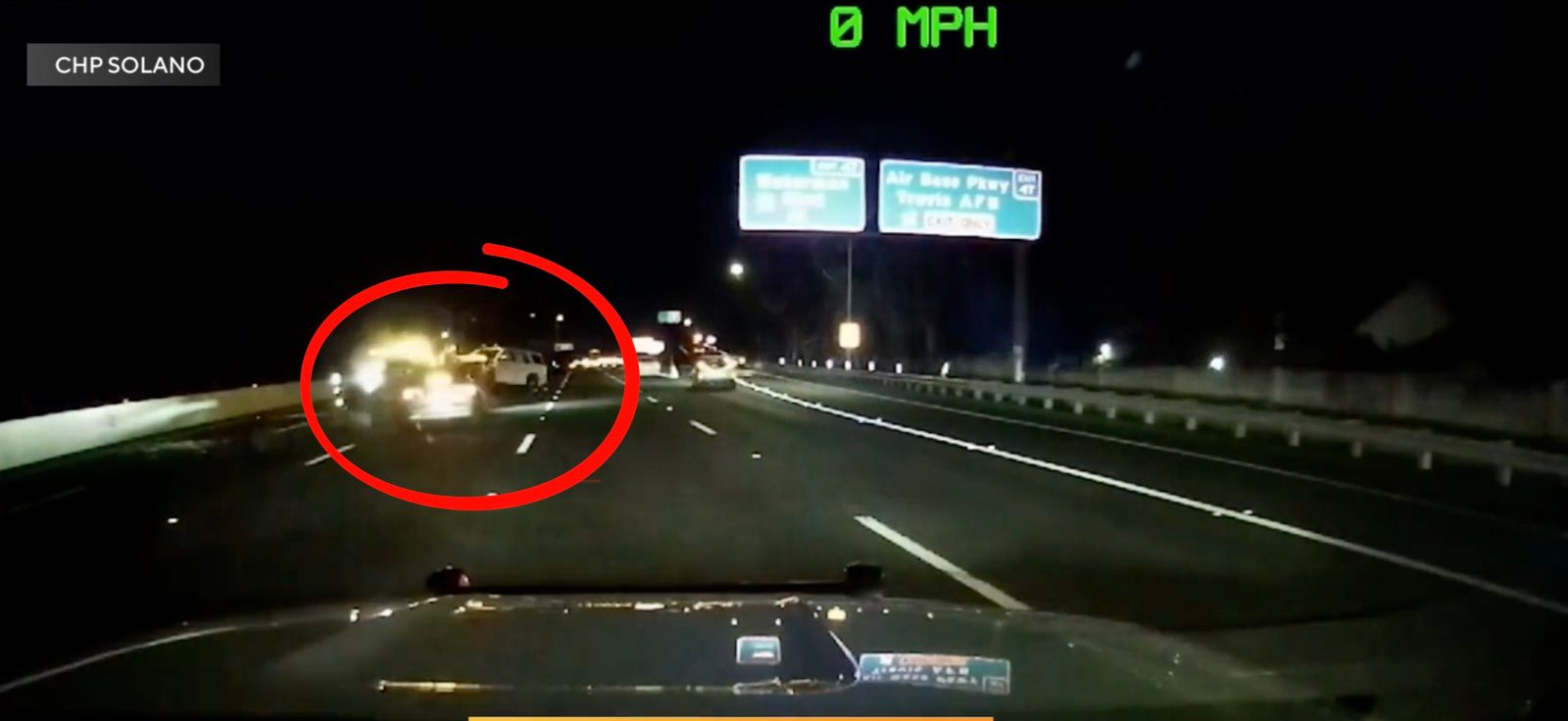
Two California Highway Patrol officers are nursing serious injuries this week after a Tesla slammed into their marked cruiser while it sat inside a closed-off stretch of Interstate 80 in Fairfield. The 22-year-old behind the wheel reportedly told investigators he had been sleeping while the car’s Full Self-Driving system was active.
CHP published dash camera footage of the strike on Thursday. One clip comes from the Dodge Charger patrol unit itself; a second was captured by another vehicle parked at the scene.
What the Scene Looked Like Before Impact
The collision came just before midnight on Tuesday, October 13, on eastbound I-80 west of Air Base Parkway. Officers had already been working a fatal wreck roughly an hour earlier — a 19-year-old from San Pablo lost control of a Honda Civic and was struck by a Chevrolet Tahoe. He did not survive.
By the time the Tesla arrived, four lanes were shut down and marked off with flares and cones, CHP said. The car reportedly came through the closure at highway speed and plowed into the Charger, with both troopers still seated inside.
The Tesla driver, a Sacramento resident, came away with only minor injuries. Neither investigation has been closed.
CHP used its statement to draw a line: FSD is an assistance feature, and the person in the driver’s seat remains responsible for paying attention and staying in control. “Technology does not relieve drivers of their responsibility to safely operate their vehicles,” the agency said. Officials have not named the Tesla model or the software build involved, and for now the driver’s account is the only suggestion the system was engaged. Vehicle logs should settle that question.
A Pattern Regulators Already Know
This is not unfamiliar ground. Back in August 2021, NHTSA opened a probe after a string of Teslas running Autopilot ran into stopped police cruisers and fire apparatus — frequently at night, with flares, cones and emergency lights already in place. That case wrapped with Tesla’s December 2023 recall of more than 2 million vehicles, remedied through an over-the-air update that added extra driver-attention prompts.
FSD hasn’t closed the gap. In June 2024, a Tesla operating on FSD struck a parked Fullerton police car while officers were working another fatal crash. That driver admitted he had been on his phone.
A night lane closure ringed with flares is about as unambiguous a “stop or move over” cue as a roadway offers. If the system was active in Fairfield, it went straight through one at freeway velocity.
The Monitoring Question
FSD (Supervised) relies on the cabin camera to confirm the driver is watching the road. It is designed to escalate warnings and eventually disengage if attention lapses. A driver genuinely asleep should not get far.
Which leaves two possibilities: he had only just nodded off, or the camera missed it. There’s no answer yet.
What is clear is that Tesla has been loosening this monitoring rather than tightening it — we recently reported how easily the system can be defeated, even by holding something as simple as a dollar bill in front of the lens. Last December, Elon Musk said FSD users can now text while driving “depending on context of surrounding traffic.” Texting behind the wheel is illegal in California.
Driver Fault and Corporate Fault Aren’t Mutually Exclusive
The driver bears responsibility, full stop. Falling asleep at freeway speed and nearly killing two officers who were already cleaning up after a fatal crash deserves consequences, and CHP is right to say so.
But Tesla doesn’t get to step away from this either. It sells a product called “Full Self-Driving” in the US, agreed this month to drop that name in Europe after German regulators called it misleading, and its CEO tells owners they can text with it engaged. Tell people the car drives itself, and some of them will believe you. A 22-year-old heading home at midnight is exactly who believes you.
This is the complacency trap I’ve written about for years: FSD becomes more dangerous as it becomes more capable. Scroll social media and you’ll find legions of Tesla fans convinced the system is dependable enough to check out. It plainly isn’t. Juries are catching on — Florida’s $243 million Autopilot verdict assigned a third of the blame to Tesla, and the Katy, Texas FSD crash earlier this year showed the same dynamic from a different angle.
And the technical failure stands. Emergency scenes are precisely the scenario NHTSA identified in 2021. Five years and a 2-million-vehicle recall later, a Tesla running the company’s most advanced driver-assist software allegedly drove into one anyway. Musk keeps promising unsupervised FSD on customer cars. If Tesla wants the driver out of the loop, will it accept the liability for crashes like this? Until it does, it shouldn’t be telling anyone it’s fine to look away.
Source: Electrek
What do you think?