
Tesla Robotaxi Extends Austin Hours—Why Night Driving Remains Its Hardest Problem
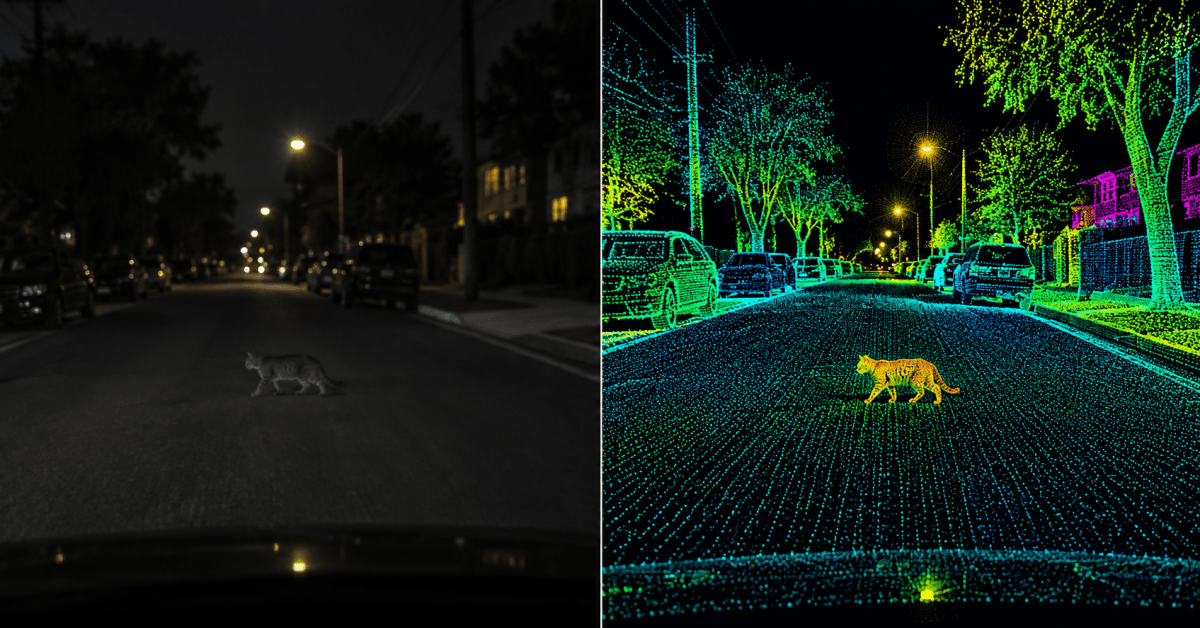
Tesla has stretched the operating window for its Robotaxi service in Austin by one hour, pushing the nightly cutoff from 10 PM to 11 PM. The small change drew an explanation from CEO Elon Musk, who framed the challenge in deceptively simple terms: the system struggles to spot small, low-contrast objects in darkness, and his example was a “grey kitten on grey tarmac.” It is a vivid illustration of a well-documented limitation of camera-only perception—when an object blends into its background and light is scarce, passive optical sensors have very little to work with.
That specific failure mode is precisely what active sensors were built to address. A camera depends on ambient light bouncing off objects and on those objects standing out from their surroundings. Lidar, by contrast, emits its own laser pulses and measures the return time, generating a precise three-dimensional shape and distance for whatever occupies the road—day or night, and regardless of whether the object happens to match the asphalt in tone. Radar performs a comparable role using radio waves and adds velocity information, and it keeps functioning through fog, dust and glare. The industry’s leading driverless operators deploy all three sensor types together; Waymo’s latest hardware generation pairs 13 cameras with 4 lidars and 6 radars across a fleet that runs around the clock.
Tesla has charted a deliberately different course. The company stripped radar from its vehicles in 2021, removed ultrasonic sensors the following year, and has never shipped a production car with lidar. Musk has repeatedly dismissed those sensors publicly—calling lidar a “fool’s errand” in 2019, a “seductive local maximum” in 2022, and later arguing that combining sensor types can create contention that undermines safety. Yet as far back as 2021, he acknowledged in private correspondence that vision supplemented by high-resolution radar would outperform vision alone. Federal regulators are currently examining a large population of Teslas over crashes involving Full Self-Driving in reduced-visibility conditions.
The episode also highlights a practical inconsistency. In Austin, sunset currently falls shortly after 7 PM, meaning the Robotaxi fleet is already operating in full darkness for hours before its new 11 PM stop—well after the point Musk describes as the unresolved problem. Customer-owned Teslas running the same camera-based software face no such curfew. Meanwhile, competing autonomous services continue operating through the night without interruption. And the long-standing argument that lidar is prohibitively expensive is weakening: Rivian recently indicated that adding lidar to a vehicle now costs only a few hundred dollars. What was once a costly differentiator increasingly looks like a routine component—which raises the question of how many more incremental hour-by-hour extensions Tesla will make before revisiting the sensor question outright.
What do you think?