
Tesla Cybercab Sheds Door Skin in Philadelphia Street Incident
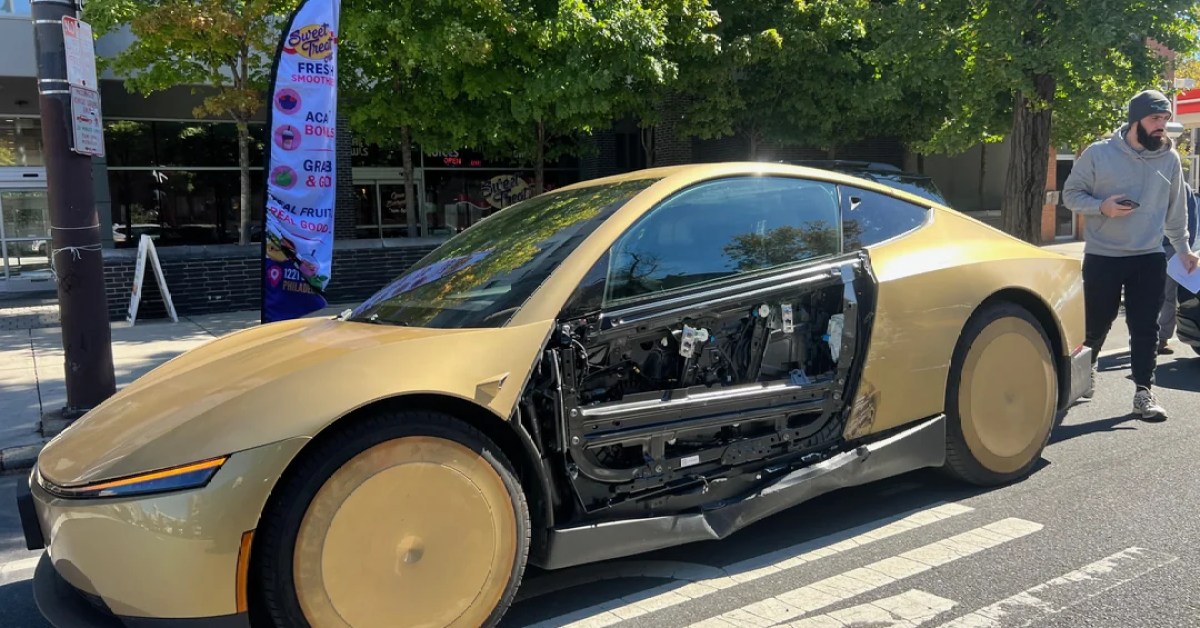
A gold Tesla Cybercab turned up on South Broad Street in Philadelphia this week with a striking bit of damage: the entire outer skin of its driver-side door was gone, leaving the inner frame, window regulator and wiring fully visible to passersby. The images, shared on Reddit by a user who goes by ryephila, show a car stopped roughly a mile south of City Hall. The glass survived intact, the underlying structure doesn’t appear bent, and the remaining harm is minor — a crumpled rocker trim below the door and some scuffs toward the rear quarter panel. The person who posted the photos didn’t witness the collision, but described it as looking like a low-speed incident that tore the left door panel away. A dark sedan visible in a second shot isn’t clearly connected to the event, and there’s been no information about injuries.
Plastic that is meant to pop off
What looks dramatic on camera may actually reflect the Cybercab’s construction philosophy. Tesla skips paint entirely on the vehicle; its panels are molded plastic with the color blended into the material itself. Engineering lead Lars Moravy and design chief Franz von Holzhausen explained the approach to Sandy Munro last year, describing a colored outer skin bonded to a plastic backing and secured with fasteners accessed from inside the cabin. A door skin that detaches as one piece is therefore close to the intended behavior of that architecture. On a conventional steel-bodied car, the same impact typically means a dented door, a trip to the body shop and a paint booth. Theoretically, Tesla can simply attach a fresh skin and return the car to service — though the visible damage near the bottom of the door could make that less straightforward than it sounds.
Why the car was on Broad Street at all is the more consequential question. Pennsylvania requires a certificate of compliance from PennDOT to operate what it calls a highly automated vehicle — meaning SAE Level 3 or above, whether or not a person is aboard. Only seven entities hold that certification, and Tesla is not among them. Waymo is, with clearance to run in Philadelphia with a driver present. Gold Cybercabs began appearing around the city in mid-September, with several photographed at a Tesla store in Devon, and the company declined to explain their purpose at the time.
Without the certificate, the vehicle on Broad Street was most plausibly either hand-driven or operating Tesla’s software as a Level 2 driver-assist system, which keeps legal responsibility with a human behind the wheel. Tesla has been installing Cybertruck steering wheels into test Cybercabs for exactly that kind of work, though the photos don’t reveal whether this particular car had one.
That distinction shapes whether the incident lands in federal records. NHTSA’s Standing General Order compels reporting for crashes involving automated driving systems even when the sole consequence is property damage above a set threshold. A Level 2 crash is only reportable if someone dies, is hospitalized, an airbag deploys, or a pedestrian or cyclist is struck. If it qualifies, it would join the agency’s database as a driver-assist case, alongside the record 207 Autopilot and FSD crashes Tesla reported in a single month earlier this year — entries that, like the rest of Tesla’s, come with the narrative description redacted.
Questions remain open. Nobody knows who struck whom, and if a human driver drifted into the Cybercab’s path, Tesla’s software played no role. The panel is the most revealing detail: it separated cleanly with the structure beneath apparently unharmed, which could mean a cheap, unpainted plastic skin absorbed the hit and can be swapped in short order — or that a body panel releases too readily and ends up loose on a city street after a glancing blow. A couple of photographs can’t settle that.
What do you think?