
TDK Unveils DC-Link Film Capacitors Built for 135°C Operation
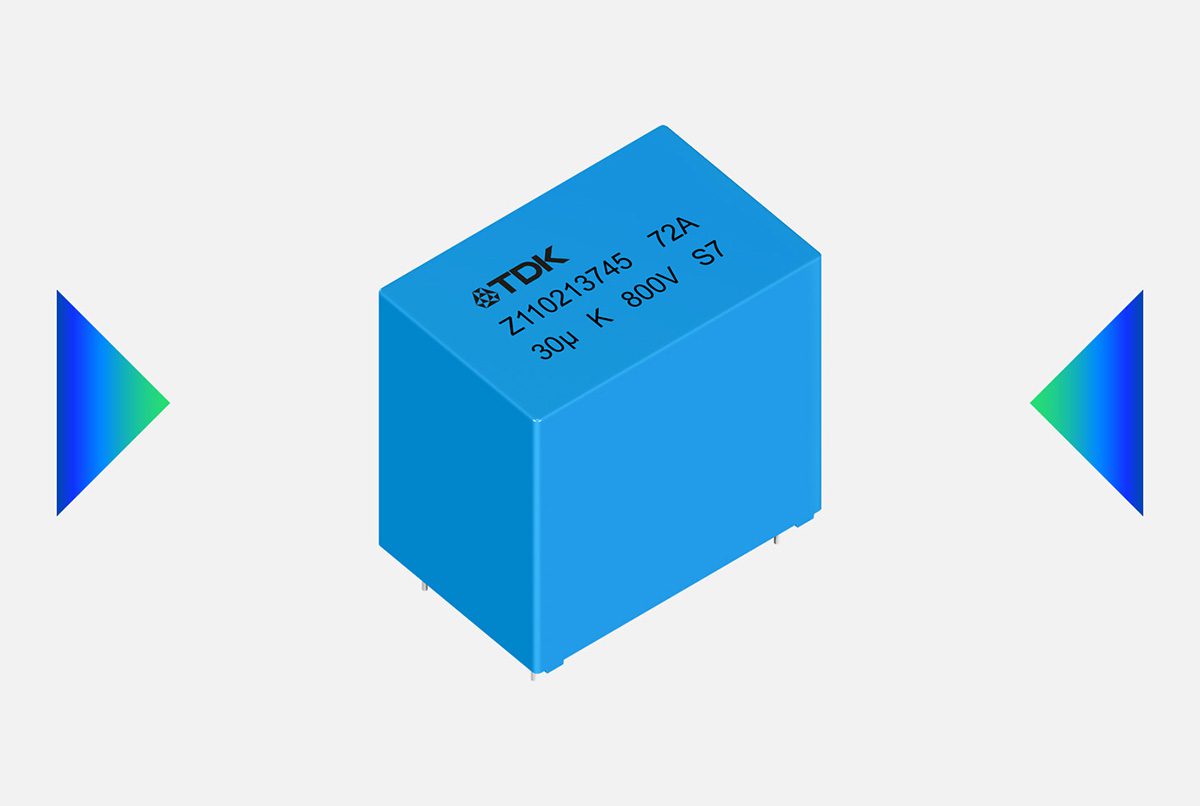
TDK has expanded its passive component lineup with the B3272*A/G/T family of DC-link film capacitors, a series the company says can run continuously at case temperatures reaching 135°C. Notably, the parts hold their full ratings without any derating up to 105°C — a detail that matters in power electronics where heat is the constant enemy of longevity.
The core of the new series is TDK’s EPN dielectric, a material blending polypropylene with cyclic olefin copolymer. TDK notes this same dielectric has already seen service in its ModCap UHP power capacitors, giving it a track record the company can point to. By raising the thermal ceiling, the design aims to give engineers more breathing room when laying out DC-link stages for automotive and industrial power conversion.
To understand why this matters, consider the DC-link capacitor’s job. It sits between the power source and the switching stage, soaking up ripple current that would otherwise disturb the circuit. That ripple current generates heat inside the film, and heat traditionally forces designers to either derate the capacitor or add cooling measures. TDK points to the broader trend of higher power density, shrinking enclosures and hotter ambient conditions as the forces squeezing passive components in inverters, on-board chargers and DC-DC converters.
The electrical specs cover rated DC voltages from 800 V to 1,200 V and capacitance values spanning 1.0 µF to 60 µF. TDK offers the parts in two-pin and four-pin configurations, with lead spacings of 27.5 mm, 37.5 mm and 52.5 mm. Maximum RMS current, measured at 85°C and 10 kHz, ranges from 3.5 A to 24 A depending on the variant. TDK rates useful life at 100,000 hours when operated at rated voltage and 85°C, and lists self-healing behavior and overvoltage tolerance among the series’ characteristics.
TDK highlights two versions for specific layout challenges. The four-pin G types are positioned for low-inductance busbar interfaces, helping cut parasitic loop area in fast-switching inverter stages. Meanwhile, the low-profile B32726T targets assemblies where vertical space is at a premium, such as compact automotive and industrial builds. On the compliance side, the series carries a flame-retardant plastic case with epoxy resin sealing rated to UL 94 V-0, along with AEC-Q200E qualification and RoHS compatibility. For designers looking to model the parts before committing to a layout, TDK supplies SPICE model libraries and its web-based Capacitor Life And Rating Application (CLARA) tool.
What do you think?