
Chlorine Boost Could Push Lithium-Sulphur Cells Past 1,700 Wh/kg
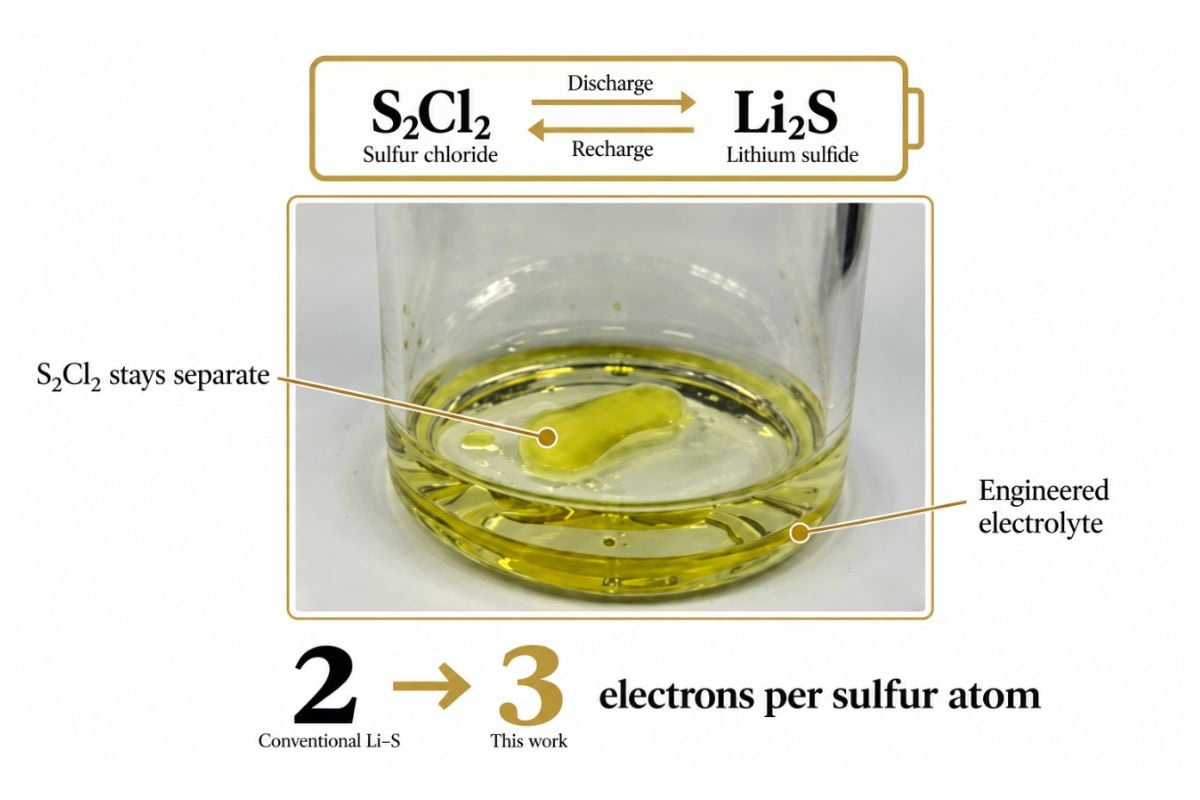
Lithium-sulphur chemistry has been sitting in the “promising but impractical” drawer for years. Sulphur is cheap, plentiful and theoretically stores far more charge per kilogram than the cobalt-and-nickel cathodes used in today’s lithium-ion packs, yet nobody has managed to make it survive enough charge cycles to matter. A joint research effort from two US universities now claims to have found a way around one of the chemistry’s foundational limits — by asking sulphur to do more work than it normally does.
The team, drawn from Vanderbilt University in Tennessee and the University of Maryland, published its findings in Nature Energy. Their idea is deceptively simple: introduce chlorine into the reaction so that each sulphur atom handles three electrons instead of the usual two. That extra electron transfer lifts the cell’s average operating voltage from roughly 2.05 volts to 2.54 volts while simultaneously raising how much charge the sulphur can hold — an increase the researchers put at about 58 per cent in laboratory measurements.
Combined, the two effects are what produce the headline figure. In the experimental test cell, a single kilogram of sulphur was able to store upwards of 1,700 watt-hours of energy. Getting there required more than just mixing in a halogen, however. Chlorine is aggressive by nature, and the sulphur-chlorine intermediate that forms during discharge has a habit of dissolving and drifting toward the lithium-metal anode, which would kill the cell quickly. To hold it in place, the group ran molecular simulations to design an electrolyte that keeps chlorine chemically active while preventing that migration. Several spectroscopic methods were then used to verify that the sulphur really does pass through the new state again and again as the cell charges and discharges.
Durability remains the open question. A pouch cell built for the experiment held on to 78 per cent of its original capacity after 100 charge cycles — a decent early result but well short of what automotive duty cycles demand. The prototype also relies on a lithium-metal anode and consumes more electrolyte than a production design could afford, both of which flatter the numbers. When every essential component is counted rather than just the electrode, the researchers estimate a cell-level gravimetric energy density of 477 Wh/kg — about 37 per cent above comparable conventional lithium-sulphur systems, though still a projection rather than a measured pack figure.
“The traditional way of thinking about lithium-sulphur batteries leaves some of sulphur’s redox capacity untapped,” said De-en Jiang, Professor of Chemical Engineering and Chemistry at Vanderbilt and a co-corresponding author of the study. “We wanted to see whether we could expand sulphur’s redox capability and use it to store more energy.” Whether that untapped capacity ever reaches a vehicle floor is a long way off, but the result gives sulphur chemistry a fresh mechanism to build on rather than another incremental nudge.
What do you think?