
TDK Adds 1,000 V and 1,500 V Gas-Filled Contactors to Its High-Voltage Lineup
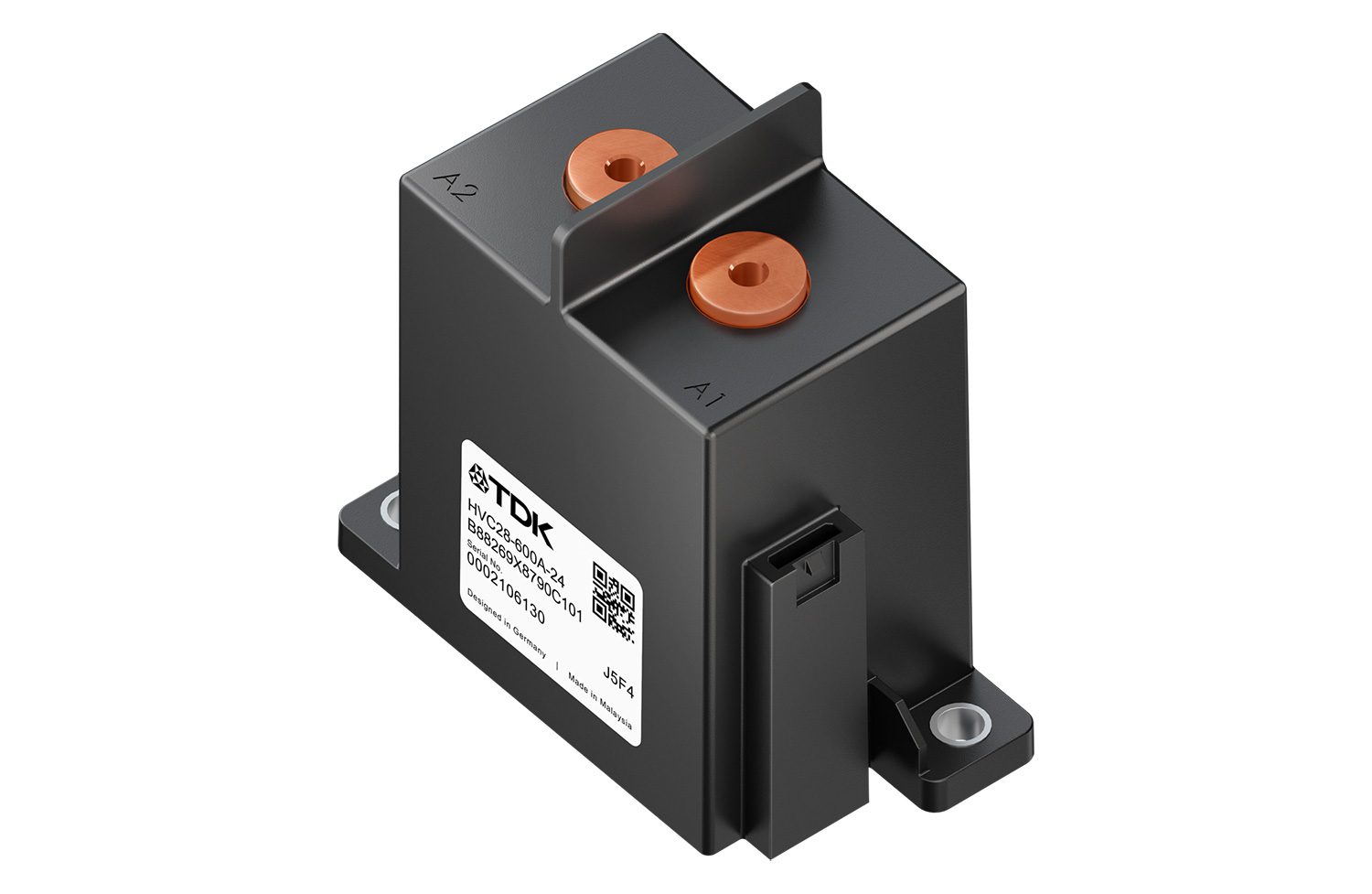
TDK is expanding its high-voltage switching portfolio with two new families of gas-filled DC contactors. The HVC28 targets automotive systems running up to 1,000 V DC, while the HVC29 is built for industrial installations that reach 1,500 V DC.
The parts are aimed squarely at the hardware that sits between a battery pack and everything downstream of it: disconnect units, junction boxes, and the DC fast chargers that feed them.
Where the Two Series Differ
The two contactors share a footprint but split on electrical headroom. The HVC28 is the automotive-facing part, rated for traction battery systems in passenger cars and commercial vehicles, xEV battery disconnect units, high-voltage junction boxes, and DC fast-charging stations.
Its short-circuit capability is 16 kA for 5 ms, and under specified resistive-load test conditions it can perform one maximum cut-off at 1,600 A and 1,000 V.
The HVC29 is the industrial sibling. Short-circuit capability drops to 6 kA for 5 ms, but the series is pitched at energy storage systems, solid-state transformers, uninterruptible power supplies, and DC fast chargers. TDK also notes it can support 800 V DC architectures in AI data centers.
Key Specs: 300 A, 400 A, 500 A or 600 A continuous ratings · 12 V or 24 V single-coil versions at 6 W · 95.5 x 96 x 49 mm · 640 g (HVC28) / 630 g (HVC29) · −40 °C to 85 °C
The Engineering Inside
Both series rely on a ceramic, gas-filled arc chamber to break DC current, a design choice that matters because DC arcs do not self-extinguish the way AC arcs do. TDK also made the main terminals polarity-free, so current can run in either direction without a wiring penalty.
An integrated connector is meant to trim the work of low-voltage hookup during system assembly. And for safety-critical designs, there is an optional normally closed mirror contact that gives mechanically linked feedback on the state of the main contact — useful for switching-state monitoring in automotive and industrial systems alike.
Compliance and Availability
- Standards: CE and UKCA compliant, certified to UL 60947-4-1
- Mirror contact: Conforms to IEC 60947-4-1
- Current ratings: Four options per series, from 300 A to 600 A
Why the 800 V Data Center Line Matters
The industrial angle is the more interesting part of this launch. Contactors are unglamorous components — nobody specs a car because of one — but they are the gatekeepers between a high-voltage pack and the rest of the system.
As EV platforms climb past 800 V and charging infrastructure pushes toward higher power, the switching hardware has to keep pace. TDK is betting the same component can serve both the vehicle side and the stationary side, where battery storage and AI data center power racks are converging on similar voltage classes.
That overlap is not accidental. It is the same insulation, arc-quenching, and feedback problem in two different boxes.
Photo: TDK / Charged EVs · Official Press Kit / Editorial (Editorial / Press Kit)
Source: Charged EVs
Curious how this compares to other EVs? Try our comparison tool →What do you think?