
SpaceX Details Plan for a One-Million-Satellite Orbital AI Network
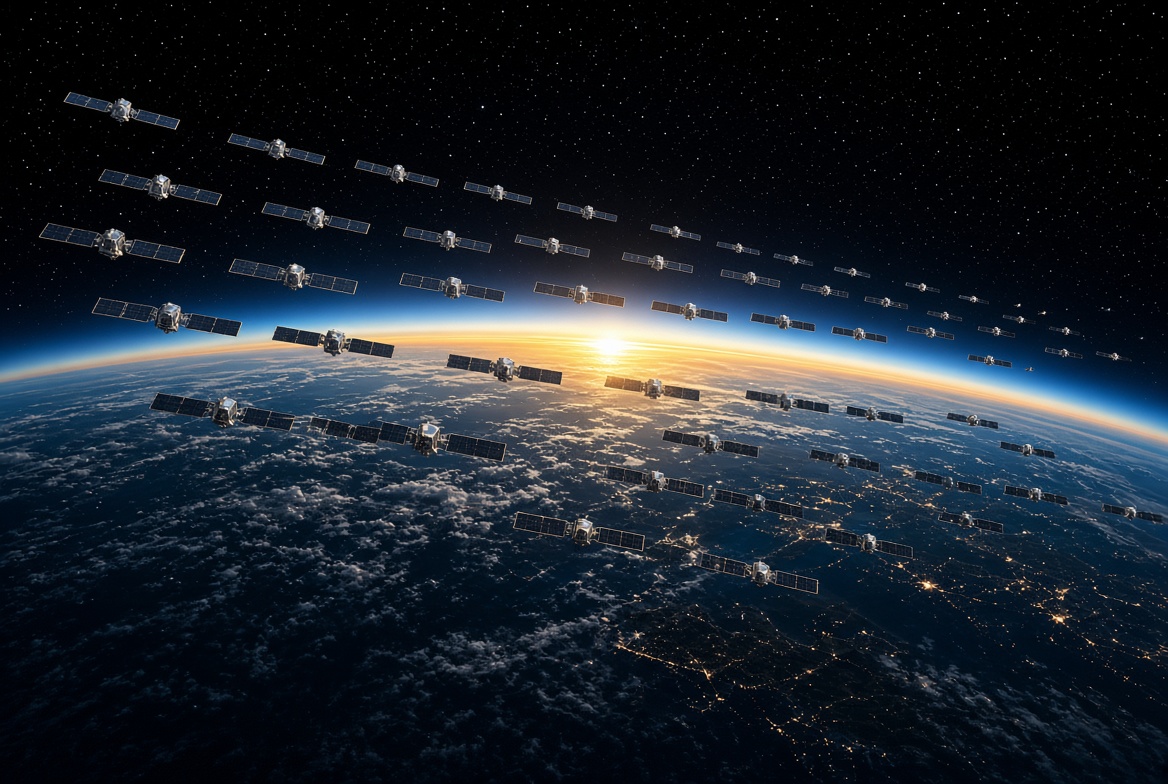
SpaceX has publicly committed to the largest satellite fleet any operator has ever proposed, and it argues the whole plan hinges on other companies changing how they share information in orbit. On a newly published Space Safety page, the company says it intends to run as many as 100,000 Starlink broadband satellites alongside up to one million “Starmind” AI satellites, a figure far beyond anything previously stated.
The numbers underline how aggressive the ambition is. Roughly 11,000 Starlink craft are in orbit today, so the broadband target alone would mean about a ninefold increase. Starmind is SpaceX’s orbital AI compute constellation; CEO Elon Musk confirmed the name in June after a trademark filing by xAI surfaced, and by August the company said it was developing the compute payload with Nvidia. US regulators accepted a filing for up to a million satellites in February.
SpaceX also published a new concept render of a full Starmind constellation and offered its most concrete technical description yet. Vice President Michael Nicolls explained that the satellites will not fly as independent machines: clusters of roughly ten spacecraft will be linked by about 10 terabits per second of inter-satellite bandwidth so they can pool enough coherent compute to run AI models, then pass results back to Earth through Starlink’s laser links.
Packing hardware that densely makes collision avoidance the defining challenge, and much of the safety page is addressed to rival operators. SpaceX says Starlink faced collision risks involving about 650 maneuvering third-party satellites in 2026, with only around half of those operators sharing their data. It logged roughly 164,000 additional risk events over six months in which the closest approach occurred within four hours of an unannounced maneuver. Some companies cite proprietary concerns, others lack government clearance to disclose plans; SpaceX calls those practices counterproductive and says they create avoidable danger. It is offering a free ephemeris-sharing and screening service that returns risk assessments within a minute, supported by its 30,000-sensor Stargaze optical network.
The proposal is drawing pushback from astronomers and environmental groups. In a September FCC filing, SpaceX said each Starmind satellite could weigh as much as 4,000 kilograms, nearly seven times a Starlink V2 Mini. Musk has dismissed fears about orbital crowding, saying in June that space is vast and that the company already knows how to run very large constellations safely. SpaceX says its Gigasat factory in Bastrop, Texas, is built to mass-produce the AI satellites, with thousands of deployments potentially beginning as early as late 2027.
What do you think?