
Reach Stackers Look Like a Hydrogen Job, But Ports Keep Ordering Battery-Electric Units
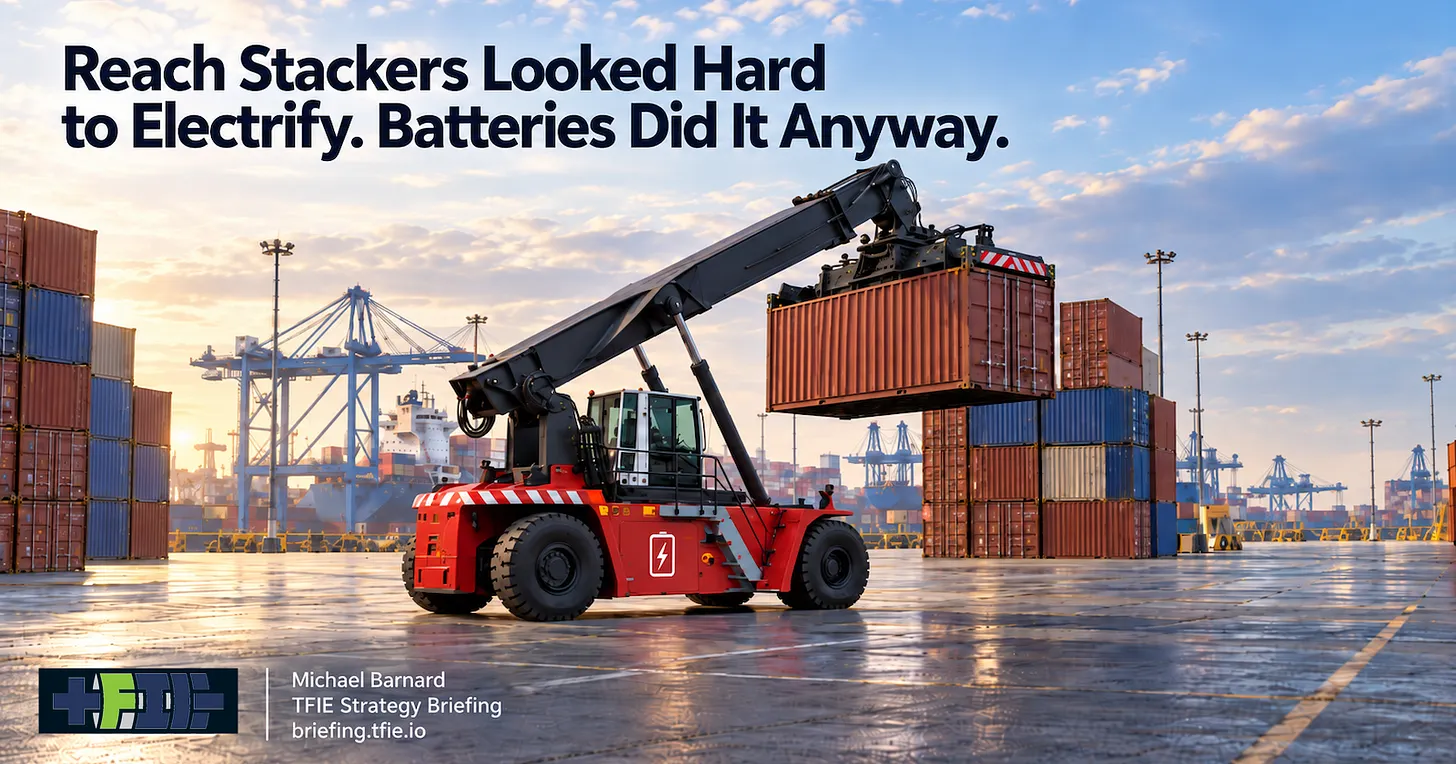
On paper, a reach stacker seems like the last machine you would try to run on a battery. The biggest units tip the scales past 70 tonnes before they even grab a container, and they spend their days hoisting 40-tonne boxes several rows deep and several high in crowded freight yards where uptime is everything. Yet the equipment market is heading in the opposite direction, with electric machines gaining ground rather than hydrogen.
A rough global tally of the fleet suggests around 1,500 battery-electric reach stackers are in service, close to 15 percent of an estimated 9,300 machines worldwide, and electric models may now account for nearly a fifth of new production. The apparent contradiction fades once the machine is judged by how it actually works rather than by its weight. Reach stackers creep over short, paved distances, drawing huge power in bursts for lifting and hydraulics while spending much of the shift idling or waiting for trucks and containers to line up. Reliance Transport in New Zealand reports that its 74-tonne electric unit consumes roughly 33 kWh per operating hour while covering full eight-hour shifts and around 100 container moves on a busy day.
That energy profile reshapes the charging question. Some machines simply carry a large enough pack, with recent commercial models using batteries around 500 kWh and claiming eight to ten hours or more of runtime. Others top up during pauses that already exist in the schedule. Kalmar, for instance, designed its solution around high-power charging during ordinary coffee and meal breaks, spreading an hour of charging across periods when the operator would not have been driving anyway. Battery swapping exists for unusually intense operations, especially in Chinese equipment, but most fleets meet the utilization challenge simply by matching battery size and charger output to the existing work cycle.
The commercial record is starting to speak louder than the spreadsheets. Repeat purchases stand out: Westport went from one Kalmar electric reach stacker to an order for four more, Portonave is adding five after running its first, Helsingborg has set up a framework for as many as nine, and APM Terminals expects to buy or retrofit roughly 500 over the coming decade. Hydrogen, by contrast, has produced pilots without the follow-on fleet orders — the Port of Valencia ran an EU-funded Hyster fuel-cell prototype for a few months in 2023 and later turned to battery-electric evaluation, while Tilbury has begun a pre-production trial of an updated hydrogen unit. A machine that looks like it needs a dense fuel turns out to have a high-power, comparatively low-energy duty cycle inside a small, predictable geography — which is why ports keep buying batteries.
What do you think?