
Osaka Explores Turning Rooftop Rescue Pads Into eVTOL Vertiports
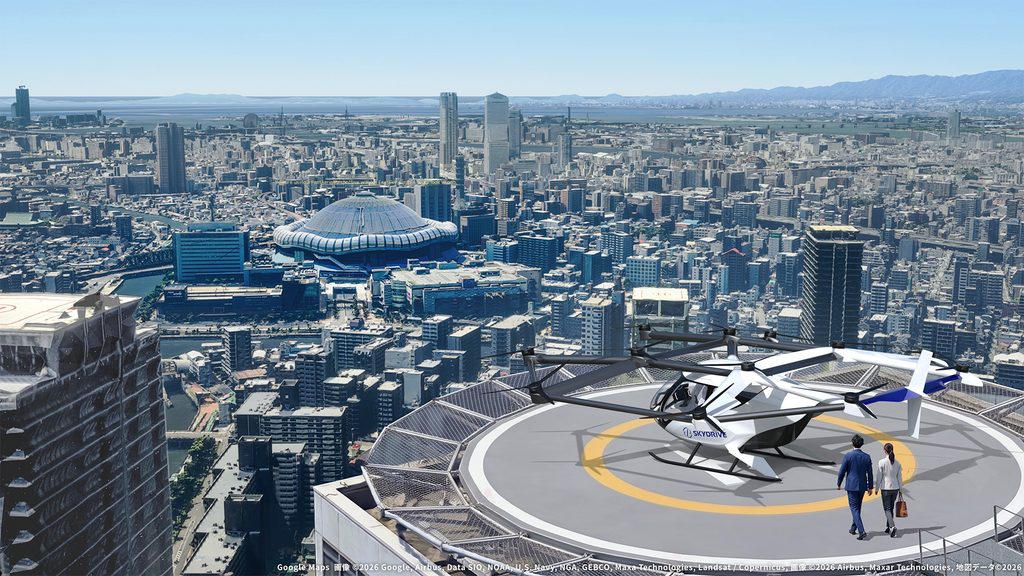
Osaka is looking upward — literally — for its next aviation move. City and prefectural authorities have joined forces with SkyDrive, Osaka Metro, Kansai Electric Power and several other organizations to investigate whether the city’s existing rooftop emergency landing pads can double as vertiports for electric vertical take-off and landing aircraft.
The feasibility study falls under Japan’s Cabinet Office Super City Initiative and builds on earlier work between SkyDrive and Osaka Metro involving eVTOL demonstrations staged during Expo 2025 Osaka. If the concept proves workable, the partners are aiming toward a possible commercial eVTOL operation across Osaka Prefecture and Osaka City starting around 2028.
Osaka City currently maintains 146 rooftop emergency landing sites, most of them atop buildings taller than 100 metres. Originally built for disaster response, these pads already feature reinforced flooring, fire suppression equipment and lighting. The study asks whether that same infrastructure could offer supplementary landing options for eVTOL services — chiefly as alternate vertiports when an aircraft cannot reach its intended destination — instead of requiring brand-new vertiports in tightly built-up districts.
Evaluators will dig into a wide range of technical and operational questions: surrounding airspace, obstacle clearance, wind patterns generated by buildings, and noise produced during take-off, landing and cruise. Structural load capacity and passenger movement during diversions are also on the checklist, as are charging equipment installation and the electrical receiving and transformer upgrades individual sites might need. Cost estimates for converting each location will be compiled as well.
A further thread concerns emergency procedures and how commercial eVTOL flights would coexist with the rooftops’ original disaster-response purpose. SkyDrive and its partners intend to collaborate with bodies such as the Osaka Municipal Fire Department to define operational scenarios and safety protocols. Osaka Metro is steering the project and coordinating both the facilities under review and stakeholder discussions, while SkyDrive is responsible for survey methodology and operational requirements. Kansai Electric Power will evaluate existing electrical gear and charging needs, Chodai will assist with technical analysis of obstacle limitation surfaces, and the Airport Environment Improvement Foundation will look at noise-related factors.
What do you think?