
NHTSA Wants Blue-Green Lights to Tell You an AV Is Driving Itself
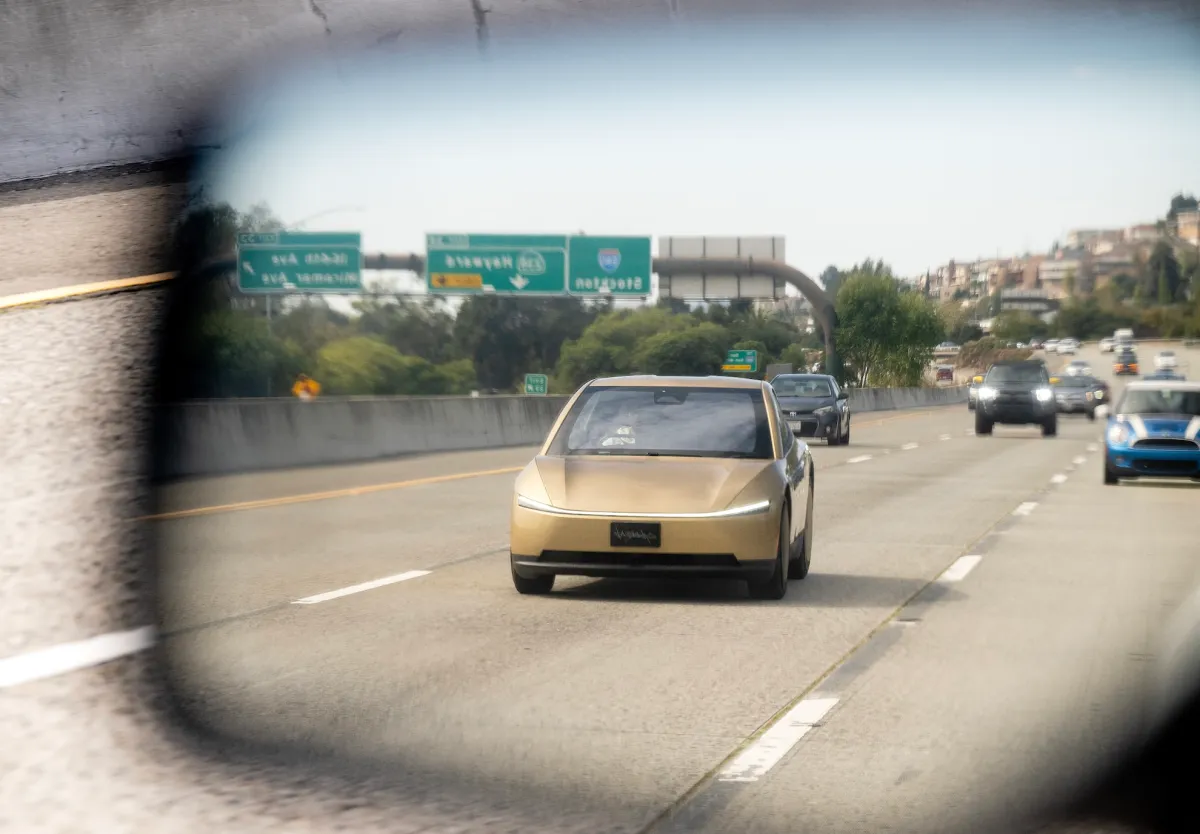
Federal safety regulators have a surprisingly low-tech idea for one of the industry’s most complicated problems: let a car tell you, with a glow, that nobody is watching the road.
The National Highway Traffic Safety Administration has floated new lighting rules for autonomous vehicles. The centerpiece is an option — not a mandate, regulators are quick to point out — to fit cyan (blue-green) lamps that stay lit whenever an AV is running in autonomous mode without a human occupant monitoring the drive.
It’s a visibility play as much as a technical one. Pedestrians, cyclists and other drivers currently have no consistent way to know whether the car rolling toward them has a person at the wheel.
What the proposal actually changes
The suggested package is specific about the hardware:
- Color: cyan, or blue-green
- Behavior: steady illumination, not flashing
- Visibility: front, rear and both flanks of the vehicle
- Mounting: the rule sets out where the lamps sit and how they switch on
The proposal also drops the requirement for manual controls on turn signals, high beams and hazard lights — controls that make little sense in a car with no driver.
NHTSA administrator Jonathan Morrison framed the move as one piece of a wider regulatory update, aimed at smoothing AV adoption without trading away safety. The agency is separately at work on a federal automated vehicle framework and is revisiting the Federal Motor Vehicle Safety Standards — rules written long before anyone imagined vehicles without pedals or steering wheels.
That gap is real. Machines like the Tesla Cybercab and the Zoox robotaxi were never designed around FMVSS assumptions, and features such as side mirrors and rearview mirrors have no obvious place on them.
The blue-green light idea won’t settle the AV debate on its own. But a shared visual cue is the sort of unglamorous infrastructure that makes a new class of vehicle legible to everyone sharing the road with it.
GM draws its own roadmap
While Washington drafts rules, General Motors used its annual GM Forward event to sketch out where it intends to sit in that future — and this time it brought dates.
The automaker is rebuilding the electrical and computing backbone of its next-generation vehicles. The goals: faster software, stronger automated driving capability, and a conversational AI assistant that will replace the 30-year-old OnStar service.
All of it lands first in 2028, inside the Cadillac Escalade IQ. That same year, GM plans to launch an autonomous highway driving feature that lets drivers take their hands and eyes off the road — and, notably, not hover ready to grab the wheel back.
GM’s bet: an overhauled vehicle architecture in 2028, a hands-off highway system the same year, and enterprise AI applied company-wide to cut its four-to-five-year development cycle roughly in half.
Legacy automakers have promised Tesla-chasing pivots before. This one reads less like a response and more like preparation for a longer contest.
Simulation gets a buyer
Rivian has acquired Third Dimension, a U.K. startup founded by gaming and autonomous-driving veterans that turns images and video into lifelike 3D environments.
The target is the gap between driving data and virtual worlds that behave like the physical one. James Philbin, who leads autonomy at Rivian, described the need as closing the “sim-to-real gap” — the mismatch between what a system learns in simulation and what it meets on the road.
Yes, simulation has been an AV staple for years. It is also still evolving, and small specialist teams are exactly what larger players go shopping for. Terms weren’t disclosed; Third Dimension had raised a $7 million seed round and employs roughly 15 engineers, and the deal was small enough that Rivian didn’t flag it in an SEC filing.
Around the paddock
- inDrive, the ride-hailing firm that lets riders and drivers haggle over fares, has signed a memorandum of understanding with China’s Pony.ai and Nvidia to test robotaxis in Kazakhstan starting in 2027.
- Reliable Robotics, which builds autonomous flying tech that can be retrofitted to existing aircraft, raised $115 million — a Series D extension split between $90 million in equity led by Nimble Partners and $25 million in debt from Silicon Valley Bank. The round now totals $275 million and pushes the company’s valuation past $1 billion.
- Waymo plans to bring robotaxi service to Madrid, with riders expected on board in 2027. Closer to home, it now runs trips to and from Harry Reid International Airport in Las Vegas.
- GM is closing a plant south of Detroit that assembled battery packs for the Cadillac Celestiq and electric drive units and packs for the Chevrolet Corvette E-Ray plug-in hybrid. A spokesperson said the lease was expiring, not a change in EV strategy.
Source: TechCrunch - Transportation
What do you think?