
Kodiak Signs First Binding Deal to Put Driverless Trucks on Open Highways
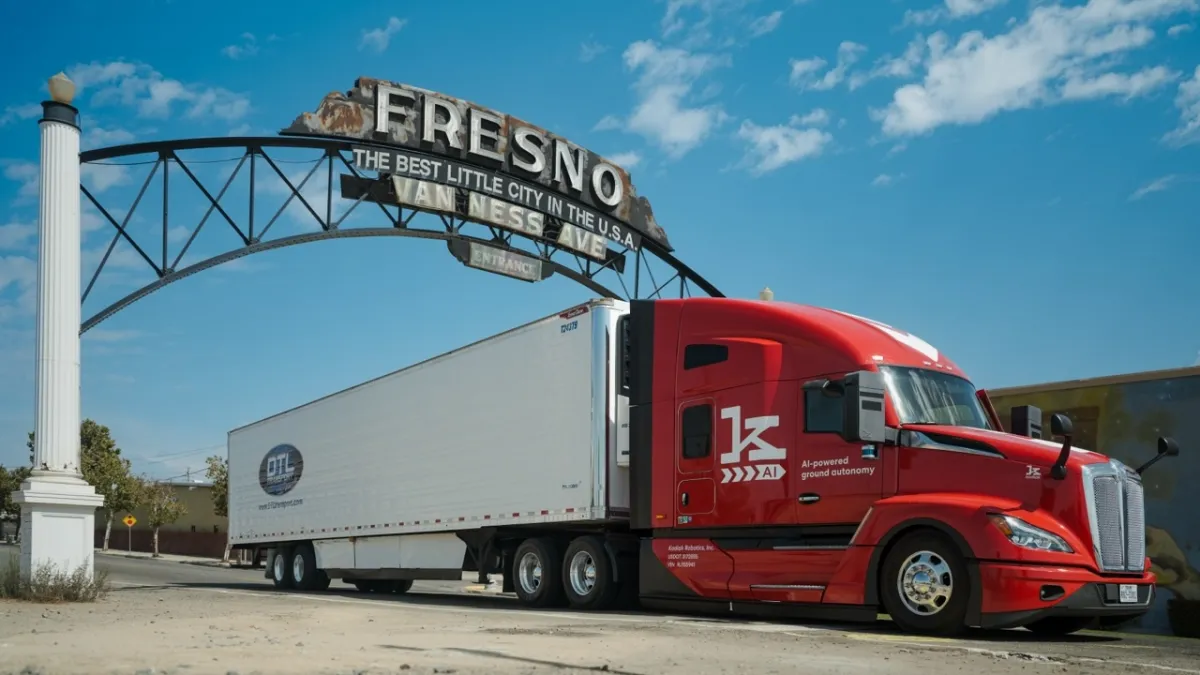
Kodiak AI has secured its first binding commercial contract for driverless Class 8 trucks on public roads, agreeing to hand 75 autonomous big rigs to California freight hauler DTL Transport beginning in 2028. The deal, confirmed Wednesday, marks a turning point for a company that has spent years proving the technology under supervision.
The timing matters. In December, Kodiak plans to pull the human safety operator out of the cab and run a genuinely driverless highway service — hauling goods for Ikea along Interstate 45 between Dallas and Houston. That milestone arrives roughly a year before DTL’s trucks start arriving.
Why a midmarket carrier, not a giant
DTL moves fresh produce and consumer goods to grocery chains, and it operates at a scale that lets it move quickly. Kodiak founder and CEO Don Burnette framed that agility as the real prize.
“It’s easier for them to integrate into their fleet because they’re not as large, and we think that this is a real turning point for the self-driving industry in general.”
Routes will start with Dallas–El Paso and the I-20 corridor linking Dallas and Atlanta. Both have already hosted Kodiak testing and freight runs, which shortens the path from signature to service.
- Delivery volume: 75 self-driving trucks, first units in 2028
- Initial lanes: Dallas–El Paso; Dallas–Atlanta via I-20
- Model: Driver-as-a-service, licensed per mile
- Contract value: Not disclosed by Kodiak
From hauling freight to selling software
The contract nudges Kodiak toward the asset-light role it has openly targeted — supplying the brains rather than running a trucking outfit. Competitor Aurora Innovation is chasing the same position.
Until now, most of Kodiak’s revenue has come from a trucking-as-a-service arrangement in which it owns and operates the vehicles on behalf of customers like Charger USA, Roehl Transport and Werner Enterprises. Those runs cover a handful of Texas routes, and Burnette still describes them as pilot-stage work.
DTL is the first customer to sign on for on-highway driver-as-a-service, where the carrier owns the trucks and pays Kodiak by the mile. The relationship grew out of a California pilot last month in which Kodiak moved perishable freight about 225 miles for DTL along Interstate 5 and State Route 99 between Fresno and Los Angeles, with a safety driver aboard.
Off-road proof came first
Atlas Energy Solutions holds the technical distinction of being Kodiak’s earliest binding customer, dating to 2024. Its 35 driverless trucks, fitted with Kodiak’s system, work private terrain in the Permian Basin of West Texas rather than public highways. Burnette expects as many as 100 in service there by mid-2027.
That sequence — closed sites first, highways second — is the argument Kodiak is making to skeptical fleets.
The financial stakes
Kodiak went public in September 2025, and its shares have since fallen about 87% from the opening-day price. A signed, revenue-generating contract gives investors something firmer to hold onto.
Kodiak hasn’t published the DTL figure, but its 2025 investor deck projected $150,000 to $190,000 in annual recurring revenue per truck. That math assumes a licensing fee near $0.97 per mile — roughly what a human driver costs — and about 225,000 miles per truck each year. Run the numbers and 75 trucks could eventually produce somewhere around **$11.2 million a year** in recurring revenue.
Projections are projections, of course. The trucks don’t arrive until 2028, and the December driverless launch will be the first real test of whether the economics hold up outside a spreadsheet.
Photo: Kodiak AI / TechCrunch - Transportation · Official Press Kit / Editorial (Editorial / Press Kit)
Source: TechCrunch - Transportation
What do you think?