
Tesla's Rocket-Shaped Houston Robotaxi Zone Has a Hole in the Middle
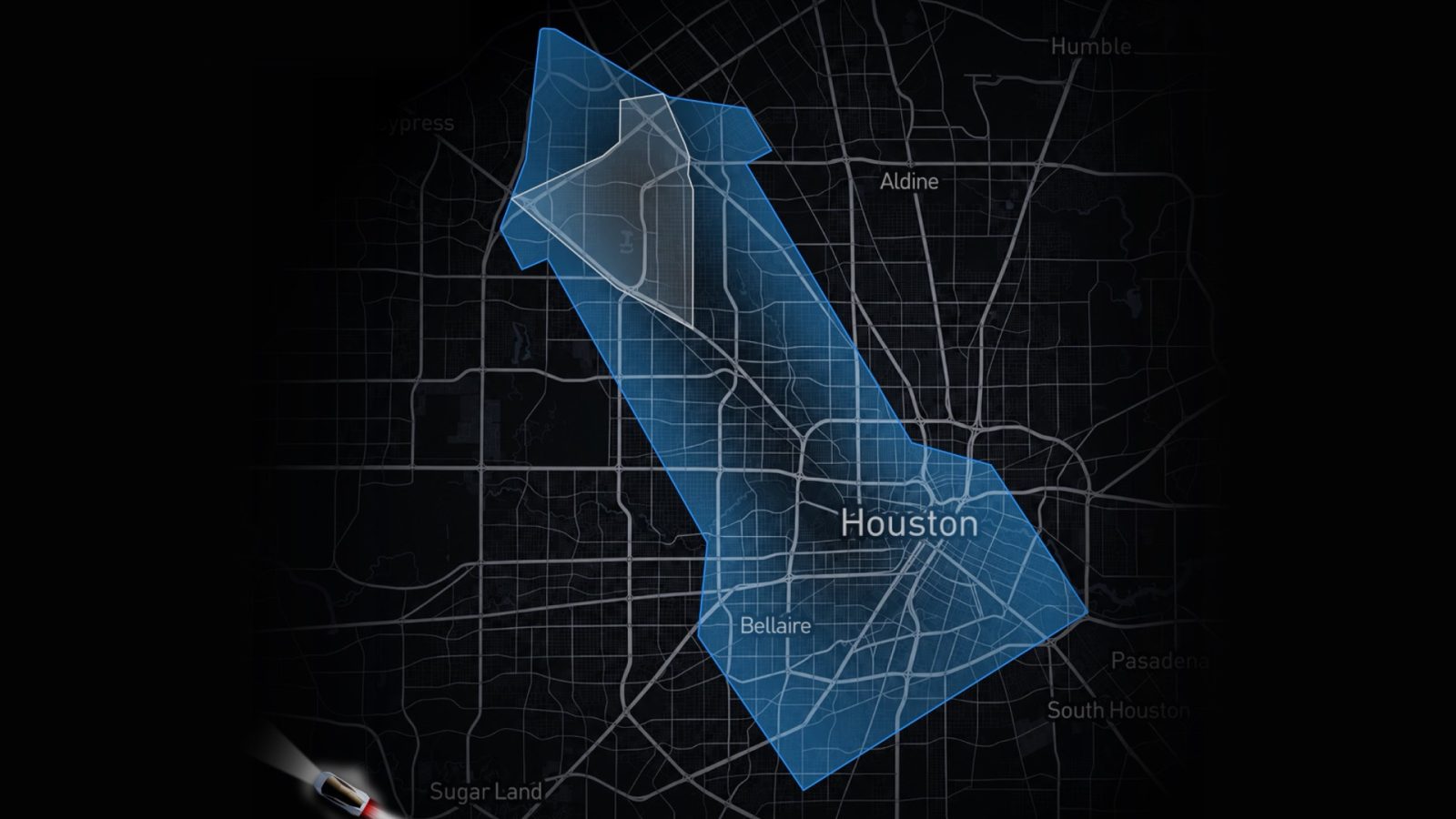
Tesla stretched its Houston Robotaxi service area into a long, rocket-like corridor this week — and at least part of that shape is a promise the app can’t keep. Ethan McKanna, who built the crowdsourced Robotaxi Tracker after a stint at Tesla this summer, tested the newly expanded zone on Monday and found that pins dropped inside the published map are sometimes rejected outright.
His verdict was blunt: Houston is “by far the most egregious ‘fake’ AV service area” he has come across.
A rocket drawn first, questions asked later
The geofence expansion was announced with a playful “Houston, we have liftoff,” turning a small launch zone in northwest Harris County into a corridor running down to downtown and Bellaire. Visually, it’s a spacecraft. Functionally, it has dead spots in the middle of the city.
McKanna posted a screen recording of the Robotaxi app with a pickup pin sitting well within Tesla’s polygon — and the app turning it down flat: “Location not available. Move the map to select a different location.”
He’s fair about the bigger picture: operators rarely cover every street inside the boundaries they publish. Still, he said Tesla’s case stands out, and suggested the shape itself was the point — the area was drawn “so they could get the starship shape.” That’s a strange reason to advertise coverage you don’t have.
Forty minutes to cross two blocks
The routing raised eyebrows too. The day before the expansion, McKanna shared a fare quote for a trip from one side of downtown to Houston Police Department headquarters on Travis Street — a distance of a couple of blocks.
Quoted trip: 2:05 pm pickup · 2:48 pm drop-off · ~43 minutes for roughly two blocks
Rather than heading straight across downtown, the planned route swung south through Midtown and the Museum District toward the Texas Medical Center, then doubled back north. McKanna’s theory is that the cars are steering clear of downtown railroad crossings, which would fit with other odd routing he’s seen in the city. He expects a fix eventually.
And it’s not all criticism — outside that snag, he said the service “feels really good in Houston,” with sensible wait times and, in his words, noticeably better driving than his recent Waymo rides.
Waymo gets the same scrutiny
Tesla isn’t alone in overselling a map. Robotaxi Tracker reported Tuesday that Waymo’s Orlando footprint shrank by 10 square miles, or 8.4%, to 109 square miles. The reason was almost comically simple: the airport had been included in the published area before riders could actually book drop-offs there.
The difference: Waymo’s gap was an airport on the edge of the map. Tesla’s is downtown, in the middle.
McKanna applied the same measuring stick to both, which is what makes his tracker worth following — Tesla discloses precious little about where its fleet runs or how large it is, and independent counts have filled that vacuum.
Why the map matters more than the logo
The map is not decoration. It’s how riders decide whether Robotaxi is an option for their trip at all. Drawing a rocket and working out the drivable streets afterward flips the order of operations — marketing first, service second.
Tesla has time to correct the downtown holes and the detours. Until then, Houston riders get the simplest test available: drop a pin and see if the app says yes.
- What works: short waits and strong driving behavior, per McKanna’s own review
- What doesn’t: advertised coverage with unreachable downtown pins
- What’s next: expected routing fixes; no timeline from Tesla
Photo: Tesla / Electrek · Official Press Kit / Editorial (Editorial / Press Kit)
Source: Electrek
What do you think?