
Honda's Inductive Highway Charging Reaches 150 kW, Road Tests Set for 2027
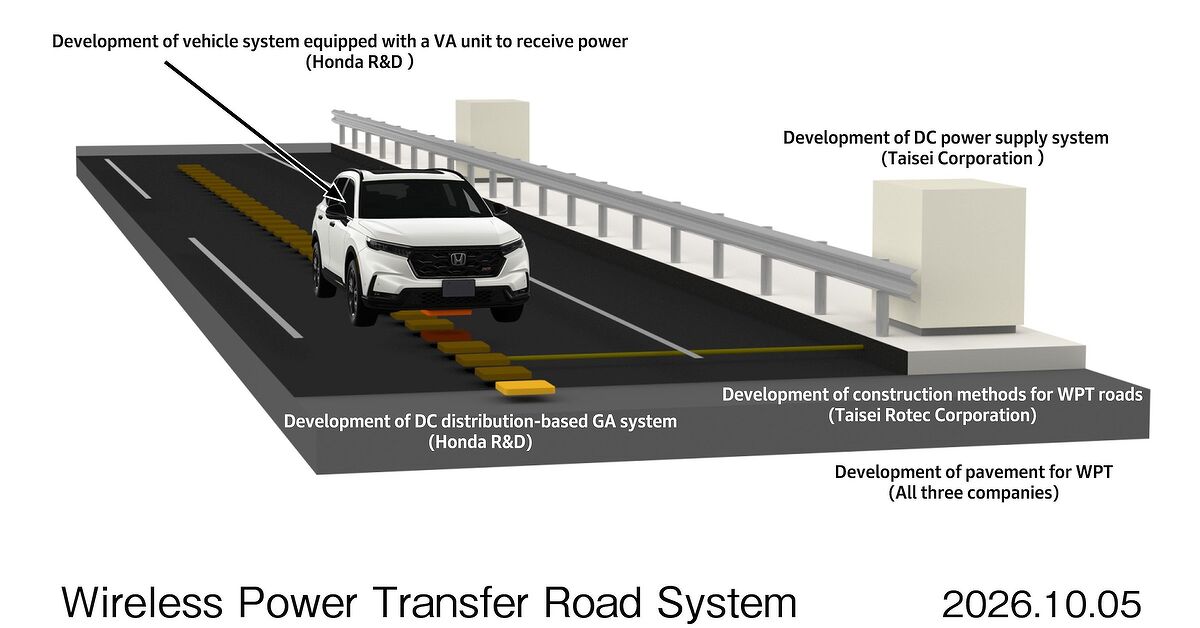
Honda is preparing to move wireless EV charging out of the lab and onto asphalt. The automaker plans to begin on-road demonstration testing on April 1, 2027, using a purpose-built stretch of pavement in Saitama Prefecture, Japan, where induction coils embedded beneath the surface are meant to transfer power to vehicles while they are moving at speed.
The project is a three-way effort. Honda is responsible for the receiver and transmitter hardware, engineered for high power density and compatibility with DC distribution. Taisei Corp. contributes a high-response DC power system, while Taisei Rotec handles burying the equipment into the road itself. According to Honda, the partners have verified the effectiveness of their technologies and have reached output of up to 150 kW. Honda frames the effort around its stated carbon-neutrality goal for 2050, with logistics and transportation applications at the front of the queue. The company has been researching the concept since 2021, and will preview it publicly at the Japan Mobility Show Bizweek in Chiba from October 13 to 16, followed by the ITS World Congress 2026 in South Korea from October 19 to 23.
The history here is a cautionary one. Qualcomm pursued a similar concept under the name Halo, demonstrating prototype EVs drawing power from an induction-equipped road in France in 2017 before abandoning the project and selling it off two years later. Formula E, once seen as a possible showcase for in-motion charging, still charges its cars while stationary. Honda’s effort is notable for how far it has pushed the power figure, but the hard engineering problems are largely unchanged.
Honda is notably quiet on the numbers that would determine whether this works in the real world. The company has not said how much range a moving vehicle could actually absorb, how many miles of coil-equipped road would be needed to add a meaningful charge, or what the infrastructure would cost to build. It also acknowledges two unresolved technical hurdles: preventing stray magnetic fields from escaping the system, and making the buried hardware durable enough to withstand 20-ton trucks rolling over it day after day.
Perhaps the most important framing is what Honda is not claiming. This is not presented as a replacement for home charging or public charging stations, and no one involved is promising a quick 10-to-80 percent top-up on the move. Instead, Honda describes the technology as a way to reduce how often drivers need to plug in at home or at a public stall. That is a considerably more modest ambition than the headline power figure might suggest, and it leaves the economics of paving highways with copper and electronics an open question.
What do you think?