
Holden EH Special: The 1963 Sedan That Put Australia on Wheels
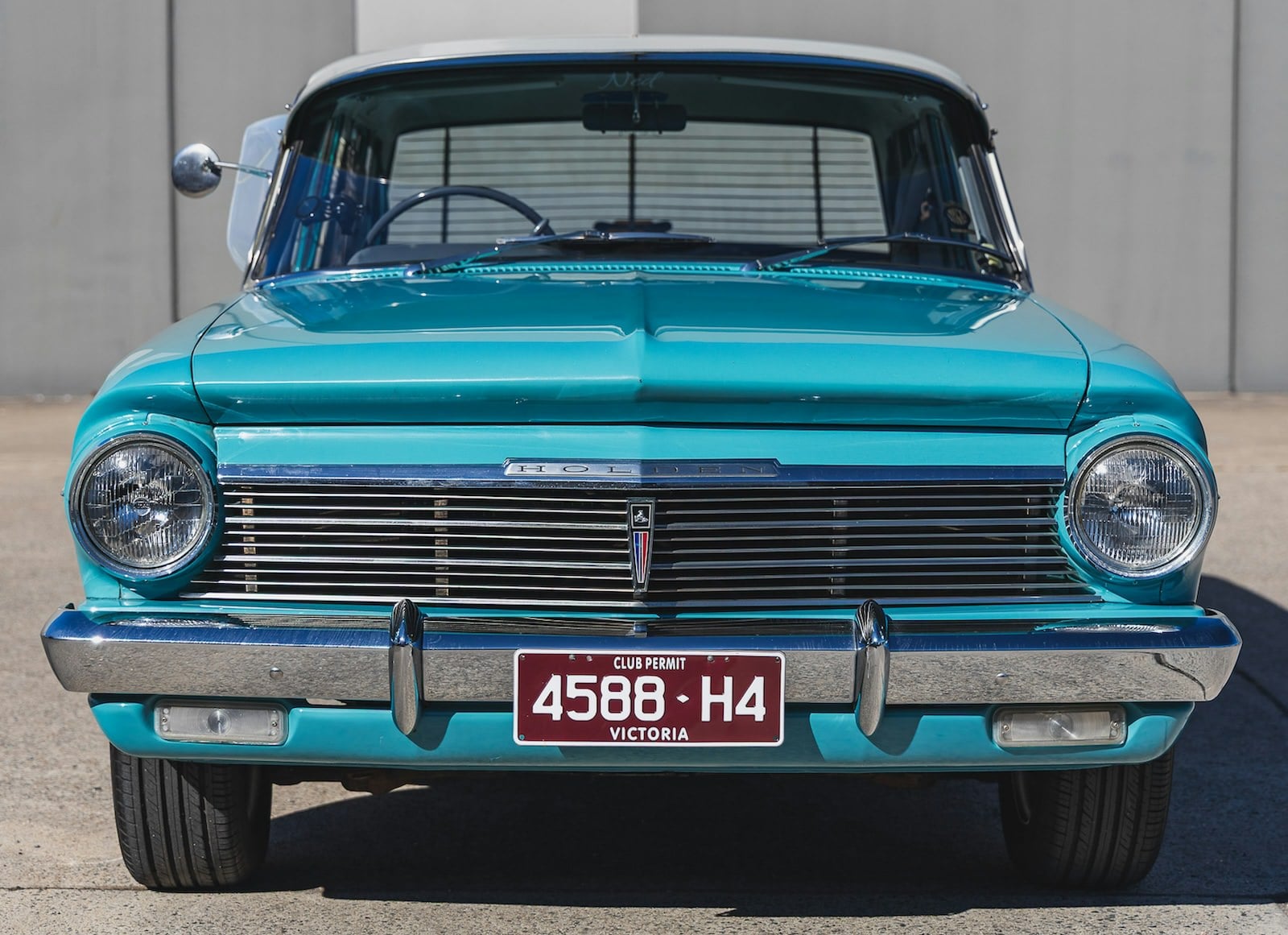
Ask an Australian old enough to remember the 1960s what their family drove, and there is a fair chance the answer is a Holden EH. Launched in August 1963, the car went on to sell 256,959 units across three model years — a figure Holden itself billed as the fastest-selling Australian car of its time.
The example you see here is an EH Special, the mid-tier trim that sat above the base Standard and below the luxury Premier. It carries the bigger of the two available six-cylinders, the 179-cubic-inch (2.9-litre) unit, and is finished in a two-tone Turquoise and White scheme. Delivery date: September 1963.
More Than a Facelift
Holden’s previous effort, the EJ, had been well received, but its 138-cubic-inch “Grey” six was getting left behind by Ford’s local offerings. The EH answered that with a genuinely new engine and a body that changed far more than the badge.
Roof, rear quarters, boot lid, front guards, bonnet, grille and tail lights were all redesigned, giving the sedan a squarer, more substantial look. The ute and panel van, notably, kept the older EJ tail lamps.
Key Specs: 179 cu in (2.9 L) straight-six · 115 bhp · 175 lb ft torque · 3-speed automatic · 67,008 miles shown
Meet the Red Motor
The nickname came from the bright red paint on the engine block. It was a clean-sheet pushrod overhead-valve design with seven main bearings and a single-barrel Bendix-Stromberg carburettor, built in two displacements sharing a 3.00-inch stroke.
- 149 cu in (2.4 L): 100 bhp at 4,400 rpm, 145 lb ft at 2,000 rpm, plus a low-compression 95 bhp option
- 179 cu in (2.9 L): 115 bhp at 4,000 rpm, 175 lb ft at 1,600 rpm
That larger motor delivered roughly 53 percent more power than the Grey it replaced, and with a beefier bottom end to match. Initially it shipped only with the Hydra-Matic automatic — the old three-speed column manual, which lacked first-gear synchromesh, simply wasn’t rated for the extra twist. A manual 179 arrived in early 1964 with a stronger gearbox, bigger clutch and thicker tailshaft borrowed from the S4 racer.
Underneath, the EH stuck with a steel unibody shell — still fairly novel for a four-door family sedan in that era. Unequal-length wishbones, coil springs, kingpins and an anti-roll bar handled the front; a live axle on semi-elliptic leaves held up the rear. Stopping came courtesy of 9-inch drums, and power steering was an option fitted to only a few thousand cars.
Bathurst and the S4
Holden had a problem in 1963. The Armstrong 500 had moved to Mount Panorama, and GM’s worldwide motorsport ban ruled out a factory team. The workaround was the EH 225 179M-S4 — a Special sedan with the 179, the manual box, a shorter 3.55:1 final drive, a Repco-PBR vacuum brake booster, a fuel tank enlarged from 9.5 to 11.75 imperial gallons, and an unusually generous tool kit.
That last item mattered: race rules at the time limited repairs to the drivers and the tools supplied with the car. Holden built 120 at Pagewood in Sydney and six more in Melbourne. Homologation nearly fell apart when organisers couldn’t find a printed price list or workshop manual — Holden produced both the day before entries shut.
Six S4s lined up on 6 October 1963, none of them officially entered by the factory. The Ford Cortina GT of Harry Firth and Bob Jane took the win after 130 laps, with Ralph Sach and Fred Morgan’s S4 a lap down in second. Another car lost a rear spring centre bolt, snapped its tailshaft, and limped home on 111 laps after a trackside fix with the standard toolkit.
As for this particular car, the odometer reads 67,008 miles — the seller believes it’s genuine — and the original service book logs 20 early maintenance entries. It’s a tidy reminder of the model that, for plenty of Australian families, was simply the default choice.
Photo: Holden / Silodrome · Official Press Kit / Editorial (Editorial / Press Kit)
Source: Silodrome
What do you think?