
Global EV Battery Race: CATL Holds 39.1% as Chinese Makers Take 73% of the Market
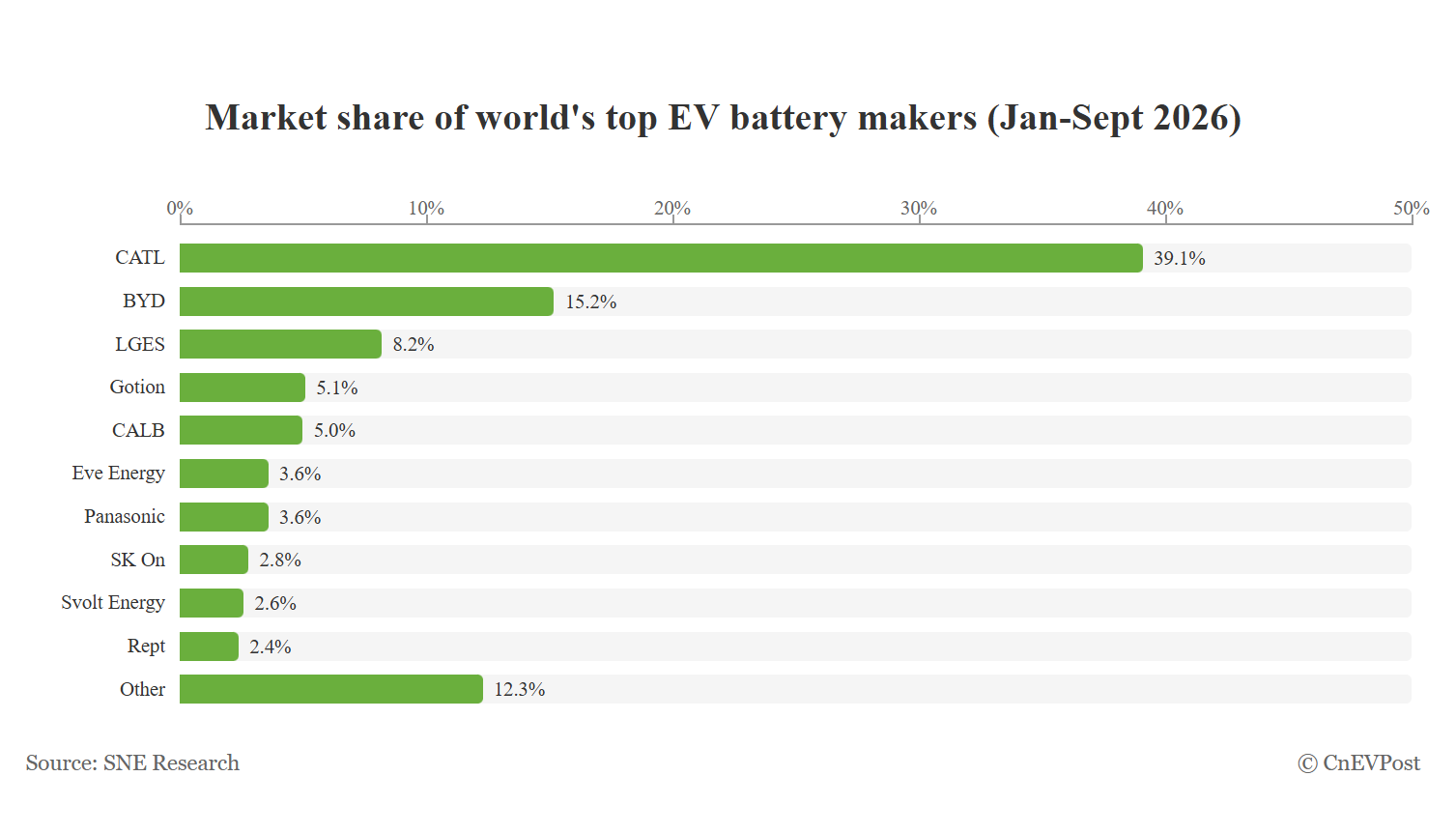
The world’s EV battery market kept growing through the first nine months of 2026, and Chinese suppliers did most of the growing. Seven Chinese companies landed in the global top ten and together controlled 73.0% of all installed battery capacity, according to fresh figures from Seoul-based research house SNE Research.
Total installations reached 994.5 GWh from January to September, a 19.7% jump over the same stretch last year. September alone set a monthly record at 145.1 GWh, although the year-on-year gain cooled to 15.8% — a hint that momentum is easing. The tally covers battery-electric cars, plug-in hybrids and conventional hybrids.
Top Five, Jan–Sept 2026: CATL 39.1% (389.2 GWh) · BYD 15.2% (150.9 GWh) · LGES 8.2% (81.9 GWh) · Gotion 5.1% (50.3 GWh) · CALB 5.0% (50.1 GWh)
CATL Pads Its Lead
CATL (HKEX: 3750) stayed firmly on top. Its 389.2 GWh represented 24.9% growth, comfortably ahead of the overall market, and lifted its share to 39.1% from 37.5% a year earlier. The figure did dip slightly from the 39.4% it held in January–August. A widening roster of overseas automaker clients is doing a lot of the work here.
BYD (HKEX: 1211) sat second at 150.9 GWh, up just 7.4%. Its slice of the pie shrank to 15.2% from 16.9% a year ago, though it edged above the 15.1% recorded through August. Combined, the two giants hold 54.3%, basically flat against last year. The story behind the numbers is the split: CATL keeps adding outside customers while BYD’s batteries largely flow into its own cars — and that gap in growth rates now stands at 17.5 percentage points.
BYD’s Home Slump, Overseas Surge
Inside China, BYD felt the pinch. Domestic EV sales fell 32.9% year-on-year, dragging its China battery installations down 7.1% to 104.9 GWh from 112.9 GWh. Outside China it was a different picture entirely — installations climbed 66.8% to 45.9 GWh. Overseas vehicle deliveries hit roughly 180,000 in September, more than double the prior year and close to 40% of the company’s total volume. That export push is now doing real heavy lifting.
South Korea’s LG Energy Solution (LGES) took third with 81.9 GWh, a mere 0.7% gain that left its share at 8.2% versus 9.8% a year ago. The company still supplies Tesla, GM, Hyundai Motor Group and Volkswagen, but regional results pulled in opposite directions:
- Europe: up 13.2% to 38.6 GWh
- Asia: up 49.4% to 11.1 GWh
- North America: down 44.9% to 16.5 GWh, wiping out most of those gains
The Chasing Pack Reshuffles
Gotion High-tech (SZSE: 002074) climbed to fourth with 50.3 GWh, up 48.1%, narrowly beating CALB (HKEX: 3931) by 0.2 GWh. CALB’s 50.1 GWh marked a 27.1% rise. Eve Energy (SZSE: 300014) jumped to sixth, growing 60.4% to 36.0 GWh and pushing Japan’s Panasonic into seventh. Panasonic slipped 0.8% to 35.6 GWh, with almost all of that tied to Tesla vehicles in North America.
SK On had the roughest stretch of any top-ten player, down 18.1% to 28.3 GWh. Its North American installations collapsed 46.7% to 7.6 GWh. Svolt Energy rose 37.9% to 25.7 GWh, and Rept Battero Energy surged 118.7% to 24.2 GWh — the fastest growth in the group — holding off Sunwoda for tenth place.
The Korean trio of LGES, SK On and Samsung SDI now holds 12.6% combined, down 4.1 percentage points.
Where the Batteries Are Going
Geography tells its own story. China accounted for 567.8 GWh, up 16.2%. Europe grew 33.1%, non-China Asia 74.1% and South America a striking 176.8%. North America went the other way, falling 24.3% to 85.9 GWh.
Two quieter trends deserve attention. LFP chemistry now makes up 57.7% of installations, up from 52.5%, as cheaper iron-based packs keep winning. And the average pack per vehicle grew 11.2% to 39.7 kWh — meaning battery demand is expanding faster than vehicle sales themselves.
Photo: CATL / CnEVPost - Battery · Official Press Kit / Editorial (Editorial / Press Kit)
Source: CnEVPost - Battery
Curious how this compares to other EVs? Try our comparison tool →What do you think?