
Fraunhofer Deepens Battery Research Ties with South Korean Partners
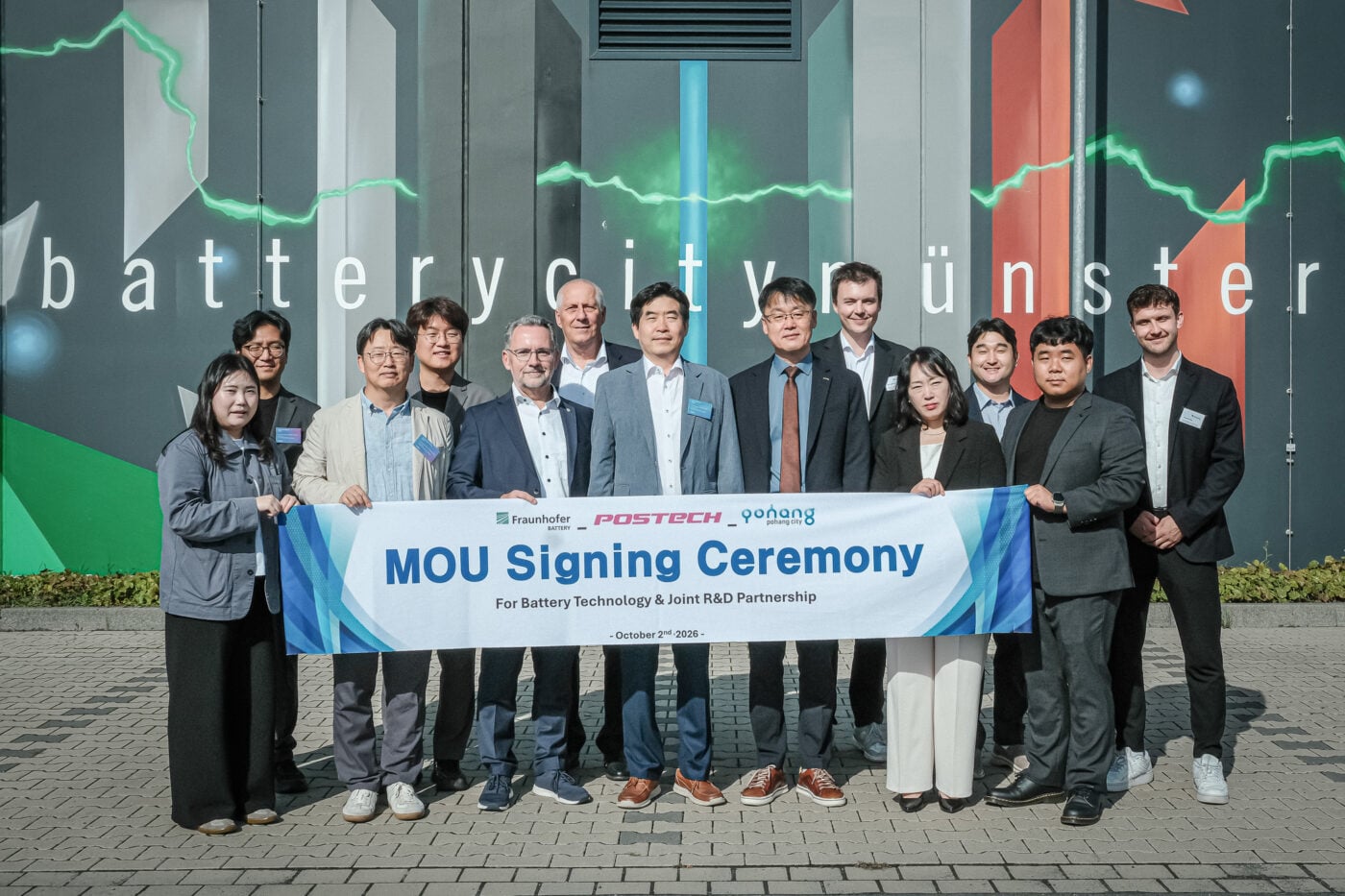
The Fraunhofer Battery Alliance has broadened its cooperation with South Korean institutions, signing two letters of intent during a delegation visit to the Fraunhofer Research Institution for Battery Cell Production (FFB) in Münster. The agreements bring together the Pohang University of Science and Technology (POSTECH), the city of Pohang, and the Korea Environment Corporation (K-eco), setting the stage for collaborative work across the battery value chain.
With POSTECH and Pohang, the partners plan to explore topics spanning lithium-ion battery materials, next-generation cell chemistries, cell and production processes, and recycling and circular economy approaches. The city of Pohang is expected to lend administrative and funding-policy backing to joint activities involving local companies and international research. POSTECH brings relevant experience to the table: earlier in 2026, a team from the university, working alongside KAIST and Gyeongsang National University, unveiled an anode-free lithium-metal battery with a volumetric energy density of 1,270 Wh/l. According to the researchers, the cell held on to 81.9 per cent of its initial capacity after 100 cycles, with the results also verified in larger pouch cells.
The Fraunhofer FFB is central to the arrangement. Its concept links laboratory work with production research for cylindrical, prismatic, and pouch cells, and projects can examine either individual process steps or complete manufacturing chains. Among the available facilities is the FFB PreFab in Münster-Amelsbüren, where new materials, cell concepts, and production methods can be tested under near-industrial conditions. The aim is to gauge scalability early on and smooth the path toward series production or large-scale industrial manufacturing.
“The development of new battery technologies and the establishment of a sustainable battery value chain require close cooperation between research and industry across national borders,” said Jens Tübke, Director of the Fraunhofer FFB and spokesperson for the Fraunhofer Battery Alliance. He added that pooling scientific expertise with the South Korean partners is intended to yield joint solutions for battery cell production and recycling. The FFB itself ranks among Germany’s largest publicly funded battery projects, with up to €750 million from the federal government for research facilities and projects, plus €320 million from North Rhine-Westphalia for land and new buildings.
The second agreement, signed with K-eco, leans more heavily toward battery recycling, material characterisation, and certification and quality assurance for recovered battery materials. The partners also want to look into research that could help meet the requirements of the EU Battery Regulation. That focus addresses a field that is technically advanced yet still economically difficult: a study within the EU Safeloop project recently put the current loss in battery recycling at roughly €1.90 per kilogram of battery pack, with hazardous goods transport, dismantling, and uncertainty in material recovery among the main cost drivers. Standardised quality and certification procedures could therefore become more important for building workable circular economy models. No specific joint projects, timelines, or additional funding volumes were disclosed with the new agreements.
What do you think?