
Ford Taps 3,000 Utilities to Make Plug-In Power Sharing Cheaper
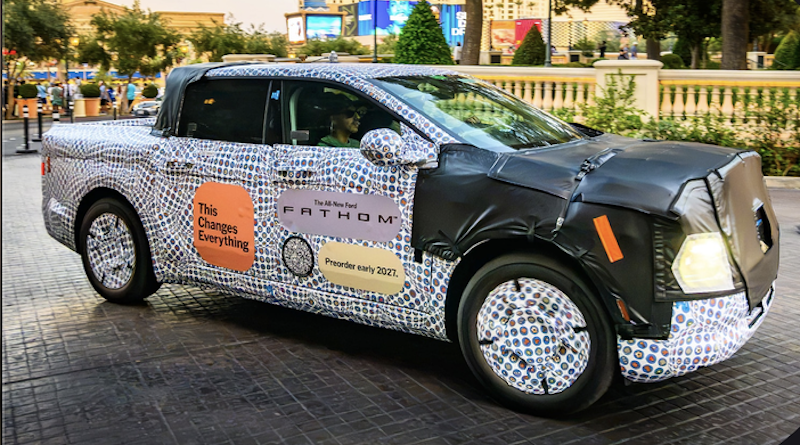
Ford is pushing for a cheaper route to two-way charging. The company says buyers of its upcoming Fathom electric pickup will get a built-in inverter, so they won’t need to buy a separate wall-mounted unit to send power back into the house.
That detail matters more than it sounds. An external inverter has been one of the quiet costs holding back vehicle-to-home setups, and Ford is now pairing the hardware change with a push to get utilities on board.
Key Specs: Ford Fathom electric pickup · MSRP from $28,350 · Built-in bidirectional inverter · Production starts next year
Ford isn’t stopping at its own driveway. The automaker wants utilities across the U.S. and Canada — roughly 3,000 of them — to help speed up adoption of bidirectional charging, which lets an EV battery double as a home backup source and a tool for shifting cheap off-peak power to expensive peak hours.
Why the Grid Rules Are the Real Hurdle
The bottleneck isn’t the truck. It’s the paperwork.
Ford points out that most interconnection processes were written with rooftop solar and stationary home batteries in mind. An electric pickup doesn’t fit that mold neatly. As the company puts it, bidirectional EVs bring fresh considerations “because they are vehicles first, not stationary equipment.”
To sort that out, Ford began working last summer with American Electric Power, BC Hydro, Consumers Energy, Exelon and Pacific Gas and Electric Co. The goal is a scalable interconnection framework in place before Fathom production kicks off next year, with utilities, regulators and automakers all at the table.
The working group has already landed on one principle: only drivers who plan to run bidirectional charging in tandem with the grid should have to go through interconnection. People who just plug in to charge — or who keep the battery for occasional backup use — would be spared the process.
The Inverter Came From an Acquisition
Ford’s head start on the built-in inverter traces back to November 2023, when it bought Auto Motive Power, a California power-management specialist. The deal brought in the company’s technology, its Santa Fe Springs facility and a team of nearly 150 employees.
AMP had already built a name for itself in this space:
- Onboard charger: Tesla NACS-compliant, supports bidirectional charging through integrated DC fast-charge contactors
- V-to-X system: Power management built for grid connections
- ampEMU: An energy management unit combining onboard charging, power distribution and fast charging up to 500 amps
Ford has kept the technical details close, but the acquisition gave it something rivals have had to source elsewhere — or skip entirely.
A Mid-Size Bet After the Lightning
The Fathom lands in a pickup market that hasn’t gone the way many expected. Tesla’s Cybertruck was pitched as a mainstream truck and fell well short of those ambitions, while Ford itself paused the full-size F-150 Lightning last year and shifted marketing weight toward the smaller, cheaper Fathom.
With an MSRP starting at $28,350, the Fathom is aimed at buyers who might not otherwise consider an electric truck. A built-in inverter and a lower home charging bill are part of how Ford plans to close that gap.
The question now is whether utilities move as fast as the truck does.
Photo: Ford / CleanTechnica · Official Press Kit / Editorial (Editorial / Press Kit)
Source: CleanTechnica
Curious how this compares to other EVs? Try our comparison tool →What do you think?