
Europe's Battery Supply Could Meet Its Own EV Demand — If Midstream Investment Picks Up
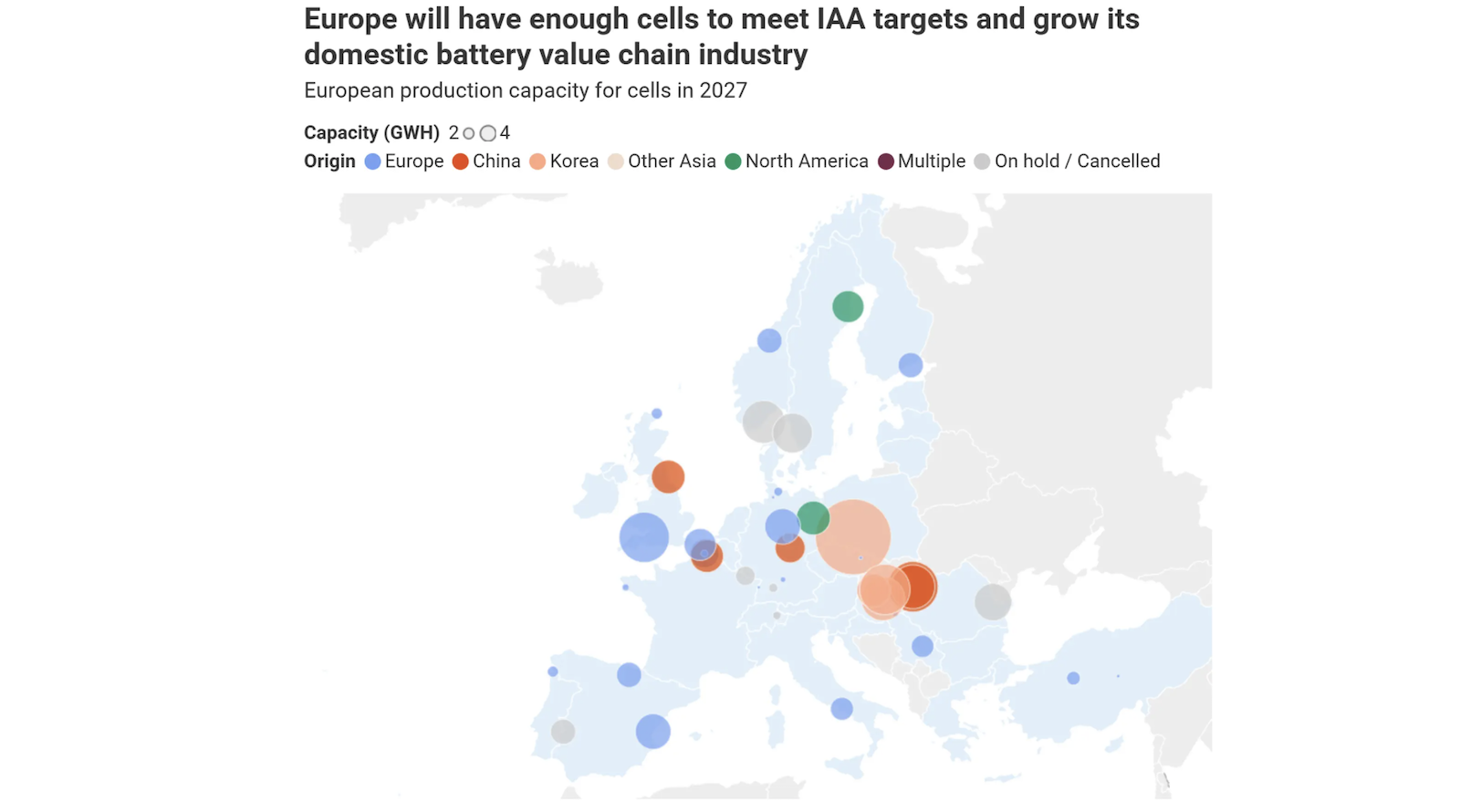
A fresh study from Transport & Environment (T&E) suggests Europe’s battery cell production is on track to satisfy demand from electric vehicles covered by the bloc’s planned Industrial Accelerator Act (IAA) by 2030. The finding pushes back against automaker claims that local-content rules are too demanding, arguing that EU cell supply can stretch far enough — provided every announced project, including mid-confidence ones, actually gets built. According to T&E, local sourcing requirements for cells and cathode active materials could lift EU battery demand by as much as 34% above the current trajectory in 2027.
The hard part lies in the middle of the supply chain, not the end. Cathode active materials (CAM) and their precursors (pCAM) are the segments where China holds an overwhelming grip — controlling as much as 90% of global capacity depending on chemistry, and roughly 95% for LFP. European CAM and pCAM plants need long-term offtake agreements with cell makers, which in turn require a predictable EV market to justify the investment. T&E’s new mapping of cell and CAM/pCAM capacity across the continent illustrates both the exposure and the headroom that exists.
Xavier Sol, who leads sustainable investments and batteries work at T&E, framed the stakes bluntly: the question is whether high-value clean tech jobs land in Europe or stay in Asia. He argued that a robust local value chain would deliver strategic independence and protect employment during a shaky stretch for the EU auto sector — but only if the IAA sends a strong enough signal to de-risk private capital. T&E also wants the IAA to include a minimum Made-in-EU threshold for pCAM sourced through trusted partners, calling it the most fragile link in Europe’s chain.
A first credibility test arrives soon: local-content rules for EVs under the EU-UK Trade and Cooperation Agreement are set to take effect in January, and carmakers are again pushing for a delay. T&E’s position is that the EU should hold its ground, since the credibility of the entire Made-in-Europe agenda depends on it.
What do you think?