
BMW iX3 Outlasts Rivian R2 by 127 Miles in 70 MPH Range Test
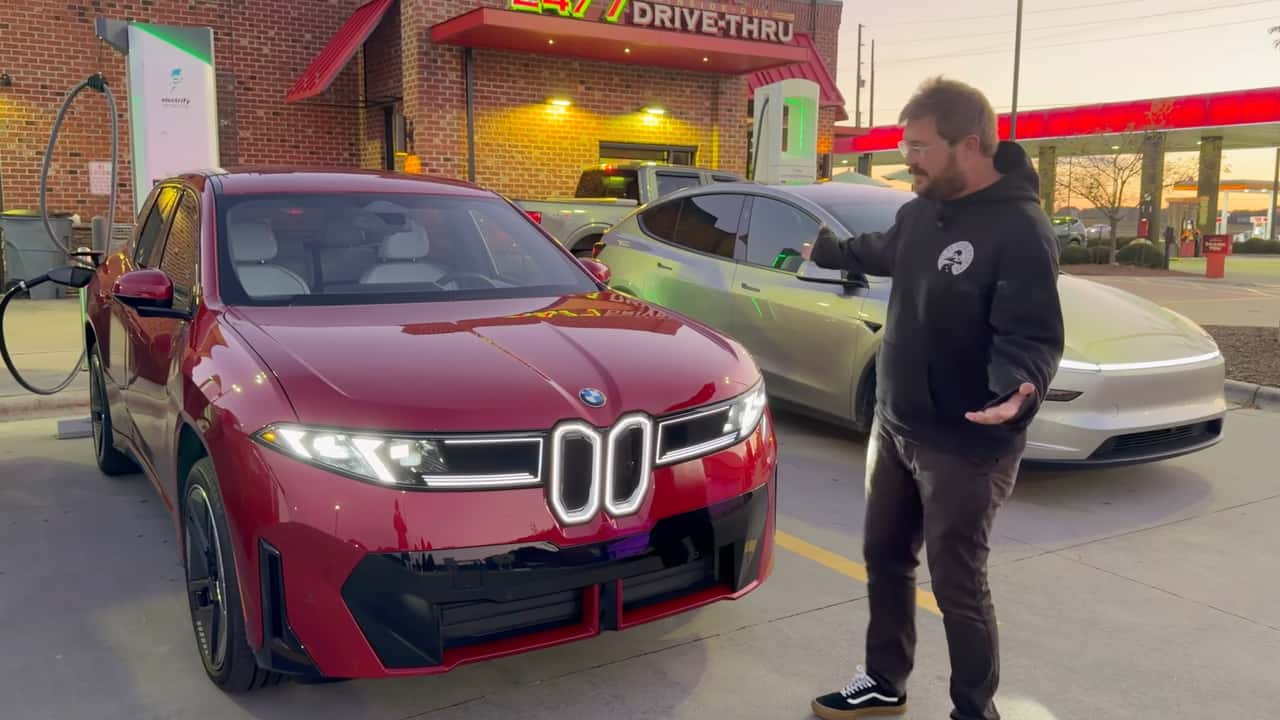
A four-way highway range test has produced a lopsided result: the BMW iX3 kept going long after the Rivian R2 ran out of electrons, finishing nearly 127 miles farther down the road.
The comparison came from Out of Spec Testing, which lined up the iX3 against the Rivian R2 Performance, the Tesla Model Y L and the Lexus RZ450e. All four crossovers left with a full charge, warm packs, correct tire pressures and the climate system running, then lapped a stretch of U.S. Route 64 in North Carolina at a GPS-verified 70 mph. Range was logged the moment a car could no longer hold that speed, so none were run flat to a standstill.
The margin is hard to ignore. BMW stopped at 339.7 miles; Rivian managed roughly 213.
Test Results: BMW iX3 — 339.7 mi · Tesla Model Y L — 286 mi · Rivian R2 — ~213 mi · Lexus RZ450e — 189 mi
Why the BMW Won — and Why It Wasn’t Efficiency
The iX3’s advantage came from energy capacity, not frugality. Testers quoted about 112 kWh usable for the U.S.-spec car (Europe gets a 108.7 kWh figure), against roughly 88 kWh in the Rivian and an estimated 84–85 kWh in the Tesla. It sipped 112.7 kWh over the run at around 3 miles/kWh.
Probably no surprise, then, that the Lexus with the smallest pack — just under 70 kWh of it — bowed out first. The RZ450e needed a charging stop after only 100 miles, dropped to zero around 187 and lost highway pace at 189. Its 2.8 mi/kWh was actually better than Rivian’s.
The R2’s showing deserves context rather than ridicule. It faced cool weather and aggressive all-terrain rubber, and it burned 86.8 kWh at roughly 2.45 mi/kWh. In a previous run on road tires in warmer conditions, it went about 253 corrected miles.
Tesla’s Efficiency Trophy
Nobody touched the Model Y L on consumption. The six-seater covered 286 miles on 81.1 kWh, with its trip computer hovering near 3.5–3.6 mi/kWh. That is comfortably ahead of the field, and it happened with a smaller battery and two more seats than most rivals here.
Wheel and tire choices weren’t kind to anyone. BMW’s optional 21-inch wheels trim its EPA figure from 434 to 399 miles. The Tesla carried 20s and a 332-mile rating, the Rivian 20s with all-terrains and a 307-mile rating, the Lexus 20s and 257 miles.
Charging wasn’t the focus, but the iX3 still made a point. It is the only 800-volt machine in the group, and once depleted it pulled 122 kW straight away — essentially the ceiling of the mobile charger used. The Tesla, by contrast, accepted power far more slowly at first.
Price-wise, all four sit above $60,000, with the heavily optioned BMW closest to $70,000.
Separate consumption-based projections against the Mercedes GLC Electric and Volvo EX60 put the iX3 at 338 miles, the Mercedes at 279 and the EX60 P10 at 260 — with the bigger-battery EX60 P12 theoretically near 320.
So yes, BMW’s win was decisive. But the test also served as a reminder that Tesla still knows how to stretch a kilowatt-hour better than almost anyone.
Source: InsideEVs
Curious how this compares to other EVs? Try our comparison tool →What do you think?