
- Deconstruct UNECE R157 Automated Lane Keeping System (ALKS) technical and operational requirements, including its amendment history.
- Enumerate the mandatory ADAS hardware codified under EU General Safety Regulation II (GSR II) and its role within type approval.
- Contrast the US's fragmented (federal + state) regulatory model, China's fast-moving proactive framework, Japan's early L3 certification milestone, and Turkey's UNECE-alignment approach.
- Evaluate DSSAD (Data Storage System for Automated Driving) versus EDR (Event Data Recorder) statutory logging requirements and their role in liability allocation.
Global Regulations: UNECE, EU GSR II, US, China, Japan and Turkey
ASSUMPTION — Assumes familiarity with SAE J3016 automation levels (AD-03), the basic logic of the type-approval process, and the UNECE R155/R156 cybersecurity framework (AD-21).
In this lesson, you will learn:
- The UNECE Framework — a brief recap of R155/R156 and a detailed look at R157 ALKS: the world’s first international conditional-automation regulation.
- EU GSR II — the list of active safety hardware mandated on new vehicles and its role within type approval.
- The US — NHTSA/FMVSS’s fragmented federal-state model, and the California DMV AV testing/deployment permit program.
- China — a fast-moving, scale-driven regulatory sandbox approach.
- Japan — an early milestone as the world’s first commercial L3 type-approval.
- Turkey — an alignment approach shaped by UNECE membership and the EU customs union.
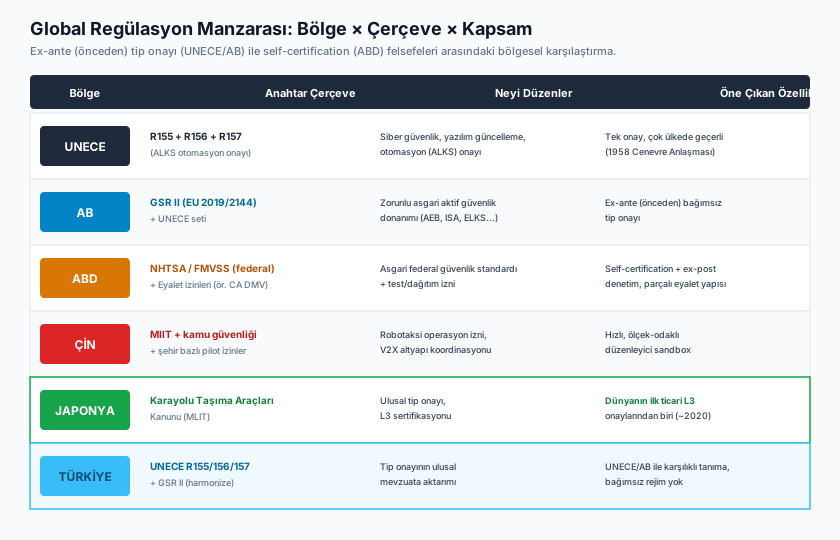
- Regional Summary Table — Region × Framework × Scope × Notable Feature.
- DSSAD vs EDR — two distinct post-collision liability-recording systems.
Commercializing automated driving technologies requires far more than engineering maturity — it hinges on compliance with rigorous international legal frameworks governing vehicle type-approval and homologation. Two dominant regulatory philosophies coexist globally: the United Nations/European Ex-Ante Type Approval model — where an independent authority audits a vehicle before it reaches the market — and the United States’ Self-Certification model, where the manufacturer attests compliance and the regulator enforces after the fact (ex-post enforcement).
1. The UNECE Framework: From R155/R156 to R157
As covered in AD-21 — Automotive Cybersecurity: ISO/SAE 21434, TARA and UNECE R155/R156, UNECE R155 (Cybersecurity Management System) and R156 (Software Update Management System) mandate vehicle software integrity and security as a type-approval requirement. R157 takes this framework a step further — it is the first international regulation to govern automation itself.
1.1 UNECE R157: Automated Lane Keeping System (ALKS)
R157 establishes the binding technical rules for Automated Lane Keeping Systems in passenger and light commercial vehicles — the world’s first instance of an intergovernmental body granting legal approval to a conditional-automation function (roughly corresponding to SAE L3).
- ODD Boundaries: The system may only operate on physically divided motorways free of pedestrians and cyclists.
- Speed Limit: The initial 2021 publication permitted operation only up to (a “traffic jam chauffeur” scenario).
- Driver Availability & Transition Demand: Non-driving-related secondary activities (e.g., watching content on an in-vehicle screen) are legally permissible while the system is engaged; however, once the system issues a transition demand, the driver must resume the dynamic driving task (DDT) within a reasonable timeframe.
- DDT Fallback & Minimal Risk Condition (MRC): If the driver fails to respond, the system must independently bring the vehicle to a safe stop within its lane or onto the shoulder (a Minimal Risk Maneuver).
ASSUMPTION — R157 has been extended through multiple amendment packages since its original publication; public reporting indicates the speed ceiling has been progressively raised and automated lane-change functionality has been added. Because this is a living, evolving regulation, the current exact speed limit and scope should be verified against UNECE’s current official text — figures beyond the initial value are not stated here with certainty.
1.2 Transition Window and the Liability Logic
R157’s most critical engineering-legal intersection is its transition-demand mechanism: before the system disengages, it must give the driver a sufficient window to respond; if the driver fails to respond, the system itself must reach a safe state. This design directly codifies the defining feature of L3 covered in AD-03 — the DDT resides with the system, but can be handed back to the human via a transition demand — into binding legal text.
2. European Union GSR II (Regulation EU 2019/2144)
GSR II operates on a different layer than R157: it does not regulate automation level at all — instead it mandates the minimum active safety hardware every new vehicle must carry as a type-approval prerequisite. Effective July 2024, all newly registered Category M (passenger) and N (commercial) vehicles in the EU (and, via harmonized national law, in aligned countries including Turkey) must carry:
| Mandated Technology | Operational Description | Typical Sensor Architecture |
|---|---|---|
| Advanced Emergency Braking (AEB) | Collision mitigation for vehicles, pedestrians, cyclists | Forward Camera + Forward Radar |
| Intelligent Speed Assistance (ISA) | Speed limit sign recognition; driver warning/accelerator resistance on excess | Vision Pipeline + GNSS Navigation Map |
| Emergency Lane Keeping (ELKS) | Steering intervention preventing roadway departure | Forward Vision Camera |
| DDAW / ADDW | Driver drowsiness and distraction monitoring | In-Cabin IR Camera (DMS) |
| BSIS & MOIS (Heavy Vehicles) | Blind-spot and moving-off blind-spot warning | Lateral/Forward Radar, Ultrasonic |
| Event Data Recorder (EDR) | Black-box telemetry capture around a collision | Airbag ECU / Central Gateway |
INTERPRETATION — GSR II and UNECE R157 are complementary, not overlapping: GSR II says “every vehicle must carry this baseline safety hardware” (a feature/hardware mandate); R157 says “if a manufacturer chooses to offer a conditional-automation function like ALKS, it must meet these technical rules” (a functional-approval regime). GSR II applies to every vehicle; R157 only comes into play for manufacturers who choose to offer that specific feature.
3. The United States: A Fragmented Model
In contrast to UNECE’s unified multilateral approach, the US regulatory landscape is split across federal and state layers:
- NHTSA / FMVSS (Federal): The National Highway Traffic Safety Administration sets minimum vehicle safety standards via the Federal Motor Vehicle Safety Standards (FMVSS). The model reflects the US’s self-certification philosophy: the manufacturer attests compliance and brings the vehicle to market; NHTSA investigates suspected violations after the fact, can compel recalls for defective systems, and uses the Standing General Order (SGO) mechanism to require crash reporting.
- State Level: Historically, the testing and public-road deployment of higher-automation (L3+) vehicles has largely fallen under state jurisdiction. California DMV, for example, operates separate permit categories for autonomous vehicle testing (the Autonomous Vehicle Tester Program) and fully driverless commercial deployment (a Driverless Deployment Permit) — a manufacturer needs one permit to conduct road testing in California and a separate one to carry passengers commercially.
FACT — The practical consequence of this fragmentation: a system being “legal” in the US doesn’t rest on a single approval — it requires both federal FMVSS compliance and each operating state’s own testing/deployment permit regime. Under the UNECE model, by contrast, a single type approval (e.g., an e-mark obtained in one European country) is broadly recognized across all parties to the 1958 UNECE Agreement.
4. China: A Rapidly Proactive Framework
ASSUMPTION — China’s automated-driving regulatory environment is among the fastest-changing in the world; the observations in this section reflect the general trend, and current exact city/permit lists should be verified against official Chinese sources (MIIT, the Ministry of Public Security, and relevant municipal regulations).
China’s approach charts a third path distinct from the US’s ex-post model and the EU’s ex-ante model: central authorities (MIIT — the Ministry of Industry and Information Technology — and relevant public security bodies) directly authorize commercial robotaxi operation within limited geographic zones in specific pilot cities (commonly cited in public reporting: Beijing, Shanghai, Shenzhen, Wuhan, among others) — a fast-iterating regulatory sandbox model. This is a relatively proactive approach in which rules are revised quickly as scale grows, coordinated alongside heavy investment in V2X and smart-road infrastructure.
5. Japan: An Early L3 Milestone
ASSUMPTION — The following draws on public reporting; exact certification dates, production volume, and current operational status should be verified against current records from Japan’s Ministry of Land, Infrastructure, Transport and Tourism (MLIT).
Around 2020, Japan amended its Road Transport Vehicle Act and is recorded as having granted one of the world’s first commercial SAE Level 3 type approvals, for a limited-production model (reported to be a premium Honda sedan). This is a national, early-mover milestone independent of R157’s international ALKS framework, and is commonly referenced as “the world’s first legally certified Level 3 vehicle.”
6. Turkey: A UNECE-Alignment Approach
ASSUMPTION — Turkey’s automated-driving regulatory landscape is far less documented in international sources than the other regions covered here; the framework below summarizes the generally known structure, and exact, current statutory text should be verified against the Ministry of Industry and Technology and TSE (Turkish Standards Institution).
Turkey is a party to the UN UNECE framework under the 1958 Geneva Agreement, and its customs-union relationship with the EU gives it a strong incentive to keep its technical regulations broadly aligned with the EU/UNECE framework. In practice, this means Turkey tends to follow harmonized national transpositions of UNECE R155/R156/R157 and GSR II rather than developing an independent, standalone automation-level regime — a type approval obtained in Europe is broadly recognized in Turkey as well. This stands in fundamental contrast to the US’s independent federal/state regime described in §3.
7. Regional Summary Table
| Region | Key Framework(s) | What It Governs | Notable Feature |
|---|---|---|---|
| UNECE (Multilateral) | R155, R156, R157 | Cybersecurity, software updates, ALKS automation | A single approval recognized across many countries (1958 Agreement) |
| European Union | GSR II (EU 2019/2144) + UNECE set | Mandatory baseline active-safety hardware + automation approval | Ex-ante independent type approval |
| United States | NHTSA/FMVSS (federal) + state permits (e.g., California DMV) | Minimum federal safety standards + testing/deployment permits | Self-certification + ex-post enforcement, fragmented state layer |
| China | MIIT + public security + city-level pilot permits | Robotaxi operating permits, V2X infrastructure coordination | Fast, scale-driven regulatory sandbox |
| Japan | Road Transport Vehicle Act (MLIT) | National type approval, L3 certification | One of the world’s first commercial L3 approvals (~2020) |
| Turkey | UNECE R155/R156/R157 + GSR II (harmonized) | Transposition of type approval into national law | Mutual recognition with UNECE/EU, no independent regime |
8. Legal Liability Telemetry: DSSAD vs EDR
Regulations mandate two distinct, complementary recording systems to determine whether liability for a collision or incident rests with the human or the automated system:
+--------------------------------------------------------------------------+
|                  DSSAD vs EDR REGULATORY COMPARISON                      |
+--------------------------------------------------------------------------+
|  Parameter     | DSSAD (UNECE R157)           | EDR (UNECE R160 / 49 CFR)  |
|----------------+------------------------------+----------------------------|
|  Core Purpose  | Determines who held dynamic  | Records physical crash     |
|                | driving task control          | dynamics for reconstruction|
|  Trigger Event | Mode change, transition       | Airbag deployment,         |
|                | demand, MRM onset, fault      | above-threshold delta-v    |
|  Retention     | Chronological trip-level log  | Frozen window: a few       |
|                | (retained on the order of     | seconds before, shortly    |
|                | months)                       | after the event            |
|  Key Variables | Timestamped ALKS status,      | Vehicle speed, steering,   |
|                | driver-warning timestamp,     | brake pressure, throttle,  |
|                | takeover confirmation         | seatbelt buckle status     |
+--------------------------------------------------------------------------+
FACT — When a Level 3 vehicle is involved in a collision, liability determination begins with DSSAD records: if the automated system held the dynamic driving task (DDT) at the moment of impact, liability shifts toward the manufacturer; if a valid transition window had elapsed without driver intervention, liability reverts to the driver. EDR, independent of that liability determination, separately records the physical crash dynamics (speed, acceleration, braking, seatbelt status) for accident reconstruction and insurance purposes — the two records answer different questions.
Frequently Asked Questions (FAQ)
Q: Can a manufacturer sell an L2 system in the US and deploy the identical system in Europe?
FACT — Generally not identically. Behavior ranges acceptable in the US often must be adapted to meet additional European constraints under regulations such as UNECE R79 (steering equipment) — for example lateral acceleration limits and turn-signal confirmation timing — since the EU’s ex-ante type-approval model requires a different technical validation process than the US’s self-certification model.
Q: Does Turkey run its own independent type-approval process for automated vehicles?
ASSUMPTION — Based on the generally known structure, no; because of its UNECE membership and EU customs-union relationship, Turkey transposes the UNECE/EU framework into national law rather than developing an independent approval regime. However, because Turkey-specific detail on this topic is sparsely documented internationally, the exact process should be verified with the Ministry of Industry and Technology / TSE.
Q: What exactly is UNECE R157’s speed limit?
ASSUMPTION — The regulation began at in 2021 and has since been expanded through subsequent amendment packages; because the exact current ceiling and scope conditions have changed over time, this lesson does not assert a precise current figure — the current official UNECE text should be verified.
Summary
- Two dominant regulatory philosophies exist globally: UNECE/EU’s ex-ante independent type-approval model, and the US’s self-certification plus ex-post enforcement model.
- UNECE R157 (ALKS) is the first international regulation governing conditional automation; its ODD boundaries, transition-demand window, and MRC requirements form a living document that has expanded over time.
- EU GSR II, independent of automation level, mandates baseline active-safety hardware (AEB, ISA, ELKS, DDAW, etc.) on every new vehicle — working complementarily alongside R157.
- The US’s layered federal (NHTSA/FMVSS) + state (e.g., California DMV’s AV permit program) structure is fundamentally different from UNECE’s unified multilateral model.
- China follows a fast, scale-driven regulatory sandbox approach; Japan delivered an early commercial L3 type-approval milestone; Turkey aligns with the UNECE/EU framework rather than running an independent regime.
- DSSAD records who held driving responsibility (human vs. system); EDR records the physical dynamics of the collision — complementary statutory recording systems serving different purposes.
Sources and Verification Note
The frameworks presented in this lesson draw on UNECE Regulation No. 157 (ALKS), EU Regulation 2019/2144 (General Safety Regulation II / GSR II), UNECE R155/R156 (see AD-21), and SAE J3016 terminology. US data references 49 CFR Part 563 (EDR). The sections on China, Japan, and Turkey, as well as R157’s exact current speed/scope limits, are flagged ASSUMPTION — these areas are either changing rapidly or sparsely documented in international sources; for precise, current information, consult the relevant official regulatory bodies (UNECE, the European Commission, NHTSA, MIIT, MLIT, and Turkey’s Ministry of Industry and Technology).
Next Lesson
- AD-27 — Real-World Systems and Manufacturer Review: Industry Analysis: We now examine how the legal frameworks covered here — especially the link between SAE level and liability — actually play out in real production systems, comparing Tesla, Waymo, Mercedes-Benz, GM, and more at the engineering level.
Technical Diagrams
Quiz
What milestone does UNECE Regulation R157 represent in automotive history?
UNECE R157 is the world's first binding international type-approval regulation establishing technical criteria for SAE Level 3 Automated Lane Keeping Systems.
Which legally mandated onboard recording architecture establishes whether the human driver or the automated system exercised the DDT at the moment of an incident?
DSSAD registers timestamped status transitions of the automated system, establishing legal culpability by logging exactly when system handover requests occurred.
What is the fundamental difference between the European Type-Approval framework and the US Self-Certification system?
Under Type Approval, vehicles must be pre-certified by authorized independent technical agencies prior to sale. The US model relies on manufacturer self-certification backed by post-market NHTSA recall investigations.
Under UNECE R157, what deterministic protocol must the ALKS system execute if a human driver fails to respond to a 10-second Transition Demand?
If the driver remains unresponsive following a Transition Demand, the ADS must autonomously execute a Minimal Risk Maneuver, decelerating to a stop in a Minimal Risk Condition.
Glossary
| English Term | Definition |
|---|---|
| Automated Lane Keeping System (ALKS) | The subject of UNECE Regulation No. 157 — the first UNECE regulation to formally permit a form of conditional automation (SAE L3-like) within a defined speed/ODD limit. |